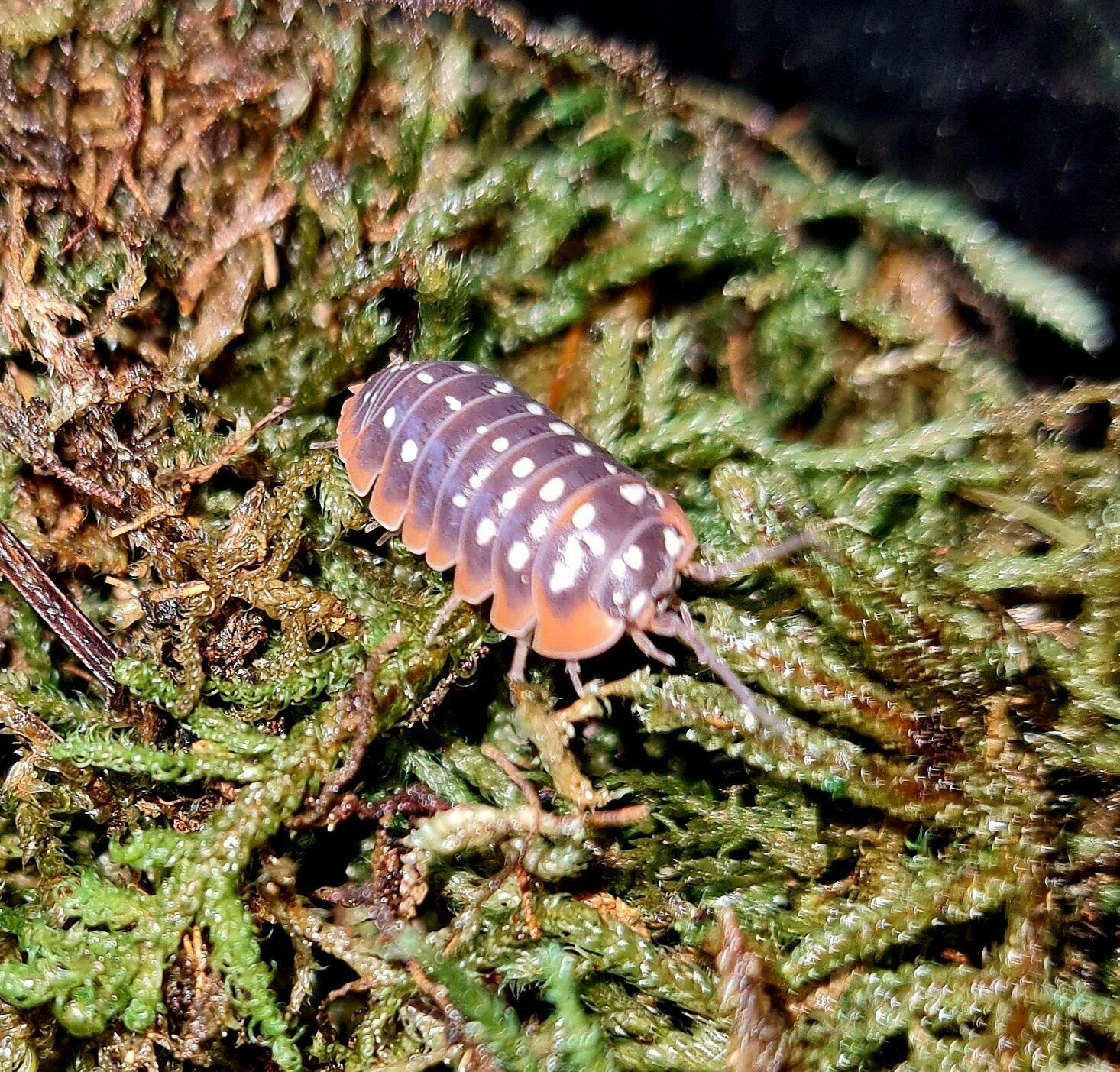
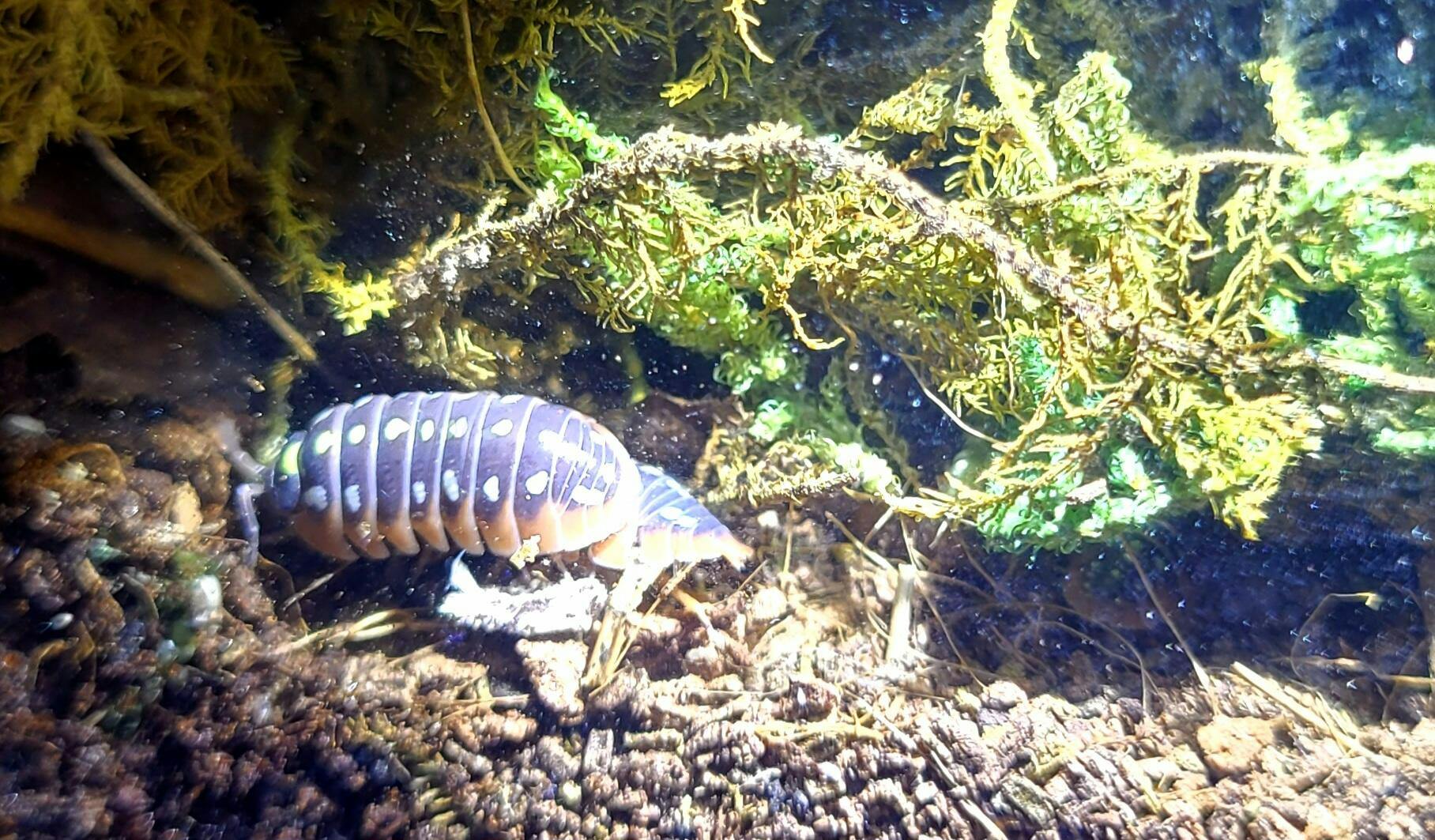
Clown Isopods (Armadillidium klugii 'Montenegro') are among the most visually striking species in the hobby. Their dramatic colouration - dark bodies edged with red "skirts" and scattered with yellow or cream spots - is genuinely eye-catching and unlike anything else in most collections.
The name "Clown" comes from their spotted, colourful appearance, though their behaviour is anything but clownish. These are actually rather shy, retiring isopods that prefer to stay hidden, particularly when first introduced to a new environment. The "Montenegro" designation refers to their geographic origin along the Adriatic coast.
What makes their appearance particularly fascinating is that it's thought to be a form of mimicry. The colour pattern closely resembles the Mediterranean black widow spider (Latrodectus tredecimguttatus), potentially deterring predators who mistake these harmless isopods for something far more dangerous.
Armadillidium klugii are well-suited to drier setups than many isopod species, making them excellent choices for semi-arid bioactive enclosures where tropical species would struggle.
A Glimpse
Origin: Montenegro, Adriatic coast (Balkan region of Europe)
Scientific Name: Armadillidium klugii 'Montenegro'
Difficulty Level: Easy to Medium
Size: Up to 18mm
Temperature: 21-27°C (23-26°C optimal for breeding)
Humidity: 30-50% (with moisture gradient)
Rarity: Low to Medium
An Overview
Armadillidium klugii originates from the coastlines of the Adriatic Sea, ranging from Croatia through Montenegro and into Albania and western Greece. The "Montenegro" variety is one of several regional forms available, each with slightly different colouration.
Montenegro Clowns typically display dark grey to black bodies with distinctive red edging (the "skirt") around their segments, decorated with yellow, cream, or white spots. The exact colouration varies between individuals, and some specimens show more vibrant markings than others. Their cousin, the "Dubrovnik" variety from Croatia, tends to have simpler white spots without the same red colouration.
These isopods have a reputation for being slow starters. New cultures often take time to settle in, and it's not unusual to lose a few individuals during the initial adjustment period. Don't be discouraged - this is normal for the species. Once established, they become reliable breeders, particularly during warmer months.
Behaviourally, Clown Isopods are notably shy compared to more confident species like Zebras or Magic Potions. They prefer to stay hidden and are most active at night. You may not see them as often as other species, but their striking appearance makes every sighting worthwhile.
Varieties
Several regional varieties of Armadillidium klugii are available in the hobby:
Montenegro - Dark bodies with red skirts and yellow/cream coloured spots. The classic "Clown" look.
Dubrovnik - From Croatia, typically showing brighter red coloration with white spots rather than coloured ones.
Montenegro Orange - A selectively bred morph with vibrant orange base colouration instead of dark grey/black. Highly sought after by collectors.
All varieties share similar care requirements.
Basic Care
Clown Isopods require slightly different care than many tropical species. They're adapted to drier, Mediterranean-type conditions and won't thrive in constantly humid enclosures.
The key to success with A. klugii is providing a proper moisture gradient. Unlike species that prefer uniformly humid conditions, Clowns need a sharp divide between wet and dry areas. Roughly one-third of the enclosure should be kept damp (using sphagnum moss), while the remaining two-thirds stays dry to bone-dry. They absolutely must have access to a moist area for rehydration, but the majority of their environment should be arid.
Good ventilation is essential - more so than for tropical species. Stagnant, humid air quickly leads to mould problems and can cause colony crashes. Add plenty of ventilation holes to your enclosure and ensure air can circulate freely.
Temperature should be maintained at 21-27°C, with the higher end of this range (23-26°C) encouraging faster breeding. They'll tolerate typical room temperatures without issue.
A shoebox-sized container (6-8 quart) works well for a starter colony. These isopods are slow to establish, so patience is required - expect 3-4 months before you start seeing offspring.
One important note: Clown Isopod cultures can crash relatively quickly if their specific needs (moisture gradient, ventilation, protein) aren't consistently met. They're not difficult to keep, but they do require attention to these details.
Feeding
Clown Isopods are detritivores with a preference for leaf litter and softwood over fresh vegetables. Their diet in the wild consists primarily of decomposing organic matter.
Primary foods (should always be available):
Hardwood leaf litter (oak is excellent, magnolia leaves are reportedly a particular favourite)
Soft, rotting wood
Sphagnum moss (they'll graze on this)
Bark pieces
Supplementary foods (offered 1-2 times weekly):
Fresh vegetables - carrots, courgette, cucumber, squash
Soft plants (they enjoy nibbling on moss and soft-leaved plants)
Protein sources - fish flakes, freeze-dried shrimp, dried mealworms
Commercial isopod foods
Calcium supplementation is particularly important for this species. Provide constant access to:
Cuttlefish bone
Crushed eggshells
Calcium powder
Maintaining calcium availability is crucial for breeding success - don't let supplements run out.
Clown Isopods have hard exoskeletons that require plenty of calcium and protein for healthy moulting and reproduction. The freeze-dried shrimp/fish provides both and is an excellent supplement.
Feed only what can be consumed within 2-3 days and remove uneaten fresh food promptly. In the drier conditions these isopods prefer, food spoilage is less rapid than in humid setups, but overfeeding can still attract pests like fungus gnats and mites.
Appearance and Behaviour
The Montenegro variety displays a dark grey to black base colour with distinctive red edging ("skirts") along the margins of each body segment. Scattered across the body are yellow, cream, or white spots in varying patterns - no two individuals look exactly alike.
Adults reach approximately 18mm in length. They have the characteristic rounded, pill-shaped body of Armadillidium species and can roll into a complete, gapless ball when threatened.
The striking colouration is believed to be Batesian mimicry of the Mediterranean black widow spider. By resembling a dangerous species, these harmless isopods may gain protection from predators who avoid them out of caution.
Behaviourally, Clown Isopods are notably shy and secretive. They're primarily nocturnal, doing most of their foraging at night. During the day, expect them to stay hidden under bark, in leaf litter, or burrowed into the substrate. They won't be as visible as more confident species, but this secretive nature is entirely normal.
They're social animals that live in clusters, using group behaviour to regulate their microenvironment and provide collective protection. Despite their shyness, they're peaceful and show no aggression toward tank mates.
Once established and comfortable, colonies become more active and visible, particularly at higher population densities. The initial adjustment period just requires patience.
Habitat
A plastic storage container (6-8 quart) or glass terrarium (5-10 gallons) works well for a starter colony. Ventilated enclosures are essential - if using a plastic tub, drill plenty of holes and cover them with fine mesh to prevent escapes.
Ventilation is critical for this species. More airflow than you'd provide for tropical isopods. Without adequate ventilation, enclosures become stagnant, encouraging mould growth and potentially causing colony crashes.
Temperature should be maintained at 21-27°C. For breeding, aim for the higher end (23-26°C). They tolerate typical household temperatures well.
Humidity should follow a strict gradient. Approximately one-third damp (30-40% in that area), two-thirds dry to bone-dry. This is different from most isopod setups and is essential for Clown Isopod health. They cannot tolerate uniformly humid conditions.
Hiding spots are essential for these shy isopods. Provide cork bark, wood pieces, and generous leaf litter on both the wet and dry sides. They'll spend most of their time hidden, so plenty of cover helps them feel secure.
Avoid placing the enclosure in direct sunlight, and don't use misting systems that would create uniformly high humidity.
Substrate Mix
The substrate setup for Clown Isopods differs from typical tropical isopod enclosures due to their need for a sharp moisture gradient.
For the dry section (approximately 2/3 of enclosure):
Coconut coir (allowed to dry)
Sand mixed in for drainage
Dry leaf litter on top
Cork bark and wood pieces for hides
For the moist section (approximately 1/3 of enclosure):
ABG mix or moisture-retentive substrate
Sphagnum moss layer
Damp leaf litter
Throughout:
Softwood pieces (rotting preferred)
Calcium supplements (cuttlebone pieces)
Cork bark for hiding
Generous leaf litter coverage
Substrate depth should be at least 5cm (2+ inches) to allow for burrowing and hiding. These isopods will dig into the substrate, particularly in the moist area.
The key is keeping the wet and dry sections distinctly separate. Water only the moist corner - pouring a small amount along the sides rather than misting the whole enclosure. The dry section should remain genuinely dry, not just "less wet."
Breeding
Clown Isopods breed readily once established, though they're slower to get started than some species. Patience is essential - most keepers report 3-4 months before offspring begin appearing.
For optimal breeding success, provide slightly elevated temperatures (23-26°C), maintain the proper moisture gradient, ensure constant calcium availability, and offer regular protein supplements.
Breeding activity tends to peak during warmer months, with colonies becoming more prolific in summer. The American varieties reportedly breed somewhat faster than European ones, but all Klugii take time to establish.
Females carry eggs in a brood pouch and give birth to live young. The tiny mancae can be raised alongside adults without issue. As the colony grows, you'll notice increased activity and visibility - established colonies are noticeably more confident than new ones.
Once breeding begins in earnest, colonies can become quite prolific. However, cultures can crash if care requirements slip, so maintain consistent attention to ventilation, moisture gradient, and calcium supplementation even after the colony is established.
Adding fresh bloodlines and substrate every 6-12 months can help prevent colony crashes and maintain genetic health.