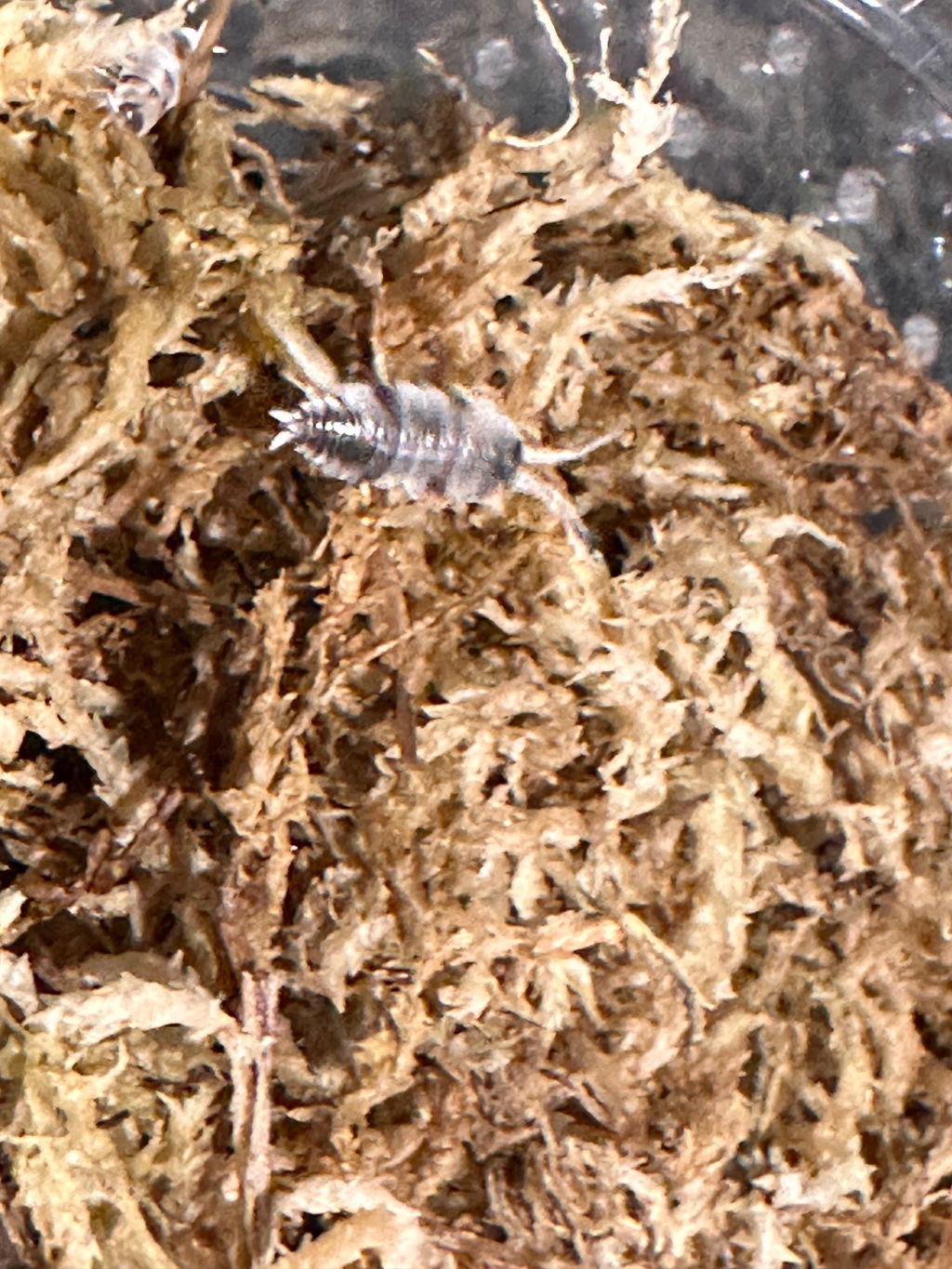
Oreo Crumble Isopods (Porcellionides pruinosus)
Care Info:
 ORIGIN
 TEMP
TEMP
 HUMIDITY
 LENGTH
 DIFFICULTY
 RARITY
- Free shipping over £65
- Low stock - 5 items left
The question I get asked about these more than any other is whether they are Dairy Cows. They are not, and the confusion is understandable, because both are black-and-white woodlice sold to the same people for the same jobs. But they are different animals from different genera, and buying the wrong one for your setup is a mildly annoying mistake worth avoiding.
Side by side the differences are obvious. The Dairy Cow is Porcellio laevis: bigger, chunkier, with bold blotches on a heavier body and an appetite for protein that makes it a real risk to soft-bodied tankmates if it goes hungry. The Oreo Crumble is Porcellionides pruinosus: smaller, flatter, considerably faster, and finished in a soft powdery bloom that the Dairy Cow does not have. Neither rolls into a ball, which catches out anyone expecting pill bug behaviour.
What they actually look like
A pale cream-to-white base scattered with irregular black piebald patterning, no two animals marked the same way. Over the top sits the pruinescence, a fine surface coating that gives the whole colony a matte, dusted finish and shows up dramatically under a camera flash. The pattern reads clearly against dark substrate and leaf litter, which is a large part of why the morph became popular.
They stay around 10 to 12 mm, and the British Myriapod and Isopod Group gives 12 mm as the maximum for British animals. The odd larger one is on record, a 2021 Egyptian study measuring one male at 13.9mm out of 216 animals, but 15mm was too generous for a typical adult. Unlike a lot of woodlice they are out and visible during the day, so the pattern you paid for is on show rather than hidden under bark.
A designer morph, and worth being straight about it
Porcellionides pruinosus is a widespread species found across the Mediterranean, much of Europe and into southwest Asia, and it has been selectively bred into a whole family of colour forms. Oreo Crumble is one of those: a captive-bred designer line rather than a wild population, and the pied pattern does not occur naturally.
I mention it because some listings imply a wild origin or an exotic locality, and there is not one. What you are buying is the product of somebody's breeding project, which is a perfectly good thing to be, and it comes with the practical advantage that it inherits the parent species' famously bulletproof constitution. Other names you will see used are Powder Oreo Crumble and simply Oreo Crumbles.
Care, in short
Easy, and identical to the rest of the powder morphs. If you already keep Powder Oranges you can run these exactly the same way and skip the rest of this section.
Moderate humidity with real ventilation is the formula. Lay 5 cm or so of a nutritious base such as our invertebrate substrate, keep one end damper than the other, and top it with hardwood leaf litter. Magnolia leaves stand up well to a colony that eats at this rate. Pile in cork bark, because these spend most of their downtime wedged underneath something and extra surfaces effectively enlarge the tub.
The single failure mode is a sealed, stagnant, uniformly wet enclosure. That combination invites mites and culture crashes, and it is the one thing this otherwise forgiving morph will not tolerate. Ordinary heated UK room temperature is fine, though a colony breeds better with some additional heat from autumn to spring.
Feeding a fast colony
Leaf litter and rotting hardwood underpin the diet, and a colony in full swing gets through both quickly, so check more often than you would with a slower species. Add protein weekly as dried shrimp or fish flake, and keep cuttlebone permanently available, because animals that moult this often are spending calcium constantly. Keepers report that pattern definition holds up better on a calcium-supported diet, which matches what I see.
What they are good for
Three things at once, which is unusual.
As a cleanup crew they process leaf litter, biofilm and waste at a rate that suits a busy bioactive enclosure. Run them alongside a springtail culture and the two divide the work neatly, springtails on mould and the microscopic layer, isopods on everything with more substance to it.
As a starter species they are about as forgiving as the hobby gets, and they establish fast enough that a beginner finds out within weeks rather than months whether their husbandry is working.
As a display animal they are better than their reputation. Most people buy pruinosus morphs as workhorses and then find themselves watching the tub, because a surface-active monochrome colony against dark leaf litter is a good-looking thing.
They also work as feeders, though at this morph's price point most people keep the plain lines for that and enjoy these for what they look like.
Who they suit
Anyone. A sensible first isopod, a useful addition to a vivarium, and a fun collector's piece for someone assembling a range of morphs. The rest of the family is in the Porcellionides collection, and the wider catalogue in isopods for sale.
Our full Porcellionides pruinosus care guide covers the species in depth, from setup and temperature to feeding and breeding, and the care it sets out is identical across the colour forms.
Arriving with you
Captive-bred here in the UK and posted Monday to Thursday only, so nothing sits in the network over a weekend. They travel by Royal Mail next day by 1pm in a double-walled box, in ventilated deli tubs on damp sphagnum moss, with a 20% overcount and our live arrival guarantee. Tip them into the enclosure rather than unpacking on a worktop; these move quickly and they will use the opportunity.