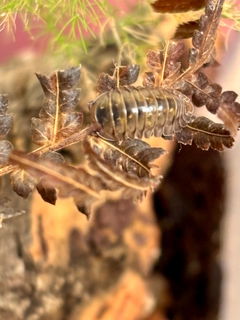
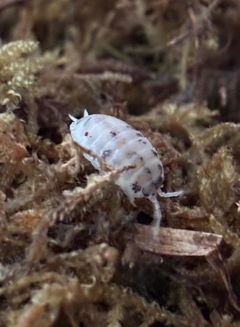
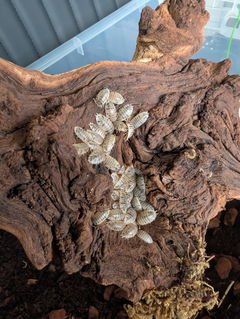
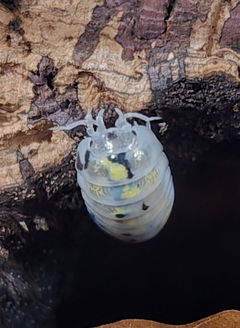
Armadillidium nasatum "White" is a selectively bred colour morph of the common nosy isopod, named for the distinctive rectangular protrusion on its head that resembles a small nose. This white morph ranges from off-white to pale cream, sometimes with a slight yellow tinge, and in some individuals appears almost translucent. The "White Out" variant—which may be what's sold here—takes this further with completely white bodies and white eyes (a true albino). Either way, you're getting a striking pale isopod that stands out against dark substrate while retaining all the hardiness and easy care that makes A. nasatum such a reliable species.
A Glimpse
-
Origin: Western Europe (captive-bred colour morph)
-
Scientific Name: Armadillidium nasatum
-
Common Names: Nosy Isopod, Nosy Pill Woodlouse, White Out (albino variant)
-
Maintenance required: Low
-
Average Size: 12-20mm (approximately 0.8 inches)
-
Rarity: Uncommon morph of a common species
-
Temperature: 15-28°C (59-82°F)
-
Ventilation: Medium to High
-
Humidity: 45-80% (with moisture gradient)
-
Favorite food: Leaf litter, decaying wood, vegetables
-
Supplements: Calcium (cuttlebone), protein (fish flakes)
Armadillidium nasatum "White": Introduction
Armadillidium nasatum often gets confused with its close relative Armadillidium vulgare, the common pill bug. The key difference is that distinctive "nose"—a small scutellum that protrudes from the front of the head, giving the species both its scientific name (nasatum means "of the nose") and common name. It's subtle, but once you know what to look for, you can spot it.
The white morph doesn't occur naturally in the wild. It's the result of selective breeding over generations, isolating individuals that showed reduced pigmentation until the trait bred true. The "White Out" variant is considered albino—completely white with white eyes—while the standard "White" morph may retain some off-white or cream colouration with normal dark eyes. Both are visually striking against the browns and greens of a typical bioactive setup.
What makes A. nasatum particularly useful is its tolerance for drier conditions compared to many isopod species. While they still need access to moisture, they handle the lower humidity end of the spectrum well, making them suitable for bioactive setups housing animals that prefer it on the dry side. They're also native to Europe and have established populations in the UK, so their temperature tolerance matches our climate well.
Armadillidium nasatum "White": Physical Traits and Characteristics
- Adults reach 12-20mm in length (around 0.8 inches)
- Slightly elongated build compared to A. vulgare
- Distinctive rectangular protrusion ("nose") on the head
- White to off-white body colouration, sometimes with yellow tinge
- "White Out" variant has completely white body and white eyes (albino)
- Some individuals appear slightly translucent
- Can roll into a ball, though not as perfectly spherical as A. vulgare
- Smooth, calcified exoskeleton
The pale colouration makes them highly visible in enclosures, which is either a benefit (easy to observe) or consideration (more visible to predators in bioactive setups). Individual variation exists within the morph—some appear more cream-coloured, others more pure white.
Behaviour
Armadillidium nasatum is one of the more outgoing Armadillidium species.
Activity patterns: More active and visible than many isopod species. You'll often see them exploring the enclosure at various times of day rather than hiding constantly.
Movement: They migrate between moist and dry areas of their enclosure throughout the day, seeking the conditions that suit them at any given time. This is why a moisture gradient matters.
Defence: Like other Armadillidium, they roll into a ball when threatened—though the ball isn't as perfectly spherical as in A. vulgare.
Social behaviour: Gregarious. They prefer company and higher numbers lead to higher visibility. A well-populated colony will have isopods out and about rather than all hiding.
Defensive secretions: They can secrete defensive compounds when stressed. Always wash hands after handling.
Diet
A. nasatum are straightforward feeders with no special requirements.
Primary foods:
- Leaf litter (oak, beech—hardwoods preferred)
- Decaying wood
- Organic matter in substrate
Supplementary foods:
- Vegetables: carrots, courgette, squash, cucumber
- Occasional fruit (sparingly—high sugar)
- Commercial isopod foods
Protein: Offer protein once or twice weekly:
- Fish flakes
- Freeze-dried shrimp or minnows
- Fish pellets
- Dried insects
Calcium: Provide cuttlebone, crushed limestone, or oyster shell. Armadillidium species have calcified exoskeletons and benefit from readily available calcium.
Feeding approach: The bulk of their diet should be leaf litter and decaying wood—keep these available at all times. Supplement with vegetables and protein. Remove uneaten fresh foods before they spoil. Feed protein on the drier side of the enclosure to prevent it attracting pests.
Armadillidium nasatum "White": Breeding
A. nasatum breeds readily with no special requirements.
Breeding basics:
- Fast breeders once established
- Medium-sized broods
- Sub-adults begin breeding before reaching full size
- Multiple broods throughout lifetime
Important note on mancae (babies): Newborns require higher humidity than adults and are more sensitive to drying out. Maintain a good moisture gradient in your enclosure—the moist area gives young isopods somewhere to retreat during their vulnerable early stages.
Colour breeding: This is a line-bred morph, so breeding white to white should produce white offspring. Introducing wild-type individuals would likely result in loss of the white colouration over generations.
Armadillidium nasatum "White": Habitat Setup
Simple setup requirements make this species ideal for beginners.
Enclosure: A shoebox-sized container works for a starter culture. Plastic storage bins with gasket seals work well. For larger cultures, 6-quart containers or small glass terrariums are suitable. Moderate ventilation—not too much, not too little.
Substrate: Use a moisture-retaining substrate:
- Organic topsoil as base (pesticide-free)
- Sphagnum peat moss mixed in
- Leaf litter on top
- Decaying wood pieces
Depth of 5-8cm allows burrowing. No special requirements—standard isopod substrate works well.
Humidity: 45-80%—they tolerate a wide range. The key is providing a moisture gradient:
- Keep one-third to half of the enclosure moist (damp sphagnum moss works well)
- Leave the remainder drier
- Allow isopods to choose their preferred humidity
- Mist the moist side regularly rather than the entire enclosure
Ventilation: Medium to high compared to tropical species. They handle drier conditions better than most isopods, so good airflow is acceptable. If the substrate dries out too quickly, reduce ventilation.
Temperature: 15-28°C (59-82°F). Room temperature in UK homes suits them perfectly—low 20s Celsius is ideal. No supplemental heating needed in most situations.
Décor:
- Cork bark pieces (placed over moist areas to retain humidity)
- Leaf litter
- Decaying wood
- Seed pods, bark pieces for hiding
Bioactive Use
A. nasatum makes an excellent bioactive cleanup crew, particularly for drier setups.
Ideal applications:
- Temperate vivariums
- Semi-arid bioactive setups
- Enclosures for animals requiring lower humidity
- Any setup where tropical isopods might struggle with lower moisture
Strengths:
- Tolerates drier conditions than most isopods
- Active and visible
- Hardy and forgiving
- Breeds readily to maintain population
- Handles UK room temperatures well
Considerations:
- Medium size means larger predators may eat them (fine if intended as feeders)
- White colouration makes them more visible—could attract predator attention
- Still needs access to moisture—not suitable for truly arid setups
Good pairings: Works well with species that prefer moderate to low humidity environments. The white colouration provides visual contrast and makes monitoring population easier.
Tank Mates
Compatible with most peaceful invertebrates and appropriate reptiles/amphibians.
Compatible:
As cleanup crew for:
- Leopard geckos (may eat them)
- Bearded dragons (may eat them)
- Corn snakes
- Ball pythons
- Other species preferring drier conditions
Note: Their medium size and visible colouration means larger inhabitants will likely prey on them. This is fine if you want isopods as both cleanup crew and supplementary food—their breeding rate should maintain the population. If you want a permanent visible colony, house with animals that won't predate them.
Suitability
Armadillidium nasatum "White" suits a wide range of keepers and applications.
Good choice for:
- Beginners wanting an easy first isopod
- Keepers wanting visible, active isopods
- Bioactive setups for drier-environment animals
- Those wanting a white/pale isopod without paying premium prices
- UK keepers (tolerates our climate well)
Less suited for:
- Very humid tropical setups (other species may do better)
- Truly arid environments (still needs moisture access)
- Keepers wanting isopods that stay hidden (these are active and visible)
Care level: Very easy. This species forgives mistakes that would kill more sensitive isopods. Temperature and humidity can vary from ideal and they'll tolerate it. One of the most forgiving isopod species available.
Value: Reasonably priced for a colour morph. You get the visual appeal of a white isopod with the bulletproof hardiness of a species that's been thriving across Europe for millennia. Good value as both display animals and functional cleanup crew.
Other morphs available: A. nasatum comes in several colour morphs:
- Wild type (grey/brown)
- Peach/Georgia Peach (soft orange)
- Dalmatian/Pearl (white with black flecks)
- White Out (albino—completely white with white eyes)
What to expect: Expect active, visible isopods that get on with things without demanding constant attention. Expect easy breeding once established. Expect them to handle conditions that would stress more demanding species. The white colouration provides genuine visual interest, and their tolerance for drier conditions makes them more versatile than many alternatives. They're the sort of isopod you can set up, maintain properly, and enjoy without constant worry—exactly what a beginner or busy keeper needs.