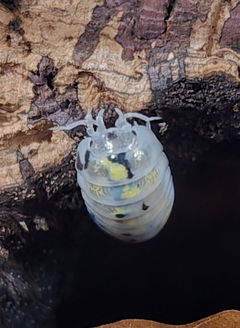
Lava Isopods (Ardentiella sp.)
Care Info:
- Free shipping over £65
- Low stock - 1 item left
- Backordered, shipping soon
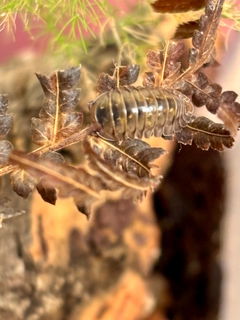
Lava Isopods are one of the most visually striking morphs in the Ardentiella genus — a Vietnamese hobby morph with deep reds, lava-oranges, and warm yellows contrasting against dark undersides, creating an appearance that genuinely evokes molten rock. Combined with notably larger adult size than other Ardentiella morphs and the genus's reputation for active surface behaviour, Lava is one of the more dramatic choices for keepers wanting a display-grade Ardentiella. The trade-off is the standard genus difficulty profile (ventilation paradox, frass sensitivity, cooler temperatures) plus premium pricing — this isn't an entry-level isopod.
This is part of our wider Ardentiella collection (formerly listed as Merulanella, updated to reflect the March 2025 taxonomic reclassification). If you've kept other Ardentiella morphs — Scarlet, Batman, Pink Lambo, Ember Bee, Tricolor, or others — the care approach for Lava is essentially identical. The genus shares the same fundamental requirements, the same quirks, and the same level of difficulty across morphs. What differs is the visual character and, in Lava's case specifically, the notably larger body size.
One honest framing point up front. Ardentiella isopods are rated Hard difficulty for genuine reasons — primarily the high-humidity-plus-high-ventilation paradox and the genus's sensitivity to substrate frass buildup. At £80 per 5 specimens, Lava sits in the premium Ardentiella price tier and isn't an impulse-buy isopod. If you've never kept Ardentiella before, we'd genuinely rather you started with the easier morphs (or even easier genera entirely) and worked up. Losing a colony to husbandry mistakes is properly expensive with this genus. To set things up properly from the start, browse our accessories collection for substrate components, leaf litter, and other items this species depends on.
Quick Care Summary
- Scientific Name: Ardentiella sp. "Lava" (formerly Merulanella sp. "Lava"). The genus Ardentiella was erected by Kästle & Regalado Fernández in March 2025; the type species is A. bicolorata (originally described 1885 by Budde-Lund as Armadillo bicoloratus)
- Common Names: Lava Isopods, Ardentiella Lava, Merulanella Lava (older name)
- Family: Armadillidae (order Isopoda, suborder Oniscidea)
- Genus context: Ardentiella currently contains two formally described species (A. bicolorata and A. caerulea) plus many undescribed hobby morphs. Lava is one of these undescribed morphs — a hobby designation rather than a formal taxonomic species
- Origin: Vietnam — properly tropical and subtropical Southeast Asian habitats; the broader genus also documented from Myanmar
- Adult Size: 18–20 mm — among the larger Ardentiella morphs. Multiple hobby sources document Lava as growing notably larger than other Ardentiella, reportedly up to approximately 1.5 times the size of an Ember Bee
- Lifespan: 1–2 years under optimal conditions; longer in well-managed colonies with proper substrate maintenance
- Difficulty: Hard — captive-bred specimens are noticeably more forgiving than wild-caught, but this isn't a beginner species regardless of source
- Temperature: 19–26 °C with the cooler end preferred — properly different from most tropical hobby species. They can suffer in prolonged heat above 26 °C
- Humidity: 60–75% with a moisture gradient — moderate rather than tropical-high
- Ventilation: High — properly critical. Cross-ventilation through mesh-covered openings on opposing sides of the enclosure
- Climbing: Yes — adults and especially juveniles/mancae can climb vertically on smooth plastic, much like cockroaches. Escape-proof setup is non-negotiable
- Activity: Active both day and night — properly surface-visible compared to most isopods
- Body shape: Relatively flat compared with Cubaris — built for climbing and surface activity rather than deep burrowing
- Appearance: Deep reds, lava-oranges, and warm yellows contrasting against dark undersides — properly distinct from other Ardentiella morphs. Every individual shows slightly different patterning, so a colony has a living, varied look rather than each animal being an identical copy
- Reproduction: Standard isopod reproduction — females carry eggs in a marsupium until release as mancae
- Breeding rate: Fair to prolific in established CB colonies; slow growth rate
- Rarity: Very rare in UK hobby
What Makes Lava Ardentiella Special
The molten-rock aesthetic. The Lava morph's signature feature is its colouration — deep reds, lava-oranges, and warm yellows on the dorsal surface contrasting against dark undersides. The combination genuinely does evoke molten rock or flowing lava under good display lighting, which is properly distinct from the brighter saturated palettes of morphs like Scarlet or the darker colouration of Batman. For display-focused keepers wanting properly dramatic visuals, Lava delivers some of the most striking colouration available in the genus.
The individual variation. Unlike some hobby morphs where every animal looks essentially identical, Lava colonies show genuine individual-level patterning variation. The base colour palette is consistent (reds, oranges, yellows, dark undersides), but the exact distribution of colours and the patterning details vary between specimens. A colony has a living, varied look that develops character over time rather than being a uniform mass of identical animals. For keepers who appreciate the biological reality of within-population variation, this is genuinely interesting; for keepers wanting maximum visual uniformity, it may feel less polished than morphs with more consistent patterning.
The notably larger size. Multiple hobby sources document Lava as growing meaningfully larger than other Ardentiella morphs — reportedly up to about 1.5 times the size of an Ember Bee, for example. The 18–20 mm care icon size is the upper range typical of the morph; well-fed mature Lava can reach noticeably larger than smaller-bodied morphs in the genus. For keepers comparing morph options, this is a real practical difference rather than just aesthetic preference.
The Ardentiella genus character. Like other morphs in the genus, Lava shows the active surface behaviour, day-and-night activity patterns, and observable group dynamics that distinguish Ardentiella from typical Cubaris or Porcellio species. You'll see these animals out and about rather than constantly hidden under cork bark. For display-focused keepers tired of "invisible isopod" species, this is a genuinely different keeping experience.
The 2025 taxonomic context. The entire hobby trade in "Merulanella" was reclassified in March 2025 when Kästle & Regalado Fernández published the genus revision. Genuine Merulanella now refers only to three species in New Caledonia — none in the hobby. All Vietnamese, Thai, and Southeast Asian "Merulanella" in trade — including Lava — were moved to the new genus Ardentiella. This is properly recent taxonomy that you may not see reflected on older retailer sites or hobby blogs.
The careful-husbandry reward. The genus's reputation for difficulty isn't because the husbandry is mysterious — it's because the requirements are properly specific (high ventilation despite needing humidity; cool temperatures despite being tropical; sensitivity to substrate frass build-up). Keepers who match the requirements get colonies that thrive and breed reliably. Keepers who treat them like generic tropical isopods get colony crashes. The species rewards precision rather than punishing every minor variation.
The captive-bred advantage. CB Ardentiella populations are significantly more forgiving than wild-caught animals. The captive lineages have generation depth in artificial conditions and tolerate hobby setups noticeably better. We sell CB stock specifically because the survival outcomes are properly different.
About the Name and the Ardentiella Genus Revision
The naming situation has changed substantially recently and is worth understanding properly.
- Pre-2025 trade name: All Vietnamese and Southeast Asian "Merulanella" in the hobby, including Lava, were sold as Merulanella sp. with various morph designators
-
The March 2025 revision: Kästle & Regalado Fernández published a comprehensive reassessment that split the old Merulanella genus into multiple groups. The key conclusions:
- Genuine Merulanella now refers only to three species in New Caledonia — none of which are in the hobby
- All Vietnamese, Thai, and Southeast Asian "Merulanella" in trade — including Lava, Scarlet, Batman, Red Diablo, Tricolor, Ember Bee, Phoenix, Pink Lambo, and the rest — were moved to a new genus, Ardentiella
- Currently two formally described species: Ardentiella bicolorata (the type species, originally Budde-Lund 1885) and Ardentiella caerulea (the "yellow panda" in the pet trade; originally Collinge 1916)
- "Lava" as a morph designation: The Lava name refers to a hobby-recognised colour lineage — not a formally described species. It's an Ardentiella sp. "Lava" specifically, where the species-level identity is undetermined. The name references the molten-rock aesthetic of the colouration rather than referring to any biological feature
- Why the name change matters: If you're researching care online, older sources will discuss this animal as Merulanella sp. "Lava" — the husbandry information remains valid, but the genus name is outdated. Recent reliable sources will use Ardentiella
- Family Armadillidae: The family designation is unchanged by the genus revision. Ardentiella sits alongside other Armadillidae genera in order Isopoda, suborder Oniscidea
-
Distinguishing from other Ardentiella morphs:
- vs Scarlet: Scarlet is predominantly red; Lava combines red, orange, and yellow tones with darker areas
- vs Batman: Batman is predominantly dark; Lava is dramatically warm-coloured
- vs Tricolor: Tricolor shows distinct red/yellow/black banding patterns; Lava patterning is more variable and less obviously banded
- vs Ember Bee: Ember Bee is smaller-bodied and shows different colour distribution; Lava is properly larger and more uniformly warm-coloured across the dorsum
Setting Up the Enclosure
The enclosure setup is properly the most important factor in Ardentiella success. Two non-negotiables: escape-proof construction and high ventilation.
Escape-proofing: Ardentiella — especially mancae and juveniles — can climb vertically on smooth plastic and glass, much like cockroaches. The flat body and longer legs that make them visually distinctive also make them properly competent climbers. Tight-fitting lids with no gaps are essential. Check for any openings, including around lid clips and at ventilation hole edges.
Ventilation: This is the requirement that catches out the most keepers. Ardentiella need high humidity AND high ventilation simultaneously — a combination that feels contradictory but is genuinely the right approach. Cross-ventilation through fine mesh on opposing sides of the enclosure allows airflow without losing humidity entirely. The air should be moving through the enclosure, not sitting in it. Stagnant humid conditions kill Ardentiella faster than almost any other husbandry mistake.
A modest enclosure size suits these animals — a 5–10 litre plastic tub or small terrarium works for a starter group of 5–10 animals. Larger isn't necessarily better; smaller enclosures are easier to manage for ventilation and humidity precision.
Provide proper structure. The semi-arboreal behaviour means vertical elements aren't optional:
- Cork bark slabs in horizontal and vertical orientations
- Branches and twigs for surface activity
- Lichen-covered branches if available — properly appreciated
- Multiple hide options at different substrate depths
Browse our accessories range for cork bark, branches, and natural cover options.
Important husbandry note: Frass build-up is the second major failure mode for Ardentiella. The genus is properly sensitive to substrate degradation — frass accumulation raises substrate acidity and colonies have been reported to crash within weeks once levels become problematic. Replace substrate every 6 months minimum; monitor between replacements for signs of compaction or visible frass concentration.
Substrate
Substrate quality and freshness matter genuinely more for Ardentiella than for most isopod genera. The right mix:
- Quality organic topsoil or forest humus as the foundation (pesticide-free)
- Decaying hardwood leaf litter mixed throughout and layered generously on top — browse our accessories collection for ready-prepared leaf litter
- Crumbled white rotten wood mixed in and on top — both food and habitat
- Sphagnum moss and lichen-covered pieces — properly appreciated
- Springtails inoculated to consume excess moisture and prevent mould
- Calcium sources — cuttlebone, crushed limestone, oyster shell. Always available. Our calcium options cover the full range
Keep substrate moist but never waterlogged — damp to the touch but not so wet you can squeeze water from it. Maintain a moisture gradient with one side slightly damper than the other.
Replace substrate every 6 months minimum. This is the standard Ardentiella maintenance schedule and is genuinely non-negotiable. Frass build-up reaches problematic levels around this timeframe. Some keepers replace more frequently (every 4 months); few successful keepers go longer than 6 months.
Humidity and Temperature
Maintain humidity at 60–75% with a moisture gradient — properly modest by tropical isopod standards. Don't try to achieve 80%+ humidity; Ardentiella actively prefer less moisture than most hobby species. Mist lightly when the surface dries; don't soak the substrate.
Temperature should be 19–26 °C with the cooler end (19–22 °C) preferred. This is properly different from most tropical hobby species. UK average room temperature is genuinely within or below this range for much of the year, which makes Ardentiella unusually well-suited to UK conditions — they don't typically need supplementary heating, and may actually benefit from cooler-than-room-temperature setups during summer heat.
Heat tolerance is limited. Prolonged temperatures above 26 °C cause stress and can lead to colony decline. Dedicated keepers use wine coolers, dedicated cool rooms, or temperature-controlled cabinets to maintain low temperatures through UK summer heatwaves. If your home regularly exceeds 26 °C in summer without cooling, consider this carefully before buying.
Through UK winters, no supplementary heating is typically needed — the 19 °C lower end of the species's preferred range matches UK living-room ambient. If your home runs cooler than 19 °C in winter, low-wattage side-mounted heat on a thermostat brings the enclosure to the right range.
Diet
Ardentiella accept a varied diet but have some properly specific preferences:
- Hardwood leaf litter — properly the dietary foundation; should always be available. Browse our accessories collection for ready-prepared leaf litter
- White rotten wood — both food and substrate component; constantly consumed
- Lichen — genuinely appreciated and worth offering when available
- Moss — sphagnum and other moss varieties are nibbled
- Fresh vegetables — courgette, sweet potato, baby corn well-received; carrot also works
- Fresh fruit — occasionally; banana, mango. Replace promptly to prevent mould
- Protein supplements — gammarus shrimp, fish flakes, similar. Once or twice weekly. Browse the protein options in our accessories collection
- Calcium sources — cuttlebone, crushed limestone, oyster shell. Always available. Our calcium options cover the full range
Notable preference: Bee pollen — popular with many other isopod species — is reportedly not accepted by Ardentiella. Don't waste it on this genus; offer alternative protein sources instead.
Remove uneaten fresh food promptly. Mould in an Ardentiella enclosure is properly problematic given the species's substrate sensitivity — don't let food residue accumulate.
Breeding
Ardentiella breed without special triggers given proper husbandry. Captive-bred colonies establish reliably; wild-caught animals are genuinely much more challenging.
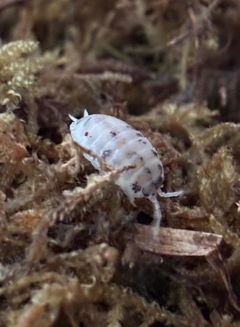
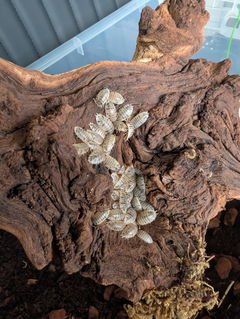
The breeding sequence follows standard isopod patterns — females develop a marsupium (brood pouch) on the underside of the body, where eggs develop and mancae are released. Mancae emerge as miniature versions of adults and grow through successive moults. The Lava colour pattern develops with maturation — newly-released mancae are typically less dramatically coloured than adults, with the warm lava palette becoming more apparent through successive moults.
For breeding success:
- Properly stable conditions — temperature, humidity, ventilation, substrate quality
- Mixed-age starter group — provides best chance of having both sexes represented and overlapping generations
- Continuous leaf litter and rotten wood — both for adult feeding and manca development
- Calcium consistently available
- Substrate replacement every 6 months — frass accumulation affects breeding rates before it kills adults
- Patience — growth rates are properly slow even when conditions are right; don't expect rapid colony expansion
Established CB colonies breed at fair to prolific rates. Wild-caught animals can take 6–12 months to establish productive breeding, and many colonies fail to do so at all. This is why we specifically sell captive-bred stock.
Who Should Buy Lava Ardentiella?
Ideal for:
- Experienced isopod keepers with established success across multiple genera
- Display enthusiasts drawn to dramatic warm colouration and the molten-rock aesthetic
- Collectors building a focused Ardentiella display alongside other morphs in the genus
- Keepers comfortable managing ventilation and humidity simultaneously
- Anyone with cooler-than-average UK home temperatures — the species's cool preferences actually suit British conditions
- Patient keepers prepared for slow growth and 6-month substrate replacement schedules
- Keepers specifically wanting the larger-bodied Ardentiella morph
- Keepers with budget for premium-priced isopods
Not ideal for:
- Complete beginners to isopod keeping — start with easier species and work up
- Setups that can't maintain high ventilation
- Homes that regularly exceed 26 °C in summer without cooling
- Keepers unwilling to commit to 6-month substrate replacement
- Anyone wanting impulse-buy isopods — the £80 price point demands proper preparation
- Setups without vertical structure — the semi-arboreal behaviour needs accommodation
- Keepers wanting maximum visual uniformity within a colony — the individual variation is real and won't suit every aesthetic preference
Realistic Expectations
The ventilation requirement genuinely is the most common failure point. New keepers often instinctively restrict ventilation to maintain humidity, which works for most tropical isopods but kills Ardentiella. The species needs both high humidity AND high ventilation — achieved through fine-mesh cross-ventilation rather than sealed setups. If you don't think you can manage this combination, this isn't the right genus regardless of how visually appealing the morphs are.
Frass sensitivity is real. Multiple keeper accounts document colony crashes within weeks of substrate becoming compromised. The 6-month replacement schedule isn't optional optimisation — it's genuine maintenance. Some keepers replace more frequently as a precaution. Skipping or extending the replacement timeline is one of the more common ways established colonies fail.
Individual variation is a feature, not a defect. Every Lava specimen looks slightly different from its colony-mates. If you're expecting morph uniformity — each animal looking essentially identical — this isn't that kind of morph. The variation is the point. Some keepers love this; others find it makes colonies feel less polished. Manage expectations accordingly.
The larger size advantage is real but not dramatic. Lava is reported to grow notably larger than other Ardentiella, but we're talking about a 20 mm-class isopod becoming slightly larger — not transforming into a giant species. If you want truly large isopods, look at Porcellio species instead. Lava's "larger" is "larger than other Ardentiella," not "large in absolute terms."
The genus rename is recent and ongoing. Many hobby sources still use "Merulanella" terminology. Both names refer to the same animals; the husbandry advice across either name is broadly applicable. But if you're researching online, prioritise sources from 2025 onwards that use the current Ardentiella naming.
The Lava morph name doesn't tell you about the biology. "Lava" is a hobby designation referring to colouration rather than any biological feature distinguishing this lineage from other Ardentiella morphs. Care, behaviour, breeding rates, and lifespan are largely the same across morphs — what differs is the colour and the slightly larger body size in Lava's case. If you're choosing between Ardentiella morphs primarily on aesthetic preference, that's a reasonable approach.
Climbing capability is real and surprising. New keepers often underestimate how effectively even mancae climb smooth plastic. The escape-proofing requirements aren't precautionary — they're genuinely necessary. Use clip-locked lids; check for any gaps regularly.
Growth is slow. Don't compare colony expansion rates to faster-breeding species like Dairy Cow isopods or Powder Blues. Ardentiella development is properly slower across all life stages. A starter group of 5–10 animals may take 12+ months to show visible recruitment. Patience is part of the genus's husbandry.
The CB advantage is real. We sell captive-bred Ardentiella because the survival outcomes for new keepers are substantially better than for wild-caught animals. Don't compare your experience to historical accounts of wild-caught colony establishment from the early days of the genus in the hobby — modern CB lineages are properly more forgiving.
Heat tolerance is properly limited. Through UK summers, monitor temperatures carefully. Prolonged exposure above 26 °C causes stress, and brief excursions into 28+ °C territory can kill animals. Keep enclosures away from direct sunlight and out of warm rooms during heatwaves. If your home runs hot in summer, this isn't the right genus.
UK escape isn't an environmental risk. Despite the escape-proofing emphasis, UK outdoor conditions are too cool and dry for Ardentiella to establish wild populations. Recapture escapees promptly but don't worry about establishing feral colonies.
Use collapsible tabs for more detailed information that will help customers make a purchasing decision.
Ex: Shipping and return policies, size guides, and other common questions.