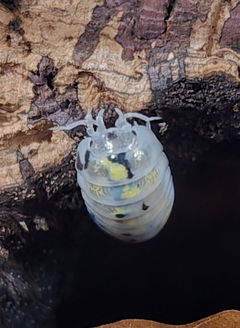
Rodatzi Giant African Land Snails (Lissachatina Fulica)
Care Info:
- Free shipping over £65
- In stock, ready to ship
- Backordered, shipping soon
The Rodatzi is properly one of the most visually striking colour morphs of the Giant African Land Snail — a golden yellow-banded shell paired with dark body colouration that immediately stands out against the typical brown-and-tan colouration of wild-type animals. At up to 18 cm shell length and with a properly straightforward care profile, Rodatzi GALS are genuinely one of the most accessible exotic invertebrates available to UK keepers. If you've kept any Lissachatina fulica morph before, you already know what to do. If this is your first snail, they're properly one of the easiest exotic invertebrates to start with.
This is part of our wider Other Invertebrates collection and works properly well alongside our isopod and millipede products as part of a broader exotic invertebrate keeping interest. For keepers who appreciate the visual appeal of distinctive morphs over wild-type forms, the Rodatzi sits alongside other recognised GALS colour lines (Jade, Jadatzi, Albino) as one of the more visually interesting options in the species.
One honest framing point worth understanding up front. Giant African Land Snails come with genuine responsibilities — they're prolific breeders (one snail can lay 100–400 eggs per clutch, multiple times per year), and the species is classified as invasive. Under the Wildlife and Countryside Act 1981, it is illegal to release GALS (or their eggs) into the wild in the UK. Egg management is properly non-negotiable for keepers with multiple snails. We're upfront about this because the responsibility is real — these are genuinely easy to keep, but also genuinely capable of becoming overwhelming if you don't manage breeding. To set things up properly from the start, browse our accessories collection for substrate components, calcium sources, and other items this species depends on.
Quick Care Summary
- Scientific Name: Lissachatina fulica (Férussac, 1821) — current accepted taxonomy per WoRMS, MolluscaBase, GBIF, and EPPO Global Database. Widely listed in older literature and hobby contexts as Achatina fulica, which is now considered a synonym
- Synonyms: Achatina fulica (the older and still widely-used name); Achatina (Lissachatina) fulica (alternate representation)
- Common Names: Rodatzi Giant African Land Snail (GALS), Rodatzi morph
- Class: Gastropoda; order Stylommatophora; family Achatinidae
- Genus context: Lissachatina was originally described as a subgenus by Bequaert in 1950 and raised to full genus rank based on molecular evidence supporting its anatomical reproductive distinctness from Achatina sensu stricto. The genus contains several African land snail species; L. fulica is by far the most widely-traded
- Origin: East Africa — coastal regions and Indian Ocean islands. Now widely distributed across tropics due to human-mediated introductions over the past 200 years
- Adult Size: Up to 18 cm (7 inches) shell length; properly substantial
- Lifespan: 5–6 years on average; up to 9 years with excellent care; some sources report up to 10 years
- Difficulty: Easy — genuinely beginner-friendly
- Temperature: 21–26 °C — supplementary heating typically needed through UK winter months
- Humidity: 75–90% — these are tropical snails that need it properly damp
- Reproduction: Obligate-outcrossing hermaphrodites — every individual has both male and female reproductive organs, but mating with another snail is required (self-fertilisation is theoretically possible but uncommon). Sexually mature at 5–6 months. Clutches of 100–400 eggs, multiple times per year
- Diet: Primarily herbivorous — vegetables, leafy greens, fruit; protein supplements weekly; constant calcium access
- Legal status: Legal to keep as a pet in the UK. Release into the wild is illegal under the Wildlife and Countryside Act 1981. Federally prohibited in the US
- Rarity: Common in UK hobby — established morph in established species
What Makes the Rodatzi Morph Special
The shell colouration. The Rodatzi morph displays properly distinctive golden-yellow base colouration on the shell with darker brown banding. This is paired with a dark body, creating a contrast that genuinely stands out against the common brown-and-tan wild-type. Under good lighting, the golden shell catches the light in a way that wild-type colouration simply doesn't. For keepers who want a visually distinctive display animal, this is properly one of the right choices.
The combination of size and colour. L. fulica is genuinely substantial — up to 18 cm shell length means a properly impressive animal regardless of morph. Combined with the Rodatzi's golden colouration, you get visual impact from both scale and pattern. The shell becomes a properly meaningful display feature in the enclosure rather than just a structural necessity.
The beginner-friendly biology. Behind the dramatic appearance, L. fulica husbandry is genuinely straightforward. Standard tropical conditions (warm, humid), wide dietary acceptance, hardy constitution, tolerant of moderate husbandry variation. The Rodatzi morph doesn't require any specialist care beyond what any GALS keeper would provide. For first-time exotic invertebrate keepers, this is properly the right entry point.
The morph cluster context. Giant African Land Snails are bred in several established colour morphs:
- Wild-type: Brown shell with darker bands; tan/brown body — the standard appearance
- Rodatzi (this morph): Golden yellow shell with brown banding; dark body
- Jade: Dark shell; pale body — properly different colour combination
- Jadatzi: Combines Jade's pale body with Rodatzi-style golden shell
- Albino: Pale throughout — reduced pigmentation in both shell and body
All morphs are the same species (L. fulica) with identical care requirements. They can be housed together and will interbreed. If you're collecting multiple morphs, keeping them in the same enclosure is properly fine — just be aware that offspring from mixed-morph pairings may not reliably express either parent's colouration.
The handling tolerance. Unlike many exotic invertebrates which can't be handled meaningfully (or where handling stresses the animal), GALS are properly gentle and tolerate calm handling well. They're not aggressive and won't bite in any meaningful sense. The radula (rasping mouthpart) can be felt as a tickling sensation when they explore skin, but it's properly not painful. For keepers who want a hands-on relationship with their invertebrate pet, GALS deliver this in a way most other species in our catalogue genuinely don't.
The hermaphroditic biology. Every GALS is both male and female. This is properly biologically interesting in its own right — students and curious keepers alike find the reproductive biology fascinating. It also means any two animals can breed (which is why egg management is so important — see Breeding section below).
About the Name and the Taxonomy
The taxonomy is worth understanding properly.
- Current accepted name: Lissachatina fulica (Férussac, 1821) — this is the formally correct scientific name per the World Register of Marine Species (WoRMS), MolluscaBase, GBIF, and the EPPO Global Database
- Historical and hobby name: Achatina fulica — the older binomial name that remains widely used in older literature, hobby contexts, and general references. Many UK keepers know the species by this name
- What changed: The genus Lissachatina was originally described by Bequaert in 1950 as a subgenus of Achatina. It was later raised to full genus rank based on anatomical reproductive differences from Achatina sensu stricto, supported by molecular evidence (Fontanilla 2010, PhD thesis from University of Nottingham). Modern taxonomic databases now treat Lissachatina as a separate genus from Achatina
- Original description: The species was first described as Helix (Cochlitoma) fulica by Férussac in 1821; sometimes credited to Bowdich 1822, but Férussac 1821 has priority
- Why both names appear: Hobby trade, popular science, and older scientific references continue to use Achatina fulica. Current formal taxonomy uses Lissachatina fulica. Both refer to the same species — you'll see the genus name used differently across sources without any other actual change
- "Rodatzi" as morph name: Hobby trade designation for the golden-shell colour morph. Not a formal taxonomic distinction; the morph is captive-bred and stable through generations of selective breeding
- Family Achatinidae: Contains other large African land snails including Achatina achatina (Giant Ghana Snail / Giant Tiger Land Snail) and Archachatina marginata (Giant West African Snail) — both also kept in the UK hobby and sometimes confused with L. fulica. These are properly different species with similar care but differences in size, shell shape, and colouration
Setting Up the Enclosure
The enclosure should be properly sized — at least three times the snail's length in both width and depth. For a single adult Rodatzi, that means a minimum of around 45 × 45 cm floor space. A glass or plastic tank with a secure, ventilated lid works well. The lid needs to be properly secure — snails are surprisingly strong and will push open anything that isn't properly fastened.
Ventilation is needed but shouldn't be excessive — you want to maintain high humidity inside the enclosure. A few ventilation holes or a small mesh section in the lid is sufficient. Too much airflow dries things out too quickly.
Provide proper structure:
- At least 5 cm of moist substrate (deeper preferred — supports burrowing behaviour)
- Cork bark pieces, curved bark, or half coconut shells for hides — snails like to tuck themselves away during rest periods
- Moss patches for humidity retention and visual appeal
- Magnolia leaves or bamboo leaf litter as long-lasting surface cover. Browse our accessories range for leaf litter options
- Calcium sources at multiple points — cuttlebone, limestone pieces, crushed eggshell
Important husbandry note: Place any supplementary heating on the side or back of the enclosure, not underneath. Snails burrow extensively into the substrate, and under-substrate heating can desiccate the burrow area where snails are resting or laying eggs.
Substrate
Standard moist tropical substrate works properly well for GALS:
- Organic topsoil (pesticide-free, fertiliser-free) as the moisture-retaining foundation
- Coconut fibre (coir) mixed in for additional moisture buffer
- Substrate kept consistently damp but not waterlogged
- Optional: crumbled rotten hardwood mixed in for additional habitat structure
- Surface layer of leaf litter for cover and moisture retention. Browse our accessories collection for ready-prepared leaf litter
- Calcium sources mixed into substrate — crushed eggshell, oyster shell, or limestone. Our calcium options cover the full range
Substrate depth: 5 cm minimum, 8–10 cm preferred. Snails burrow into the substrate during rest periods and especially when laying eggs — adequate depth supports natural behaviour and gives you visual access to egg clutches when they appear (which is important for management).
Humidity and Temperature
Maintain humidity at 75–90%. Mist the enclosure daily or every other day to maintain this level. The substrate should always feel properly damp to the touch. Snails are highly sensitive to desiccation — a dry enclosure will quickly lead to health problems, retraction into the shell, and eventually death.
If you see your snail sealed inside its shell with a dried mucus membrane (called an epiphragm) across the opening, the enclosure is too dry. This is the snail's stress response to desiccation — they seal themselves in to conserve moisture. Increase misting frequency and check substrate moisture immediately if you see this.
Temperature should be 21–26 °C. UK room temperature during warmer months will sit within this range, but supplementary heating is typically needed through autumn-to-spring. A low-wattage heat mat on a thermostat, mounted on the side or back of the enclosure (not underneath), provides proper supplementary warmth.
Avoid placing the enclosure in direct sunlight, which can cause temperature spikes and dry out the substrate quickly. Brief excursions outside the optimal range are tolerated, but sustained exposure to extremes (below 18 °C or above 30 °C) causes stress.
Diet
Giant African Land Snails are properly herbivorous with a big appetite. They'll accept a wide range of foods:
- Fresh vegetables — lettuce, cucumber, courgette, sweet potato, carrot, kale, spinach, broccoli all readily accepted
- Fresh fruit occasionally — banana, apple, melon, mango. Treats rather than staples
- Avoid: Acidic or citrus fruits (oranges, lemons, grapefruit); anything treated with pesticides, fertilisers, or herbicides
- Protein supplements weekly — fish flakes, dried mealworms, or small amounts of raw unseasoned meat. Particularly important for young, growing snails. Browse the protein options in our accessories collection
- Calcium sources — properly non-negotiable. Snails need constant access to calcium to build and maintain their shells. A growing snail without enough calcium will develop a thin, fragile shell that cracks easily — and shell damage in snails can be properly serious. Keep cuttlebone in the enclosure permanently. Crushed eggshell, oyster shell, and limestone all work as alternatives or additions. Our calcium options cover the full range
Replace fresh food daily. In a warm humid enclosure, vegetables and fruit spoil quickly and can attract pest invertebrates if left.
Breeding and Egg Management
A genuine word of warning here. Giant African Land Snails are properly prolific breeders, and managing eggs is a real responsibility that comes with keeping them.
L. fulica are obligate-outcrossing hermaphrodites — every individual has both male and female reproductive organs, and produces both male and female gametes. They cannot self-fertilise, but they still need only a mating partner (not a specific sex) to reproduce. Any two snails can breed. Sexual maturity is reached as early as 5–6 months of age. Once breeding begins, a single snail can lay clutches of 100–400 eggs at a time, multiple times per year. Lifetime egg production can reach 1,000+ eggs per animal.
If you keep more than one snail, you will almost certainly get eggs. You need a plan for this. Leaving eggs to hatch unchecked will quickly result in an unmanageable number of snails — a starter pair can produce hundreds of offspring within months. Most keepers either freeze unwanted eggs (which humanely destroys them) or crush them immediately after laying. This isn't optional — it's properly a core responsibility of keeping GALS.
Important legal note: In the UK, it is illegal under the Wildlife and Countryside Act 1981 to release Giant African Land Snails (or their eggs) into the wild. They're classified as a non-native invasive species, listed among the world's 100 most invasive species globally. Releasing them — or allowing uncontrolled breeding to create a surplus you can't manage and then disposing of them irresponsibly — is illegal as well as ecologically harmful. If you can't manage the eggs, don't keep multiple snails.
For controlled breeding (if you want some offspring):
- Keep multiple animals together — sexual maturity around 5–6 months
- Provide proper substrate depth (8–10 cm) for egg-laying burrows
- Stable warm conditions encourage breeding
- Calcium availability is critical for healthy egg development
- Plan for the offspring before breeding starts — destroy excess eggs from clutches you can't accommodate
Handling
Giant African Land Snails are properly gentle, calm animals that tolerate handling well. They're not aggressive and won't bite in any meaningful sense (though you can feel the radula rasping if they explore your skin — it's a tickling sensation, not painful).
To pick up a snail properly:
- Wet your hands first — this helps the snail release naturally and reduces friction
- Gently slide the snail off the surface it's resting on rather than pulling it
- Never pull a snail off a surface by its shell. This can damage the mantle (the tissue connecting the body to the shell) and cause serious injury. Let the snail release its grip naturally before lifting
- Support the snail's weight in your palm — large adults are heavier than they look
Wash your hands properly after handling. L. fulica can carry parasites including the rat lungworm (Angiostrongylus cantonensis), which can cause meningitis in humans. This is a precaution, not a reason to avoid handling — just wash up afterwards with soap and warm water. Don't handle around food preparation areas, and supervise children carefully when they handle the snails.
Lifespan and Growth
With good care, Rodatzi GALS live 5–6 years on average, with some reaching 9–10 years. They grow rapidly in the first year — reaching sexual maturity within 5–6 months and approaching adult size within a year. Growth rate is directly linked to diet quality and calcium availability. A well-fed snail with constant calcium access will grow faster and develop a thicker, healthier shell than one kept on a poor diet.
Shell damage in growing snails is properly serious. Cracks, chips, or significant shell defects can lead to infection, mantle damage, or death. The number one prevention strategy is consistent calcium availability throughout the snail's life. The second is gentle handling that avoids shell stress. The third is proper enclosure setup that prevents falls or impacts.
Tank Mates
Rodatzi GALS can be kept with any other L. fulica morph — Jade, Jadatzi, Albino, or wild-type. They're the same species and will coexist peacefully (and interbreed, so plan for eggs).
In larger, well-maintained enclosures, GALS can share space with certain isopod species and springtails. The isopods and springtails serve as a cleanup crew, processing waste and preventing mould buildup.
- Hardy, fast-breeding isopod species like our Porcellio scaber Mix or Giant Orange (P. laevis) work properly well alongside snails
- Springtails like our springtail range handle fine substrate cleanup
- Together, they create a self-maintaining substrate ecosystem
Avoid pairing GALS with expensive or slow-breeding isopods — snails can inadvertently crush smaller enclosure inhabitants, and the high humidity GALS require limits compatible species to tropical or humidity-tolerant isopods. Premium Cubaris and Ardentiella morphs aren't ideal tank mates given the cost vs incidental loss risk.
Why GALS Make Great Pets
Giant African Land Snails are properly one of the most accessible exotic pets you can keep. They're quiet, they don't smell (if the enclosure is maintained properly), they don't need walking or socialising, and they have genuine personality — each snail has its own activity patterns, food preferences, and behaviour quirks. Children and adults alike find them fascinating to observe and handle.
The Rodatzi morph adds visual appeal on top of all this. That golden shell is genuinely eye-catching and makes a more interesting display animal than the standard brown-and-tan colouration of wild-type GALS.
For many keepers, GALS are a properly natural gateway into the wider invertebrate hobby. The basic principles transfer well — bioactive setup philosophy, substrate-based husbandry, calcium-based nutrition. Many people who start with snails end up exploring our isopods, millipedes, cockroaches, and other invertebrates. Browse our full Other Invertebrates collection to see what else is available.
What You Need to Get Started
Setting up a GALS enclosure is properly straightforward. The essentials:
- A glass or plastic tank with a secure, ventilated lid (minimum 45 × 45 cm floor space for one adult)
- At least 5 cm of moist, pesticide-free topsoil (deeper is genuinely better — 8–10 cm supports burrowing and egg-laying)
- Cork bark or similar for hides
- Cuttlebone — calcium is essential for shell health. Leave a piece in the enclosure at all times
- Fresh vegetables and leafy greens — replaced daily
- A spray bottle for misting
- A thermometer and hygrometer to monitor conditions
- A heat mat on thermostat (winter months) — side/back-mounted, never under-substrate
If you're also setting up bioactive enclosures for isopods or other invertebrates, many of the same supplies work across species. Our accessories collection has enclosures, air vents, and other essentials. Magnolia leaves and bamboo leaf litter work properly well in snail enclosures — they retain moisture, look natural, and break down slowly under high-humidity conditions.
Realistic Expectations
Egg management is genuinely the biggest responsibility. New keepers often underestimate just how quickly two snails can become twenty, and twenty can become hundreds. If you can't commit to checking for and destroying eggs from unwanted clutches, keep only one snail (which won't breed without a partner) or accept that you'll need to find homes for offspring. Releasing into the wild isn't legal and isn't an acceptable disposal method.
They're nocturnal. GALS are most active at night and during low-light hours. During the day, expect your Rodatzi to be tucked away under cover or burrowed into substrate. This is properly normal behaviour, not stress. If you want a constantly visible pet, GALS aren't the right choice; if you appreciate observing animals during their natural activity windows, they're properly rewarding.
Shell colouration develops with growth. Newly-hatched mancae (baby snails) show only modest pigmentation — the dramatic Rodatzi golden shell develops as the animal grows and lays down more shell material. Don't expect a juvenile to display full adult colouration; it develops gradually over the first year of life.
They live for years. Unlike many invertebrate hobby species with 1–2 year lifespans, GALS are a properly long-term commitment. 5–9 years (potentially up to 10) is a substantial pet relationship. Plan for the long-term care commitment before acquiring.
The parasitology is real but manageable. L. fulica can carry various parasites including the rat lungworm (Angiostrongylus cantonensis), which can cause eosinophilic meningitis in humans if ingested. UK captive-bred GALS are properly low-risk because the parasite life cycle requires intermediate hosts not typically present in UK captive conditions, but basic hygiene (handwashing after handling, no eating raw, no contact between snails and food preparation) is genuinely important.
UK escape is properly a legal and environmental concern. Escapees and abandoned snails are documented as causing real ecological concern (multiple RSPCA cases involving dumped GALS in UK parks). Under the Wildlife and Countryside Act 1981, releasing GALS into the wild is illegal. UK outdoor conditions are too cool for the species to establish sustained breeding populations year-round, but escapees can survive warm summer months and cause localised crop damage. Recapture escapees promptly.
Use collapsible tabs for more detailed information that will help customers make a purchasing decision.
Ex: Shipping and return policies, size guides, and other common questions.