Simandoa Cave Roach (Simandoa conserfariam) for Sale
Care Info:
- Free shipping over £65
- Low stock - 2 items left
- Backordered, shipping soon
The Simandoa Cave Roach is one of the most genuinely significant invertebrates available in the UK hobby — a species classified as Extinct in the Wild (EW) by the IUCN, surviving today only through dedicated hobbyist breeding programmes. Its single known wild habitat — a cave system in the Simandou Mountains of Guinea, West Africa — was destroyed by bauxite mining shortly after the species was scientifically described in 2004. Keeping Simandoa conserfariam isn't just an aesthetic choice; it's an active contribution to the continued existence of the species. Without keepers like you, this animal would be gone entirely.
This is part of our wider cockroach collection and sits alongside our other premium display roaches — the iridescent Emerald Cockroach (Pseudoglomeris magnifica) for keepers drawn to metallic jewel-toned species, the Giant Flower Cockroach for transformative juvenile-to-adult colour changes, and the Cuban Banana Cockroach as an entry-level green roach option. Among these, the Simandoa is the only one with genuine conservation significance — the only species in the UK roach hobby that you can keep specifically to keep alive.
One honest framing point up front. Simandoa conserfariam is broadly considered easy to keep and breed — it has an excellent reputation as a relatively low-maintenance display species — but a few specific husbandry quirks matter. Adults and nymphs can climb smooth surfaces, and adults are fast runners, so the enclosure must be properly escape-proof. To set things up properly from the start, browse our accessories collection for the cork bark, sphagnum moss, leaf litter, and supplementary foods that keep this species thriving.
Quick Care Summary
- Scientific Name: Simandoa conserfariam (Roth & Naskrecki, 2004)
- Common Names: Simandoa Cave Roach, Extinct in the Wild Roach, Conservation Roach, Extinct Roach
- Family: Blaberidae (subfamily Oxyhaloinae)
- Origin: Originally from a single cave system in the Simandou Mountains, Guinea, West Africa — fed on bat guano in the wild. The cave habitat has been destroyed by bauxite mining.
- Conservation Status: Extinct in the Wild (IUCN). Survives only in captive culture worldwide.
- Adult Size: Males approximately 42 mm; females approximately 47 mm
- Lifespan: Males 2–3 months after maturity; females 2–3 years
- Difficulty: Easy — peaceful, group-compatible, forgiving of moderate husbandry variation
- Temperature: 22–28 °C; warmer end (25–28 °C) supports breeding
- Humidity: Moderate — substrate kept moist; humidity around 60–75%
- Ventilation: Moderate
- Climbing: Can climb smooth surfaces — escape-proof enclosure essential
- Flying: Non-flying
- Activity: Primarily nocturnal and crepuscular; emerges at night and early morning
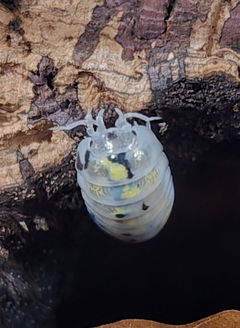
- Appearance: Glossy black body with bumblebee yellow striping across the abdomen; metallic bronzy-olive wing covers flecked with gold; black-and-yellow pronotum (shield); spiky legs
- Stridulation: Produces audible squeaks when disturbed — described as mouse-like
- Reproduction: Ovoviviparous (gives birth to live young); approximately 12 nymphs per litter
- Rarity: Rare in the UK hobby but established in international captive culture
What Makes the Simandoa Cave Roach Special
The conservation story is genuinely unique. No other species we stock has this kind of provenance. S. conserfariam was discovered in 2002 during a Rapid Assessment Programme expedition by Conservation International, scientifically described in 2004, and saw its entire wild population eliminated within roughly a decade of discovery. Mining operations in the Simandou region have destroyed the species's only known habitat. The animals you receive from us are direct descendants of those original collected specimens — the species exists today, anywhere on Earth, only because Conservation International collected a small sample and because hobbyists worldwide have kept the line going.
The colouration is striking. The glossy black abdomen carries clear bumblebee-yellow striping that's properly bold under enclosure lighting. The metallic bronzy-olive wing covers add a second contrasting tone, with small flecks of metallic gold visible at the right angles. The pronotum (the shield behind the head) is glossy black with a yellow perimeter, framing the head distinctively. The overall effect is genuinely striking — this isn't a subtle species. Nymphs start out plain black and develop the yellow striping progressively through successive moults, which means a mixed-age colony shows the full developmental range side by side.
The squeaking is real. S. conserfariam stridulate when disturbed — producing audible squeaks often compared to the sound of a mouse. This is a properly unusual feature for a cockroach and one of the more distinctive behavioural quirks of the species. It's not loud or constant, but if you handle the animals or open the enclosure they'll often vocalise briefly. For keepers used to silent invertebrates, this is genuinely engaging.
The breeding pace is steady and rewarding. Females are ovoviviparous — they give birth to live young rather than laying egg cases — with typical clutch sizes around 12 nymphs at 2–3 mm in length. Combined with the female lifespan of 2–3 years, an established colony produces multiple generations over time without overwhelming the enclosure the way faster-breeding cockroach species can. It's a manageable breeding rate that supports long-term colony stability rather than population explosions.
The ethical dimension is real. For keepers who care about the conservation context of their animals, the Simandoa offers something genuinely meaningful: by keeping and breeding this species you're participating directly in keeping it alive as a taxon. This isn't marketing language — it's the literal status of the animal. Combined with the species's straightforward care requirements and engaging behaviour, the Simandoa works equally well as a display animal, an educational species for schools and outreach, or simply a fascinating invertebrate to keep.
About the Name and Story
A brief clarification on the species's various names and the conservation context.
- Simandoa conserfariam: The scientific binomial. The genus name references the Simandou Mountains where the species was discovered; the species epithet is sometimes anglicised as "conservation" in spirit but is from Latin meaning "of the conservers" — a deliberate naming choice referencing the conservation context of its discovery.
- Simandoa Cave Roach: The standard common name.
- Extinct in the Wild Roach / Extinct Roach: The conservation-focused trade name used by some breeders to emphasise the species's status.
- Conservation Roach: Another conservation-focused trade name.
- Original description: Roth, L.M. & Naskrecki, P. (2004) in Journal of Orthoptera Research, describing a new genus and species of cave cockroach from Guinea, West Africa.
- Conservation status: Listed as Extinct in the Wild (EW) by IUCN. The original cave habitat in the Pic de Fon Classified Forest, Simandou Mountains, has been progressively destroyed by bauxite and iron ore mining since the early 2000s.
Setting Up the Enclosure
A 10–20 litre plastic container or glass terrarium with a properly secure lid suits a starter group of 5–10 animals. Escape-proofing is the single most important setup consideration. Adult Simandoas can climb smooth vertical surfaces including glass and plastic — combined with their substantial running speed, they're meaningfully better escape artists than slow-moving species like Madagascar Hissers. Foam seals around lid edges, fine mesh on all ventilation, and careful inspection before introducing animals are standard precautions.
Drill ventilation holes generously across opposing sides, covered with fine mesh. Moderate ventilation works well — enough airflow to prevent stagnation, without compromising the moderate humidity the species needs.
Provide multiple hides distributed across the enclosure. Cork bark in flat and tubular orientations, decaying wood pieces, and curled birch bark all work well — Simandoas particularly enjoy tight, packed hiding spots where multiple individuals can cluster together. They're social rather than solitary, and groups often pile into the same shelter rather than dispersing across the enclosure. Browse our accessories range for cork bark, lotus pods, and other natural hide options. Keep the enclosure away from direct sunlight and bright lighting — the species evolved in cave conditions and prefers dim light.
Important husbandry note: Skip the standing water dish. Misting and a moist sphagnum corner provide all the moisture this species needs. Many keepers also use insect jelly cups (water-substitute jelly products) which are clean, don't spoil quickly in warm humid conditions, and provide hydration plus supplementary nutrition in a single feed.
Substrate
Use a moisture-retentive substrate that supports the species's preference for moist conditions without being waterlogged:
- Organic topsoil or coco humus (pesticide-free) as the foundation
- Sphagnum moss mixed in for moisture retention — available in our accessories range
- Composted hardwood leaf litter mixed through and layered on top — browse our accessories collection for ready-prepared options
- Decaying hardwood pieces incorporated for hiding cover and as supplementary food
- Springtails inoculated into the substrate are highly recommended — they consume droppings and food waste, preventing mould in the warm humid setup
Substrate depth around 5–8 cm gives the colony room to burrow when desired — newly-born nymphs in particular will burrow into substrate for safety. Avoid pure coco coir as the only substrate; a mixed soil-based blend works better.
Humidity and Temperature
Maintain moderate humidity around 60–75%. Light to moderate misting every few days is typically enough — the substrate should feel damp but not waterlogged. This species is meaningfully more tolerant of moisture variation than the tropical Cubaris or Fillipinodillo we also stock; Simandoas come from cave conditions that are humid but not consistently wet, and they cope well with moderate fluctuations.
Temperature should be 22–28 °C. The warmer end of this range (25–28 °C) supports active breeding, while the cooler end works fine for steady maintenance of an established colony. In UK homes a low-wattage heat mat on a thermostat, mounted on the side of the enclosure rather than underneath, provides ideal supplementary warmth. Side-mounted heating creates a thermal gradient and avoids overheating substrate-dwelling nymphs.
Avoid placement near radiators or windows where temperatures fluctuate dramatically. Direct bright lighting also stresses the species — they prefer dim ambient conditions matching their cave heritage.
Diet
Simandoas are flexible generalist feeders in captivity, having moved beyond their wild diet of bat guano:
- Fresh fruit and vegetables — the dietary mainstay. Apple, orange, carrot, potato, sweet potato, courgette and similar all work well. Replace within 24–48 hours.
- Hardwood leaf litter — important secondary nutrition and substrate food source, always available. Our accessories range includes properly prepared leaf litter.
- Rotting hardwood pieces — eaten and used as cover
- Insect jelly cups — particularly well-suited to this species; clean, long-lasting, and provide hydration plus nutrition. A staple food in many established Simandoa colonies.
- Protein 1–2x weekly: fish flake, fish food pellets, dried shrimp, dried gammarus. Our accessories collection covers the full protein selection.
- Calcium sources — cuttlebone, crushed limestone, oyster shell as background availability. Our calcium options cover the full range.
Position fresh food on dishes or leaves rather than directly on substrate to make removal of uneaten portions easier and reduce mould risk in the warm humid setup.
Breeding
Simandoas breed reliably in captivity once temperature and basic husbandry are stable — which is precisely why the species has survived through hobbyist culture despite being extinct in the wild. Females are ovoviviparous, retaining developing young internally until they emerge as live nymphs (typically around 12 per litter at 2–3 mm in length). Newborn nymphs are dark coloured and tend to burrow into substrate immediately for safety.
For breeding success:
- Stable temperature in the warmer half of the range (25–28 °C is ideal for peak breeding)
- Consistent moderate humidity with the substrate kept damp throughout
- Mixed-age, mixed-sex colony — the offset male and female lifespans (males 2–3 months, females 2–3 years) mean maintaining genetic continuity requires several generations breeding alongside each other
- Adequate hides and avoidance of overcrowding — overcrowded Simandoas can nip each other's antennae
- Springtails inoculated to manage waste and prevent mould
- Minimal disturbance — like most cockroaches, they settle and breed better when left alone
- Patience — colonies expand at a manageable pace rather than explosively, which is part of why they're easy to maintain long-term
The species's reliable captive breeding is the practical foundation of its conservation status. A well-maintained colony will reliably produce multiple generations per year, directly contributing to the global captive population that keeps the species alive.
Who Should Buy Simandoa Cave Roaches?
Ideal for:
- Anyone interested in keeping a species with genuine conservation significance
- Educators, schools, and outreach programmes — Simandoas combine educational interest with relatively straightforward husbandry
- Beginner to intermediate invertebrate keepers ready for a slightly more involved species than Madagascar Hissers
- Display enthusiasts drawn to the striking black-yellow-bronze colouration
- Collectors building a focused premium cockroach collection alongside the Emerald and Giant Flower species
- Keepers interested in stridulation behaviour — the squeaking is a properly interesting biological feature
Not ideal for:
- Anyone without a properly escape-proof enclosure — climbing ability and running speed make escape a real risk in unsealed setups
- Keepers without supplementary warmth in colder UK homes
- Anyone needing feeder insects — this species is far too significant and culturally valuable to use as feed
- Keepers who want a species they can leave entirely unmaintained — moderate humidity and regular feeding are needed
- Setups in bright, exposed locations — Simandoas evolved in caves and prefer dim ambient conditions
Realistic Expectations
The conservation status is the species's defining feature, not a marketing claim. Wild populations are genuinely gone — destroyed by mining in the Simandou region. Every animal in captivity globally descends from the small sample collected before the cave habitat was lost. Keeping Simandoas is participation in keeping the species alive, full stop. Treat them accordingly.
They can climb and they're fast. New keepers occasionally underestimate the escape risk because the species has a reputation as easy to keep. The basic husbandry is genuinely straightforward, but escape-proofing isn't optional. Adults run quickly when disturbed and can climb smooth vertical surfaces. Foam-sealed lids, properly fitted mesh on ventilation, and inspection of the enclosure before transferring animals are all standard practice. Some older hobbyist sources claim they can't climb glass — newer sources and direct keeper experience consistently report otherwise. Err on the side of caution.
The squeaking is occasional, not constant. New keepers sometimes expect cricket-like ongoing vocalisation; what you actually get is brief stridulation when animals are handled or disturbed. The squeaks are individual events rather than a chorus.
Colour develops with age. Newly-born nymphs are uniformly black and don't show the species's adult colouration. The yellow striping develops progressively through successive moults, with full adult colouration not appearing until the final moult to maturity. If you start with nymphs, expect to wait several months for the full display colouration to develop.
Male lifespan is properly short. The 2–3 month adult male lifespan after maturity is well-documented and not a husbandry failure. Females live considerably longer (2–3 years), which creates the offset breeding cycle the species relies on. Maintain mixed-age groups so new males are reaching maturity as older males die off.
The bat guano detail is biological background, not a husbandry requirement. Wild Simandoas fed on bat guano in their cave habitat; captive animals do perfectly well on fruit, vegetables, leaf litter, and insect jelly without any guano supplementation. The detail is interesting context rather than a feeding instruction.
Use collapsible tabs for more detailed information that will help customers make a purchasing decision.
Ex: Shipping and return policies, size guides, and other common questions.