White-Spotted Assassin Bug (Platymeris biguttatus) for Sale
Care Info:
 ORIGIN
 TEMP
TEMP
 HUMIDITY
 LENGTH
 DIFFICULTY
 RARITY
- Free shipping over £65
- Low stock - 4 items left
The White-Spotted Assassin Bug is one of the most genuinely impressive invertebrates available in the UK hobby — a properly substantial African predator with a glossy black body, banded legs, and two distinct white spots on the wing covers that give the species both its common name and its scientific name (biguttatus means "two-spotted" in Latin). Adults reach 30–40 mm with a confident, active hunting style that's a clear departure from the slower scavenging behaviour of the cockroaches and isopods in our other collections. For keepers ready to step into the world of predatory invertebrates, this is one of the right starting points.
This is part of our wider other invertebrates collection and represents a different category from our isopod, cockroach, and millipede catalogues — true bugs of the order Hemiptera, with piercing mouthparts and a predatory lifestyle. P. biguttatus is widely kept in zoos, universities, and private collections internationally; it's one of the most accessible predatory invertebrates available, with a properly visible hunting response and a manageable temperament for keepers willing to follow the safety basics. Pair with the Cuban Cockroach as a potential feeder culture (though commercial feeders work equally well).
One honest framing point up front. This is a venomous animal. P. biguttatus has a genuine, painful bite and can spray defensive venom with surprising accuracy — often aiming for eyes. Handling is not recommended; keepers should treat enclosure maintenance with care and keep the species well out of reach of children and pets. None of this makes the species "dangerous" in a serious sense — there are no documented fatalities or permanent injuries — but it does mean basic safety practices aren't optional. To set things up properly from the start, browse our accessories collection for the cork bark, substrate components, and supplementary materials this species needs.
Quick Care Summary
- Scientific Name: Platymeris biguttatus (Linnaeus, 1767)
- Common Names: White-Spotted Assassin Bug, Two-Spotted Assassin Bug, Twin-Spotted Assassin Bug, White-Spot Assassin Bug
- Family: Reduviidae (assassin bugs); subfamily Reduviinae
- Order: Hemiptera (true bugs) — piercing-sucking mouthparts, not biting/chewing mandibles
- Origin: Endemic to tropical Africa — recorded from Senegal, Gambia, Guinea, Mali, Ivory Coast, Togo, Benin, Niger, Nigeria, Chad, Sudan, Ethiopia, Somalia, DRC, Uganda, Kenya, Tanzania, Zambia, Zimbabwe, and Mozambique
- Habitat: Humid tropical forest, particularly hollow tree stumps and decaying logs
- Adult Size: 30–40 mm body length (some sources give a wider range of 10–40 mm including all developmental stages)
- Lifespan: 1–2 years as adults; total egg-to-adult development around 6–8 months
- Difficulty: Easy to medium — straightforward husbandry but requires safety awareness and a steady prey supply
- Temperature: 22–28 °C, with 25–28 °C ideal for active hunting and breeding
- Humidity: Moderate — 50–60%; the species genuinely prefers drier conditions with good ventilation over humid setups
- Ventilation: Moderate to high — supports the species's natural preference for warmer, drier conditions
- Climbing: Adults climb readily on rough surfaces (cork bark, wood); they can't grip smooth glass effectively but the venom spray range is still significant
- Flight: Adults have wings but are not strong fliers; flight is rare in captivity
- Activity: Primarily nocturnal but will hunt and feed during the day, particularly in established setups
- Appearance: Adults glossy black body; wing covers (tegmina) bear two distinct white spots; legs banded with black and yellow/orange; piercing rostrum visible beneath the head
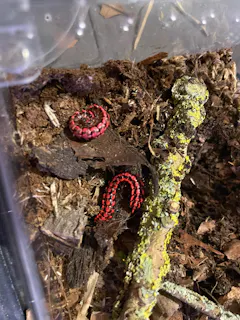
- Nymphs: Smaller versions of adults (hemimetabolous development); newly-moulted individuals briefly bright orange before darkening
- Diet: Strict predator — crickets, locusts, mealworms, dubia roaches, other invertebrate prey
- Social: Communal-tolerant in groups when well-fed; cannibalism risk when prey is scarce
- Venom: Genuinely venomous; can bite and spray defensive saliva accurately at threats
- Rarity: Common in international hobby culture; well-established in the UK
What Makes White-Spotted Assassin Bugs Special
The hunting behaviour is genuinely engaging. Unlike the slow, methodical browsing of isopods or the reactive feeding of cockroaches, assassin bugs are properly active predators. They stalk prey deliberately, deliver a fast piercing strike with the rostrum, inject saliva that liquefies the prey's internal tissues, then drink the resulting fluid. The whole sequence — stalk, strike, feed — is observable in a way that few other invertebrate behaviours are, and it's the central reason this species has been kept in zoos, universities, and private collections for decades.
The visual impact. The glossy black body with two crisp white spots, the banded legs, and the visible piercing rostrum combine to create one of the most properly striking invertebrate appearances in the hobby. The white spots are positioned on the wing covers and are visible from a distance — unlike many invertebrates that need close observation to appreciate, P. biguttatus reads cleanly from across a room. The banded legs add to the visual interest, particularly when an individual is stationary on cork bark.
The communal tolerance. Most predatory invertebrates need to be kept individually to prevent cannibalism. P. biguttatus is the meaningful exception — adults and nymphs can be kept in groups without significant cannibalism risk, provided prey is consistently available. This makes the species particularly suited to display setups where multiple animals can be observed interacting and hunting simultaneously rather than the single-individual housing many predators require.
The brief post-moult colouration. Newly-moulted assassin bugs emerge bright orange before darkening to the standard glossy black over a few hours. This transient colouration is one of the genuine surprises of keeping the species — keepers catching a recently-moulted individual often initially think they have a different species before the colour shifts back to normal within the day. It's a brief but properly memorable observation.
The parthenogenetic capability. Female P. biguttatus can reproduce parthenogenetically (without males), though this is uncommon and most breeding is sexual. This unusual reproductive flexibility is interesting biologically and means a single female can sometimes produce viable offspring without a mate — though for reliable breeding, a mixed-sex group is the right approach.
The widespread availability across the hobby. P. biguttatus has been in international culture for decades and is well-established in UK private collections, university teaching colonies, and zoo educational programmes. This means resources, advice, and feeder logistics are all readily available — you're not stepping into an obscure species, but rather one with a properly developed support ecosystem behind it.
About the Name
A brief clarification on the species's nomenclature.
- Platymeris biguttatus: The scientific binomial. The species epithet "biguttatus" literally means "two-spotted" in Latin, referencing the two white spots on the wing covers. The genus name Platymeris derives from Greek roots meaning "broad" or "flat" plus "thigh."
- White-Spotted Assassin Bug / Two-Spotted Assassin Bug: The two standard hobby names, both referring to the wing-cover spots.
- Distinction from P. rhadamanthus: The other commonly-kept Platymeris species is P. rhadamanthus, the Red-Spotted Assassin Bug. The two are similar in care but distinguishable by spot colour (white vs red/orange) and slightly different body proportions.
- Original description: Linnaeus, 1767 — making this one of the longer-described invertebrates in the hobby. Family Reduviidae, subfamily Reduviinae.
Setting Up the Enclosure
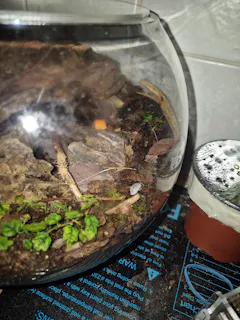
A 10–20 litre plastic container or glass terrarium suits a starter group of 3–5 individuals; scale up to 30+ litres for established adult colonies. Glass terrariums work well and allow good visibility; secure clip-locked plastic containers are equally valid and lighter. The enclosure should be wider than tall — assassin bugs use floor space and low cover more than vertical climbing, and a taller enclosure isn't a particular advantage.
Provide multiple hides distributed across the substrate. Cork bark slabs in horizontal orientations work particularly well — adults will rest under bark during the day and emerge to hunt across the substrate. Stacked egg cartons or pieces of decaying hardwood also provide acceptable cover. Browse our accessories range for cork bark and natural cover options. Don't overcrowd the enclosure with cover; leave open floor space for hunting behaviour to be visible.
Ventilation should be moderate to high — the species genuinely prefers drier conditions over humid setups. Cover ventilation holes with fine mesh; adults can fly weakly and nymphs can climb through unsecured ventilation. Glass terrariums with mesh-topped lids work well.
Critical safety note: The defensive venom spray has significant range. When opening the enclosure, keep your face well away from the inside — never put your face directly above an open container of assassin bugs. Some keepers use safety glasses during enclosure maintenance. Don't handle the animals directly; use long-handled tweezers, soft brushes, or transfer containers when moving them. Children should not be allowed to handle the enclosure unsupervised.
Water provision: a shallow water dish or soaked cotton wool works well, but isn't essential — adults derive most of their hydration from prey. If using a water dish, keep it shallow to prevent drowning of small nymphs.
Substrate
Use a layered substrate that supports the species's natural preference for dry surfaces with some moisture beneath:
- Coconut coir or organic topsoil (pesticide-free) as the foundation layer — available in our accessories range
- A shallow upper layer of dry hardwood bark chips, leaf litter, or wood chunks
- Cork bark pieces arranged across the surface for cover
- Optional: a small amount of dry moss or coco husk chunks for textural variety
- Avoid sand as the primary substrate — keeper experience reports it can irritate the animals' contact surfaces
Substrate depth around 3–5 cm is sufficient — assassin bugs don't burrow significantly. Keep the lower substrate slightly damp; the upper surface should stay properly dry. This creates a natural moisture gradient that mirrors the species's wild habitat (humid tropical forest with dry leaf litter on the surface).
Humidity and Temperature
Maintain moderate humidity around 50–60% with a clear moisture gradient — damp substrate beneath, dry surface above. Mist one side of the enclosure lightly once or twice weekly to maintain this gradient without saturating the setup. The species genuinely prefers drier conditions; overly humid setups encourage fungal issues and don't match the natural ecology where assassin bugs occupy drier microhabitats within humid forest environments.
Temperature should be 22–28 °C, with 25–28 °C ideal for active hunting and breeding. UK room temperature is consistently below the species's preferred range — supplementary heating is realistically necessary year-round. A low-wattage heat mat on a thermostat, mounted on the side or back of the enclosure, provides ideal supplementary warmth. The species responds well to a thermal gradient that lets animals choose warmer or cooler zones; side-mounted heating is preferable to under-tank heating for this reason.
The species is genuinely tolerant of moderate temperature variation. Brief drops to 20 °C aren't a problem; sustained temperatures below 20 °C slow activity, reduce hunting response, and stop breeding.
Diet
This is the section that differs most fundamentally from our other invertebrate species. P. biguttatus is a strict predator — it does not consume leaf litter, rotting wood, fruit, or any plant matter. Feed live prey items appropriate to the size of the animals:
- Crickets — the staple feeder. Black crickets, brown crickets, and silent crickets all work. Size to the assassin bug — small nymphs need pinhead or 1-week crickets; adults take large crickets without difficulty.
- Locusts — well-received and particularly visible during feeding. Brown locusts work well across most size ranges.
- Dubia roaches — excellent feeder if you have access to a colony, or buy from feeder suppliers
- Mealworms — accepted but less effective due to the hard exoskeleton; better as occasional variety than as a staple
- Waxworms — high-fat treat food; use sparingly to avoid obesity
- Fruit flies — for the smallest nymphs that can't yet tackle larger prey
Feed once or twice weekly. The species can go without food for surprisingly long periods (up to a month in some keeper reports) without distress, but consistent feeding supports normal growth and breeding. Watch the abdomen — plump and rounded means well-fed; sunken or wrinkled means more food is needed.
Prey size: adults can tackle prey up to twice their own body length, though smaller prey items are taken more reliably. Nymphs should receive prey roughly half their own size or slightly larger. Don't leave large uneaten prey items in the enclosure — surviving prey can stress or injure the assassin bugs over time.
The cannibalism factor: assassin bugs are communal-tolerant but will resort to cannibalism if prey is scarce. Maintain consistent feeding; if you're going away for an extended period, leave plenty of feeder insects (and ideally a water source for the feeders) to ensure your animals don't turn on each other.
Breeding
P. biguttatus breeds reliably in captivity once conditions are stable, which is one reason the species is so well-established internationally. Females lay eggs in clusters on substrate or cork bark — typically 10–30 eggs per clutch. Eggs hatch in 4–6 weeks at proper temperatures. Nymphs emerge as small versions of adults (hemimetabolous development means no larval-to-adult transformation) and progress through 5 instars before reaching maturity. Total nymph-to-adult development takes 6–8 months.
For breeding success:
- Sexed group — at least 2–3 of each sex; sexing is difficult at nymph stage but more apparent at adult
- Stable temperature in the warmer half of the range (25–28 °C is ideal)
- Consistent moderate humidity with proper moisture gradient
- Plenty of cover — females select sheltered spots for egg-laying
- Abundant prey availability — well-fed adults breed more readily
- Minimal disturbance — gravid females and recent egg clusters are stressed by frequent enclosure intervention
- Egg clusters can be left in situ or carefully moved to a separate incubation container for higher hatch rates
Parthenogenetic reproduction does occur but is uncommon and unpredictable. Don't rely on it as a breeding strategy; a mixed-sex group is the proper approach. Females that produce parthenogenetic offspring tend to do so as one-off events rather than sustained reproductive output.
Who Should Buy White-Spotted Assassin Bugs?
Ideal for:
- Intermediate-to-advanced invertebrate keepers ready to step into predatory species
- Display enthusiasts drawn to active hunting behaviour rather than passive scavenging
- Keepers with experience in safe handling of venomous invertebrates (tarantulas, scorpions) who want to expand into true bugs
- Educational settings (schools, universities, zoo back-of-house) where the active hunting behaviour supports teaching
- Keepers with reliable feeder insect supply or own feeder colonies
- Long-term project keepers — the 1–2 year adult lifespan and 6–8 month nymph development reward patient husbandry
Not ideal for:
- Beginner invertebrate keepers — start with isopods, cockroaches, or millipedes before stepping into predators
- Homes with young children where unsupervised enclosure access could occur
- Keepers who want a "handleable" pet — these are observation-only animals
- Anyone uncomfortable with the venom spray defence — the risk to eyes is genuine, not exaggerated
- Setups without reliable feeder insect supply
- Keepers wanting communal animals that interact socially — assassin bugs tolerate each other but don't form social bonds
Realistic Expectations
The venom is genuine. Keeper accounts consistently confirm that the bite is painful, lasting hours to days, with localised swelling and persistent discomfort. The defensive spray can travel surprising distances (estimates range from 15 to 30 cm with reasonable accuracy) and specifically targets the eyes of perceived threats. Neither effect is medically dangerous in healthy adults, but both are properly unpleasant. Safety glasses during enclosure maintenance, long-handled tools, and a "don't handle" policy are the right precautions rather than excessive caution.
The post-moult orange phase is brief. Newly-moulted individuals emerge bright orange and then darken to standard glossy black within several hours. If you catch the orange phase, enjoy it — but don't expect the colour to persist. The visible white spots and banded legs return as the cuticle hardens.
They aren't constantly active. Despite being active predators, assassin bugs spend significant time motionless in cover. New keepers expecting constant visible behaviour can be disappointed; the rewards come from observing feeding events rather than continuous activity. Set up the enclosure to encourage hunting visibility (open floor space, clearly placed prey) and accept that "watching nothing happen" is part of the experience between feeding sessions.
Cannibalism happens when food is scarce. Despite communal tolerance, hungry assassin bugs will eat each other. This isn't a flaw in the species — it's a survival strategy that has kept them successful across tropical Africa. The right response is consistent feeding, not separating animals. If you can't maintain reliable feeder access, this isn't the species for you.
Feeder logistics are part of the commitment. Unlike detritivores that eat substrate components, assassin bugs require a continuous supply of live prey. Establishing a reliable feeder source — local pet shop, mail-order feeder supplier, or your own feeder colony — is part of the keeping commitment. If you don't have time or interest in maintaining feeder access, the species will struggle.
They're not particularly social with humans. Some keepers describe assassin bugs as "inquisitive," and there's some truth to this — they'll approach the side of the enclosure where prey is being introduced and may track movement outside the glass. But there's no social bond, no recognition, and no positive response to handling. The relationship with the keeper is purely observational; treat the animals accordingly.
The parthenogenetic capability is real but unreliable. Some keepers report parthenogenetic offspring from single females, but most breeding success comes from mixed-sex groups. Don't buy a single female expecting reliable solo breeding — buy enough nymphs to ensure both sexes reach maturity in your group.
Use collapsible tabs for more detailed information that will help customers make a purchasing decision.
Ex: Shipping and return policies, size guides, and other common questions.