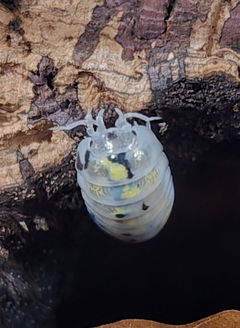
depressum isopod
Armadillidium Depressum Isopods
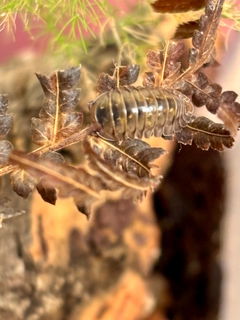
depressum isopod up close

Armadillidium depressum Isopods (Southern Pill Woodlouse) for Sale

Care Info:

Origin icon ORIGIN
UK
Temperature icon TEMP
17-26 ℃
Humidity icon HUMIDITY
50-70 %
Length icon LENGTH
18-20 mm
Difficulty icon DIFFICULTY
EASY
Rarity icon RARITY
VERY COMMON
Regular price£5.00
/
Tax included. Shipping calculated at checkout.

Quantity
  • Free shipping over £65
  • Low stock - 1 item left
  • Backordered, shipping soon

Armadillidium depressum, commonly known as the Southern Pill Woodlouse, is one of Britain's most underrated native isopods. A genuinely large, dark grey-to-black pill woodlouse with a distinctive flattened, splayed body shape, it's a properly hardy species that doubles as an attractive display animal and a hardworking cleanup crew. The "depressum" species name refers to its flattened profile — these are noticeably wider and less domed than the more familiar A. vulgare, with a body shape that makes them well-suited to squeezing into crevices in old walls and stone — their preferred wild habitat.

This is a UK-native species that's recently been spreading further north and east across the country. Historically concentrated in southwest England, south Wales and along the south coast, it's now been recorded as far north as Edinburgh — a testament to how adaptable and resilient this species is. For UK keepers, it's a chance to keep a properly British isopod in a hobby dominated by Mediterranean and tropical imports.

One honest framing point up front. A. depressum is genuinely easy to keep — one of the most forgiving Armadillidium in the UK trade — but it's still an isopod that needs the basics right: a moisture gradient, decent ventilation, and proper calcium availability. Get those in place and the colony will look after itself. Browse our accessories collection for everything you'll need for a complete setup.

Quick Care Summary

  • Scientific Name: Armadillidium depressum Brandt, 1833
  • Common Name: Southern Pill Woodlouse
  • Family: Armadillidiidae
  • Origin: United Kingdom and Western Europe — historically southwest England, south Wales and the south coast, now expanding north as far as central Scotland
  • Adult Size: 18–20 mm — slightly larger than A. vulgare
  • Lifespan: Approximately 3 years
  • Difficulty: Easy — beginner-friendly
  • Temperature: 17–26 °C — happy at standard UK room temperature
  • Humidity: 50–70% with a moisture gradient
  • Ventilation: Medium
  • Conglobation: Partial — rolls into a ball but leaves a small gap between the head and tail rather than fully enclosing like A. vulgare
  • Appearance: Dark grey to nearly black body with a distinctly flattened, splayed profile; pleon segments curve outwards causing the characteristic "splayed" tail; some individuals show subtle pale yellow or cream patches across the dorsal segments
  • Behaviour: Active, bold and confident; exceptional climbers (frequently found scaling vertical surfaces in the wild); often visible during the day
  • Breeding: Steady and reliable; broods of 15–30 young; year-round breeding in stable conditions
  • Rarity: Very common in the wild but uncommon in UK captive culture

What Makes A. depressum Special

The genuinely British provenance. Most isopods in the UK hobby come from Mediterranean, tropical or other foreign origins — A. depressum is a properly native species that you might genuinely find on the wall of an old building in southwest England or Wales. For keepers interested in UK wildlife and bioregional collections, this is one of the few hobby species that offers authentic British provenance.

The flattened, splayed body shape. The "depressum" name refers to the species's distinctive flattened profile. Where A. vulgare has a high-domed body that rolls into a perfect sphere, A. depressum is noticeably wider and lower, with pleon segments that curve outwards to give a "splayed" or "fan-tailed" appearance from behind. This isn't just a visual quirk — the shape is an adaptation for sheltering in narrow cracks and crevices in stone walls, the species's natural habitat. The result is a distinct silhouette that's immediately recognisable once you know what to look for.

The wall-climbing behaviour. A. depressum are exceptional climbers compared to most other Armadillidium. In the wild they're frequently found on vertical surfaces — old limestone walls, weathered rock faces, quarry cuttings, the sides of farm buildings. In captivity this translates to active, three-dimensional use of the enclosure when given the opportunity. Providing vertical cork bark, climbing ledges or rough stone surfaces lets them express this natural behaviour and makes the enclosure much more interesting to watch than a typical flat-bottomed isopod tub.

The partial conglobation. Unlike A. vulgare, which forms a perfectly sealed sphere when threatened, A. depressum rolls into a ball that leaves a small gap between the head and tail. It's a useful field identification feature and a nice quirk of the species — the partial roll is a different defensive strategy that's worth knowing about even if it doesn't change captive husbandry.

The bold temperament. A. depressum are noticeably more confident than many Armadillidium — they tend to keep foraging when the enclosure is opened, rather than instantly scattering for cover. Combined with their substantial size, this makes them properly observable as a display species rather than just functional cleanup crew. For keepers who want to actually see their isopods, this is a real point in the species's favour.

About the Name

A brief clarification on the species's various names.

  • Armadillidium depressum: The formal scientific binomial, described by Brandt in 1833. Use this name in any scientific or research context.
  • Southern Pill Woodlouse: The standard British common name, reflecting its historical distribution concentrated in southern Britain.
  • Historical synonyms: Occasionally still referenced under the old names Armadillidium gerstaeckeri or Armadillidium virescens; both are now considered synonyms of depressum.

Setting Up the Enclosure

A 5–10 litre plastic container with a secure clip-lock lid suits a starter colony of 10–15 individuals. Drill ventilation holes on opposite sides for proper cross-flow, covered with fine mesh. A. depressum appreciates better airflow than tropical species but doesn't need the high ventilation Mediterranean Porcellio require — medium ventilation works well.

Because this species is a strong climber, take advantage of vertical space. Cork bark pieces leaned against the enclosure walls give them surfaces to climb and shelter on — closer to their wild habitat than purely horizontal hides. Distribute flat hides across the substrate too, and place both types across the moisture gradient so individuals can pick the conditions that suit them. Browse our accessories range for cork bark, lotus pods and other natural hide options. Keep the enclosure out of direct sunlight and away from radiators or windows where temperatures fluctuate significantly.

Important husbandry note: Skip the standing water dish. A lightly misted moist corner provides all the moisture this species needs, and standing water encourages mould without serving a real purpose. Armadillidium drink primarily from substrate moisture rather than open water sources.

Substrate

Use a calcium-rich, free-draining substrate that mirrors the limestone-wall habitat the species occupies in the wild:

  • Organic topsoil (pesticide-free) as the foundation
  • Sphagnum moss concentrated in the moist corner only — not mixed throughout
  • Composted hardwood leaf litter mixed through the upper layer — browse our accessories collection for ready-prepared options
  • Crushed limestone or oyster shell distributed liberally throughout for calcium — A. depressum evolved on limestone walls and respond well to calcium-rich environments
  • Small pieces of rotting hardwood as a food source and natural cover
  • A small amount of fine sand or aquarium gravel mixed in to keep the dry zone well-draining

We recommend a topsoil-based mix rather than coco coir. Substrate depth around 4–6 cm is adequate — A. depressum are surface and wall foragers rather than deep burrowers, so getting the moisture gradient and vertical cover right matters more than depth.

Top layer: a generous covering of hardwood leaf litter — oak, beech, hazel — plus multiple flat cork bark pieces and ideally some vertical cork bark for the climbing behaviour the species is known for.

Humidity and Temperature

Maintain humidity around 50–70% overall, with roughly a quarter of the enclosure kept lightly damp via misted sphagnum moss, and the remainder allowed to dry out properly between waterings. A. depressum tolerates a wider humidity range than many isopods thanks to its synanthropic British habitat — it's adapted to the highly variable moisture conditions of dry stone walls and weathered rock faces, which dry out completely between rainfall events.

Temperature should be 17–26 °C, which matches UK room temperature year-round. This is genuinely one of the easiest species to keep at room temperature — being a British native, it's adapted to exactly the kind of cool-to-moderate temperatures most UK homes naturally provide. No supplementary heating is required. The species can also be seen year-round in the wild without seasonal dormancy, which translates to consistent activity in captivity through the colder months.

Diet

Like all Armadillidium, A. depressum are detritivores that accept a broad range of foods. Their substantial appetite reflects their substantial size:

  • Hardwood leaf litter (oak, beech, hazel) — the dietary foundation, always available. Our accessories range includes properly prepared leaf litter ready for use.
  • Rotting hardwood pieces — important secondary nutrition source
  • Vegetables 2–3x weekly: courgette, carrot, sweet potato, squash, cucumber. Replace within 24–48 hours.
  • Fruit occasionally in small amounts (apple, melon, banana)
  • Protein 1x weekly: fish flake, dried shrimp, dried daphnia. Armadillidium have a lower protein requirement than Porcellio, so don't overdo it. Our accessories collection stocks the protein supplements you'll need.
  • Calcium (essential — always available): cuttlebone, crushed limestone, oyster shell. A. depressum is particularly calcium-hungry given its limestone-wall heritage, so don't skimp on this. Browse our calcium options in the accessories range.
  • Moss and lichen — also eaten and appreciated

Don't overfeed. Uneaten fresh food spoils quickly and attracts fungus gnats and mites. The bulk of the diet comes from substrate-borne detritus, with fresh and protein offerings as supplements rather than staples.

Breeding

A. depressum breed steadily and reliably under stable conditions. Females carry developing young in a brood pouch (marsupium) for 4–6 weeks before releasing them as fully-formed miniature versions of the adults — typically 15–30 per brood. Sexual maturity comes at around 3–5 months, and breeding continues year-round when temperature and moisture are stable rather than being tied to specific seasonal cues.

For breeding success:

  • Stable temperature anywhere in the comfort range (no need to push to the upper end for breeding)
  • Consistent moisture gradient — avoid wet swings
  • Abundant calcium for breeding females, with multiple distributed sources — limestone is particularly appropriate given the species's natural habitat
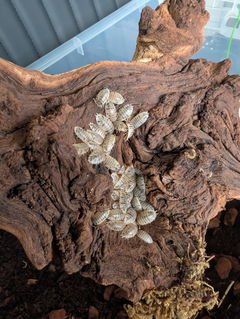
  • Plenty of flat and vertical hides — cork bark in various orientations encourages the natural clustering and climbing behaviours
  • Larger starter groups (10+) establish faster and offer better genetic diversity

The species's peaceful temperament extends to colony dynamics — unlike some Armadillidium where males can become territorial, A. depressum colonies remain harmonious even at higher densities. This makes them well-suited to long-term established colonies that build up gradually over time.

Who Should Buy A. depressum Isopods?

Ideal for:

  • Beginner isopod keepers looking for a hardy, forgiving species that handles minor husbandry variation
  • UK-focused collectors interested in keeping British native species
  • Keepers wanting an active, visible display species rather than a reclusive one
  • Anyone setting up a bioactive enclosure that needs a hardworking cleanup crew at room temperature
  • Keepers interested in climbing isopod behaviour — A. depressum are exceptional climbers when given vertical cork bark
  • Bioactive setups with reptiles or amphibians that need a substantial-sized cleanup species

Not ideal for:

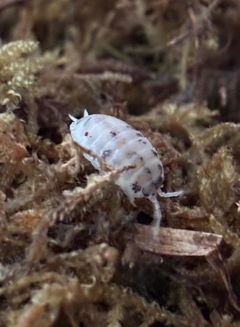
  • Keepers wanting bright colour visuals — A. depressum are wild-type grey-black with subtle yellow patches at most
  • Setups that run consistently wet without a proper dry zone — the species adapted to dry stone walls and needs the gradient
  • Keepers wanting the classic perfect-ball conglobation — A. depressum only rolls partially; A. vulgare is the species for a complete seal
  • Anyone wanting an exotic or rare premium species — this is a common British isopod, valued for its qualities rather than its rarity

Realistic Expectations

It's a common species, not a premium rarity. A. depressum is widespread in the wild across southern Britain and increasingly elsewhere — it's not a rare or premium species. The appeal here is the qualities (hardiness, size, climbing behaviour, native provenance) rather than rarity or visual flash. If you want a showy or premium species, look elsewhere; if you want a properly reliable workhorse that's interesting to observe, this is the right choice.

The colour is muted, not vivid. Wild-type animals are dark grey to nearly black, occasionally with pale yellow or cream patches scattered across the dorsal segments. There's no equivalent of the bright Magic Potion or Spanish Orange morphs in this species — what you see is what you get. The appeal is the body shape, behaviour and provenance, not pigmentation.

The partial conglobation is normal. New keepers occasionally worry that the small gap when A. depressum rolls into a ball means something is wrong with the animal. It doesn't — it's a normal species characteristic and one of the key features that distinguishes depressum from vulgare. If anything, observing this gap is a useful confirmation that you've got the species you paid for.

Give them vertical space. The single biggest difference between a healthy A. depressum setup and a mediocre one is whether vertical climbing surfaces have been provided. A flat tub with substrate and a couple of horizontal hides will keep them alive but won't bring out the species's natural behaviour. Lean cork bark pieces against the enclosure walls and you'll see noticeably more activity and confidence from the colony.

They eat soft plants. Like most Armadillidium, A. depressum will graze on soft live plants and moss if those are present in a bioactive setup. Hardy plants and tough mosses fare better than delicate ferns or soft-leaved species — worth knowing if you're planning a planted vivarium.

Use collapsible tabs for more detailed information that will help customers make a purchasing decision.

Ex: Shipping and return policies, size guides, and other common questions.


Recently viewed