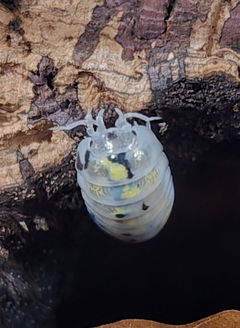
Armadillidium germanicum 'Darth Vader' Isopods for Sale
Care Info:
- Free shipping over £65
- Low stock - 1 item left
- Backordered, shipping soon
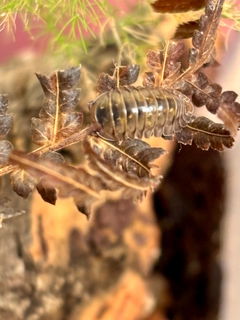
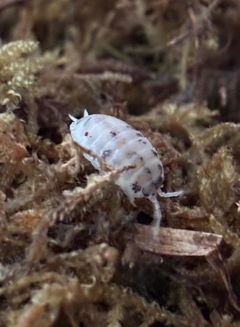
Armadillidium germanicum 'Darth Vader' is PostPods' dark colour-line of a properly-documented Central European pillbug. The base species is a real, formally-described Armadillidium — Verhoeff, 1901, documented in the World Marine, Freshwater and Terrestrial Isopod Crustaceans database and GBIF — with the 'Darth Vader' trade name applied to our darker-toned stock for the Star Wars reference everyone makes when they see them roll into the helmet-shaped defensive ball.
A nicely surprising natural-history detail: despite the species name germanicum (Latin for "German"), the type locality is actually Italy. Karl Wilhelm Verhoeff — the prolific German myriapodologist and isopod taxonomist who described the species in 1901 — gave it the German nationality name despite working from Italian specimens, which was reasonably common practice for German researchers of the era. The documented distribution per WoRMS spans Italy, Austria, and Germany — so it's a properly Central European species rather than the strictly German one the name implies.
Like all Armadillidium, the germanicum conglobates — rolling into a perfect, tight defensive ball when disturbed. With a substantial body size at the larger end of the Armadillidium range, dark dramatic colouration, and that classic pillbug roll, the Darth Vader name is well-earned. Browse the full Armadillidium collection to compare options.
Quick Care Summary
- Scientific Name: Armadillidium germanicum Verhoeff, 1901
- Common Names: Darth Vader, German Pill Woodlouse
- Family: Armadillidiidae
- Origin: Italy (type locality), Austria, Germany — Central European
- Adult Size: Up to approximately 25 mm — a substantial Armadillidium (note: published sources typically cite 13–22 mm; this stock runs at the larger end of the range)
- Lifespan: 2–3 years typical
- Difficulty: Medium — straightforward care, but appreciates stable conditions
- Temperature: 21–27°C (warm-preferring Central European)
- Humidity: 65–75% — moderate-to-high with gradient
- Ventilation: Good — balance airflow with humidity retention
- Conglobation: Yes — rolls into a tight defensive ball
- Appearance: Dark charcoal-to-black colouration in this 'Darth Vader' line (the species naturally shows variable colour; PostPods stock is selected for the darker tones)
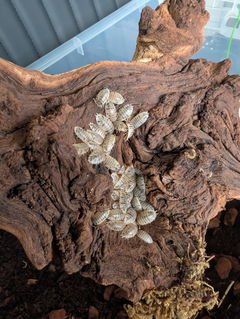
- Behaviour: Nocturnal; active in good setups; sociable in colonies
- Breeding: Reliable under stable conditions; moderate broods per cycle
- Rarity: Rare — uncommon in the UK hobby
What Makes Darth Vader Isopods Special
Several factors make this species worthwhile for a serious Armadillidium collection:
The dark colouration is genuinely dramatic. A. germanicum shows naturally variable colour ranging from pale grey with a metallic finish through to deep charcoal and near-black in the darker individuals. PostPods' 'Darth Vader' line is selected for the darker end of the spectrum — properly dark, glossy in good light, dramatic against naturalistic substrate. The Star Wars helmet comparison really does land when you see them conglobated.
Substantial Armadillidium size. With the species reaching up to 22mm in published natural-history sources and PostPods' stock running larger still (the on-page icon shows 25mm), these are flagship-sized pillbugs — properly substantial animals with real presence in a display setup. Comparable in body size to A. vulgare 'Big Italy' and A. werneri.
Proper conglobation. The defensive roll is what every Armadillidium is famous for, and germanicum does it well — tight, complete, the classic helmet-shaped sphere. With the dark colouration, the conglobated ball really does look like Darth Vader's helmet, which is the entire point of the trade name.
Genuine scientific provenance. Verhoeff, 1901 — properly Victorian-era documented species with formal taxonomic standing. Not a hobby trade name pretending to be a species; this is a real Armadillidium with a genuine type locality (Italy), with the Darth Vader name applied as marketing on top of the real taxonomic identity.
Easier than many flagship Armadillidium. At Medium difficulty, the germanicum is more forgiving than some of the demanding Mediterranean species. Adapted to Central European climate variation, it handles UK room conditions comfortably without the precision-care demands of tropical or extreme-locality species.
About the 'Darth Vader' Trade Name
Honest framing here. 'Darth Vader' isn't a long-established international hobby morph designation — it's a PostPods trade name applied to our darker-toned A. germanicum stock. Other European retailers selling the species typically just list it as Armadillidium germanicum without a trade-name overlay, and the species naturally shows variable colouration (with pale grey-metallic individuals well documented alongside the darker forms).
That said, the trade name lands properly for the right reasons: the darker specimens in our stock genuinely do show the dramatic dark colouration the name implies, and the helmet-shape of a conglobated Armadillidium really does look Vader-ish when the body's dark enough. So it's a piece of marketing applied to real visual character rather than fabrication — exactly the kind of trade name the hobby applies routinely (the same way "Magic Potion" describes a specific A. vulgare stacked-recessive morph rather than a separate species).
How A. germanicum Compares to Other Substantial Armadillidium
- vs A. vulgare 'Big Italy': Both are large Central/Mediterranean European Armadillidium. Big Italy is the large-bodied A. vulgare locality stock with classic grey-mottled colour; Darth Vader is the dark-toned A. germanicum line. Different species, comparable body sizes, very different visual presence.
- vs A. werneri 'Carrying Leucistic Gene': Both are flagship-sized Armadillidium. A. werneri is the Greek/Turkish 5-spotted "Greater Clown" species at 20-22mm; A. germanicum 'Darth Vader' is the Central European dark line at similar size. Mediterranean clown vs Central European dark — opposite aesthetic ends in the larger Armadillidium tier.
- vs A. klugii 'Yellow Fellow': Both are Mediterranean/European Armadillidium. Klugii is the bright bold "Clown Isopod" with vivid spotting; Darth Vader is the understated dark naturalistic line. Bright clown vs dark sith — natural collection companions for contrast.
- vs A. vulgare 'T- Albino': Both are Armadillidium colour-genetics morphs at opposite ends. T- Albino is the classical white albino (no pigment, white body); Darth Vader is the dark naturalistic line (heavy pigmentation). Buy both for a properly satisfying light/dark contrast pair.
- vs Magic Potion (A. vulgare): Both are conglobating Armadillidium with care similarity. Magic Potion is the easier ready-to-display stacked-recessive morph; germanicum is the rarer dark naturalistic species. Try Magic Potion first if new to Armadillidium.
Browse the full Armadillidium collection for more options.
Setting Up the Enclosure
A 6–12 litre plastic container with a secure clip-lock lid suits a starter colony of 5–10 individuals. As the colony grows, larger setups (15L+) accommodate the substantial body size and active behaviour. Drill ventilation holes on opposite sides for cross-ventilation, covered with fine mesh — good airflow is important.
Provide plenty of hides — cork bark flats, cork tubes, hollow logs, decaying wood, and flat stones replicate their natural Central European under-stone shelters. The dark conglobated balls show particularly well against light-coloured substrate or pale leaf litter — worth considering when designing the display. Browse our accessories collection for appropriate enclosures, vents, and other essentials.
Important husbandry note: A. germanicum do not need a standing water dish. Misting and a moist corner provide all the moisture they need — open water risks drowning and encourages mould in the humid setup. Skip the water dish.
Substrate
Use a moisture-retentive substrate that drains well:
- Organic topsoil base (pesticide-free) as the foundation
- Sphagnum peat moss mixed throughout for moisture retention
- Composted hardwood leaf litter (oak, beech, maple — Central European hardwoods are ideal)
- Flake soil mixed in for added nutrition
- Crushed limestone or eggshells distributed throughout for calcium
- Rotting hardwood pieces (important nutrition source)
We recommend a topsoil and sphagnum-based mix rather than coco coir. Substrate depth: 5–10 cm — adequate for burrowing and to maintain moisture gradients.
Top layer: Generous hardwood leaf litter — magnolia leaves, oak, and beech all work well — plus cork bark flats and decaying wood for cover.
Humidity and Temperature
Maintain humidity around 65–75% with a moisture gradient — keep one side of the enclosure consistently damp using sphagnum moss and damp leaf litter, while the rest stays slightly drier with leaf litter and bark cover. A. germanicum handle a moderate humidity range comfortably and dislike both waterlogged conditions and arid setups equally. The gradient approach is more forgiving than fussy precision.
As one PostPods customer noted about following the website's care guidance, getting moisture right is the key to keeping isopods successfully — for germanicum specifically, that means moderate-with-gradient rather than uniformly humid.
Temperature should be 21–27°C — warm-preferring within the Central European range. Comfortable within UK room temperature most of the year; gentle supplementary heat may help in cooler months. Avoid sustained extremes and large fluctuations.
Diet
A. germanicum are unfussy detritivores with broad Central European appetites:
- Primary diet (always available): Mixed deciduous leaf litter (oak, beech, maple, magnolia), rotting hardwood, decaying organic matter
- Vegetables (1–2x weekly): Carrot, courgette, sweet potato, butternut squash, leafy greens. Replace within 24–48 hours.
- Fruit (occasionally): Small amounts of soft fruit (apple, pear, banana — avoid citrus)
- Protein (1–2x weekly): Fish flakes, dried shrimp, dried daphnia, occasional freeze-dried bloodworms. Reptile/invertebrate shed skin if available. Browse our accessories collection for the full range of protein supplements.
- Calcium (essential — always available): Cuttlefish bone, crushed limestone, oyster shell, eggshells. Particularly important for the calcified Armadillidium exoskeleton and substantial body size — provide multiple sources.
Note on supplementation: Standard hobby calcium supplementation (cuttlebone, limestone) is genuinely essential for healthy Armadillidium moulting. Do not supplement copper. Although copper is biologically a trace nutrient in crustaceans (it's a component of haemocyanin, the oxygen-carrier in their blood), isopods get all the copper they need from any normal varied diet — leaf litter, vegetables, soil. Active copper supplementation is unnecessary at best and demonstrably harmful at higher doses: peer-reviewed research shows wild isopods actively avoid copper-enriched litter in choice experiments, copper-contaminated diets cause prolonged moult cycles and sub-lethal toxic effects, and mortality increases with chronic copper exposure. Stick with calcium for supplementation; let the diet provide the rest.
Breeding
Armadillidium germanicum breed reliably once a colony establishes under stable conditions. They're not as prolific as the fastest beginner-tier species, but a settled colony produces moderate broods regularly.
Breeding basics:
- Females develop a marsupium (fluid-filled brood pouch) where they carry developing mancae for several weeks before releasing fully-formed live juveniles
- Young reach maturity in approximately 4-5 months under optimal conditions
- Mature, well-established colonies (6+ months) breed more reliably than newly-set-up groups
- A pure colony breeds the species reliably without complication
For breeding success:
- Stable temperature within range (23–26°C is ideal)
- Consistent humidity (avoid fluctuations)
- Adequate calcium for breeding females
- Regular protein supplementation
- Plenty of bark, cork, and leaf-litter hides for gravid females
- Rich substrate with diverse organic matter
- A larger starter group establishes faster and provides genetic diversity
- Minimal disturbance during establishment
Pair With Springtails
Add a thriving springtail culture to any Darth Vader setup. Springtails handle mould and microbial growth at a scale isopods can't manage — particularly useful around protein foods and in the moist corner of the gradient. They coexist peacefully with A. germanicum and form a helpful cleanup partnership.
Who Should Buy Darth Vader Isopods?
Ideal for:
- Intermediate Armadillidium keepers ready for a properly substantial flagship-sized species
- Display keepers drawn to dark, dramatic naturalistic colouration over bright morphs
- Collectors building a Central European Armadillidium cluster (germanicum + vulgare + werneri)
- Star Wars fans who'll appreciate the helmet-shape gag every time the colony conglobates
- Anyone wanting an Armadillidium with proper conglobation behaviour and substantial size
- Naturalists who appreciate the scientific provenance — Verhoeff 1901, Italian type locality despite the "German" name
Not ideal for:
- Complete beginners — start with easier Armadillidium like Jelly Bean or Magic Potion first
- Keepers wanting an isopod that doesn't conglobate (try Porcellio instead)
- Anyone wanting vivid colour — this is a dark, understated naturalistic species rather than a bright one
- Setups prone to humidity or temperature fluctuation (germanicum prefers stability)
Realistic Expectations
The dark colour is variable. A. germanicum naturally shows a colour range from pale grey-metallic through to deep charcoal. The 'Darth Vader' name applies to our selected darker-toned stock, but expect some natural variation within the colony — not every individual will be jet black.
They conglobate properly. Like all Armadillidium, they roll into the classic helmet-shaped defensive ball. With the dark colouration, the rolled ball really does look Vader-ish — which is the entire point of the trade name.
The scientific name is misleading. germanicum means "German" in Latin, but the type locality is Italian. The species spans Italy, Austria, and Germany — properly Central European rather than strictly German.
Skip the copper supplements. Standard hobby advice and peer-reviewed research agree: calcium yes, copper no. Get copper from the natural diet.
"Darth Vader" is PostPods trade name marketing. The species itself is real and documented; the 'Darth Vader' designation is our trade name for darker-toned stock, not an established international hobby morph.
Building Your Setup
A complete Darth Vader setup needs a roomy enclosure, a moisture-retentive Central European-style substrate, abundant calcium (no copper), generous leaf litter and bark hides, and protein supplements. Browse our accessories collection for everything you need — enclosures, ventilation, leaf litter, calcium (cuttlebone, limestone, oyster shell), and protein supplements.
Browse the full Armadillidium collection for related species — including the comparable flagship-sized A. werneri and the larger A. vulgare 'Big Italy' for a complete substantial-Armadillidium cluster.
Use collapsible tabs for more detailed information that will help customers make a purchasing decision.
Ex: Shipping and return policies, size guides, and other common questions.