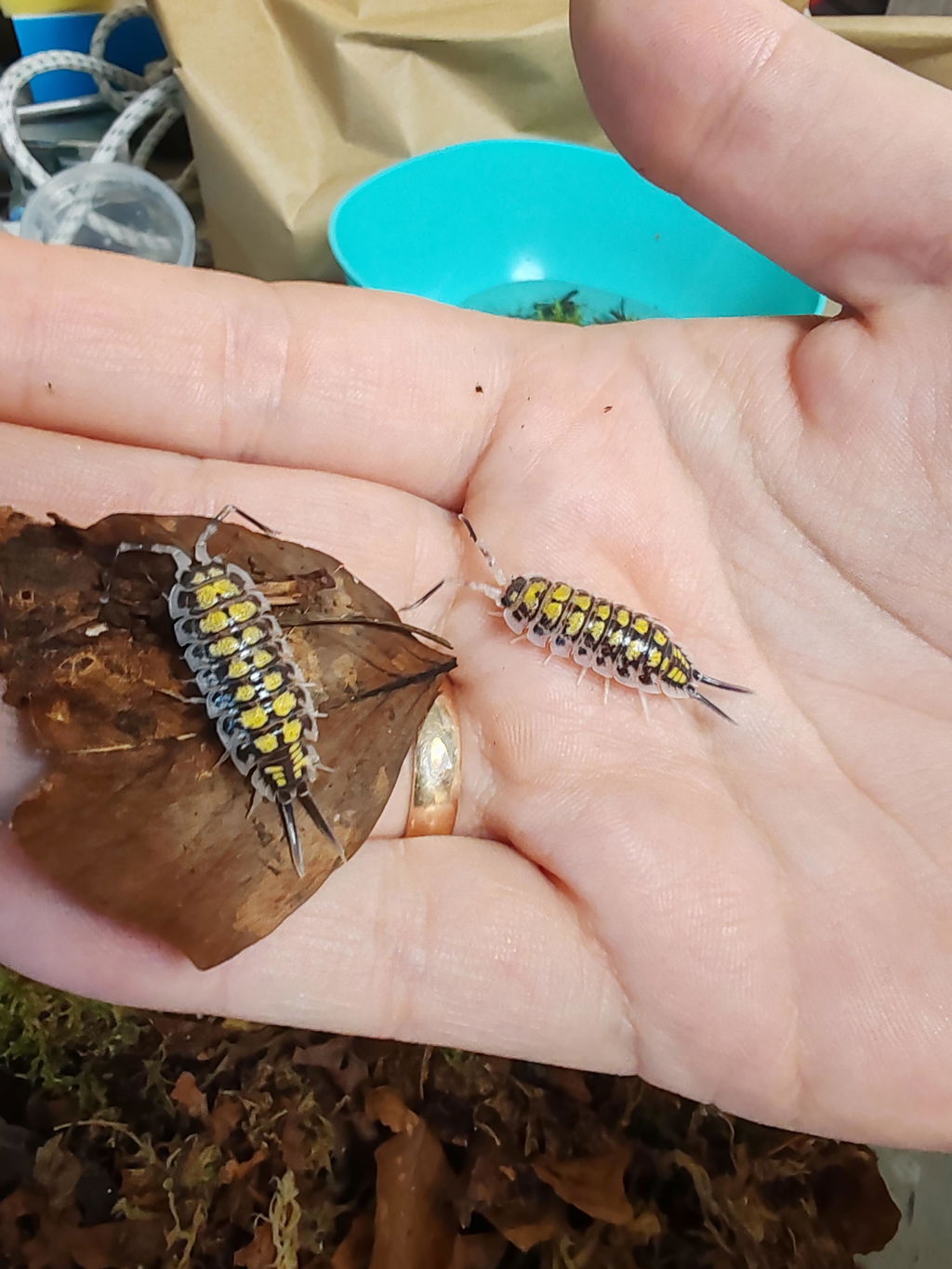
long slender isopod with white skirt long antenna large neon blocks on body with black surrounding this
porcellio ornatus high yellow
long slender isopod with white skirt long antenna large neon splatted body with black surrounding
porcellio high yellow male, you can tell its male due to the long uropods (the spines sticking out of the back end)
haasi high yellow
p haasi high yellow isopods
porcellio haasi high yellow isopods
haasi high yellow isopod
isopod for sale
Haasi high yellow
Isopods for sale
haasi isopods for sale
haasi high yellow isopods
Haasi high yellow isopods for sale

Porcellio Haasi High Yellow Isopods

Care Info:

Origin icon ORIGIN
SPAIN
Temperature icon TEMP
21-27 ℃
Humidity icon HUMIDITY
50-60 %
Length icon LENGTH
30 mm
Difficulty icon DIFFICULTY
MEDIUM
Rarity icon RARITY
UNCOMMON
Regular price£30.00
/
Tax included. Shipping calculated at checkout.

Quantity
  • Free shipping over £65
  • Low stock - 1 item left
  • Backordered, shipping soon

Porcellio haasi "High Yellow" is one of the most visually striking Spanish giant Porcellio species in the entire UK hobby — a selectively-isolated line bred for intense yellow colouration that genuinely lives up to its name. Where standard P. haasi show subtle yellow dotted patterning, the High Yellow variant displays vibrant bright yellow tones across most of the body, with characteristic darker shading on the sides and legs creating dramatic contrast. Combined with substantial size (males reach up to 20 mm body length, plus their distinctive long uropods adding another 10–12 mm), they're among the most impressive Porcellio species available — properly titan-sized animals with bold colouration.

What makes P. haasi High Yellow particularly worth seeking out is the combination: dramatic visual impact paired with Mediterranean-adapted genetics that suit drier UK home conditions. Originating from the mountainous regions of north-eastern Spain (most likely the Zaragoza area of Aragón), they're adapted to seasonal variation rather than constant tropical warmth. They're also genuinely big — the species' "Spanish Giants" reputation comes from real adult sizes that make them substantial display animals observable from across a room.

One important consideration worth flagging upfront: P. haasi males are notably territorial and will actively chase off rival males. This isn't subtle posturing — they can genuinely fight if cramped. Provide adequate space and multiple separated hiding zones and the territorial dynamics become interesting colony behaviour rather than husbandry problems.

Available in groups of 5, 10, or 20. Captive-bred stock from established UK colonies. Currently sold out across all variants — captive-bred UK stock returning when available. The single customer review describes them as "absolutely stunning" with "lovely bright colours and very long tails" — supporting the species' reputation for delivering exactly what their reputation promises.

Quick Care Summary

  • Scientific Name: Porcellio haasi 'High Yellow'
  • Subspecies: Porcellio haasi brevilovatus (some populations)
  • Common Names: Haasi High Yellow, P. haasi High Yellow, Spanish Giant High Yellow
  • Family: Porcellionidae
  • Origin: North-eastern Spain — Zaragoza area of Aragón, mountainous calcareous rock formations
  • Adult Size: Up to 20 mm body length (males); up to 32 mm including uropods
  • Lifespan: 2–3 years typical
  • Difficulty: Medium — manageable for keepers with basic Porcellio experience
  • Temperature: 18–28°C (21–27°C optimal)
  • Humidity: 45–60% with proper moisture gradient — drier than tropical species but NOT bone-dry
  • Ventilation: High — critical requirement, not optional
  • Conglobation: No — Porcellio cannot roll into a ball, they rely on speed and tonic immobility
  • Behaviour: Initially shy, becomes bolder as colonies grow; primarily nocturnal; territorial males
  • Breeding: Seasonal — prolific during spring and summer, slower in cooler months

What Makes Porcellio haasi High Yellow Special

Several factors have made P. haasi High Yellow one of the most enduringly popular Spanish giant Porcellio species:

The yellow colouration is genuinely intense. Where standard P. haasi show subtle yellow accents, the High Yellow line displays vivid bright yellow across most of the body. This isn't subtle accent shading — it's bold colouration that catches the light beautifully against natural substrate. The contrasting darker shading on sides and legs adds depth that prevents the colour from looking uniform or flat.

Substantial titan-sized scale. At 20 mm body length plus long uropods, P. haasi are among the largest commonly-kept Porcellio species — comparable in scale to Titan Isopods (Porcellio hoffmannseggii). The size combined with their bright colouration makes them genuine display animals.

The distinctive long uropods. Male P. haasi have notably elongated uropods (the "tails" at the rear of the body) — much longer than females. This sexual dimorphism is genuinely diagnostic for the species and makes sexing colonies straightforward. The customer review specifically mentions "very long tails" as a memorable feature — these aren't just functional structures, they're visually distinctive.

Selectively-bred line, not random morph. The "High Yellow" designation refers specifically to selectively-bred populations isolated for vibrant yellow expression. Standard P. haasi show variable colouration; High Yellow lines have been deliberately maintained over generations to preserve and intensify the yellow pattern. Keeping High Yellow connects you to genuine selective breeding work.

Seasonal breeders with prolific output. Unlike year-round breeders, P. haasi breed seasonally — typically with significant activity during spring and summer months. When breeding is active, output is prolific. This seasonal pattern mimics their natural Spanish climate cycle and means colony growth comes in bursts rather than constant trickle.

Mediterranean-adapted hardiness — with caveats. While P. haasi are often described as "dry-loving" Spanish species, recent keeper experience (and the species' natural habitat in calcareous rock formations) suggests they need access to moister microclimates than pure desert species. They thrive with a clear moisture gradient rather than uniformly arid conditions.

Calcareous rock origin. Their native habitat is calcium-rich limestone and mountain rock formations. This evolutionary background means calcium availability matters more than for typical isopods — they're genuinely adapted to high-calcium environments.

How Haasi High Yellow Compares to Other Spanish Giants

If you're choosing between large Spanish Porcellio species, here's how Haasi High Yellow fits in:

  • vs Titan Isopods (Porcellio hoffmannseggii): Titans are slightly larger (up to 40 mm) with cleaner grey/white colouration. Haasi High Yellow are bold yellow with darker accents — more visually vibrant but slightly smaller. Both are Spanish giants with similar territorial male dynamics and Mediterranean care. Choose Titans for sheer scale, Haasi for vivid colour.
  • vs Porcellio ornatus High Yellow: Both share the "High Yellow" name but they're entirely different species. Ornatus reach 20–25 mm with yellow markings on a grey base. Haasi reach 20 mm body length with the body itself being yellow with darker accents. Haasi have notably longer uropods. Both are Spanish, both need drier setups — but the visual styles are quite distinct.
  • vs Porcellio magnificus: Magnificus is another impressive Spanish Porcellio with bold colouration at around 25 mm. Haasi High Yellow are similar size but with the distinctive intense yellow colouration. Both are excellent step-up choices for keepers moving beyond beginner Porcellio.
  • vs Greek Shield (P. werneri): Greek Shields are distinctively flat disc-shaped with white skirted edges at around 20 mm. Haasi are more typical Porcellio shape but with bold yellow patterning and the diagnostic long uropods. Both share Mediterranean care requirements.

Browse the full Porcellio collection to compare all species.

Critical Setup Requirements

This is the most important section. P. haasi care differs significantly from typical tropical isopod husbandry, and gets some details right that many keepers get wrong.

The "dry but not bone-dry" balance. A common misconception in the hobby is that P. haasi need uniformly arid conditions. They don't. Their natural habitat is calcareous rock formations where crevice microclimates maintain higher moisture than ambient air — meaning they need access to moist areas, particularly for mancae and moulting individuals. Provide a proper moisture gradient: approximately one-quarter to one-third moist, three-quarters drier. Don't keep them uniformly dry — this is genuinely fatal over time.

High ventilation is essential. Spanish mountain origins mean they need genuinely airflow-rich enclosures. Drill plenty of holes on opposite sides of the enclosure for cross-ventilation. Mesh-covered top sections work well alongside side ventilation. Stagnant humid air is more dangerous than slightly low humidity.

Space matters more than for peaceful species. Male territoriality means cramped P. haasi get stressed and aggressive. Larger enclosures with multiple separated hiding zones reduce male-male conflicts dramatically. Minimum 15 litres for a starter colony, larger for established groups.

Higher calcium requirements than most isopods. Their calcareous rock origins demand abundant calcium availability. Multiple calcium sources distributed throughout — cuttlefish bone, crushed limestone, oyster shell, eggshells.

Setting Up the Enclosure

A 15–25 litre tub or glass terrarium suits a starter colony. Larger is genuinely better for this species — Haasi appreciate space, and territorial males need room to establish separate zones. The 3L Braplast tub is too small for adult Haasi but can work for juvenile setups during establishment.

Multiple ventilation points create cross-ventilation that single-mesh-lid setups can't match. Drill ventilation holes on opposite sides plus consider mesh-covered top sections. Cover all openings with fine mesh — Haasi are large but climbers will still exploit escape routes.

Browse our accessories collection for appropriate enclosures, ventilation, and other essentials.

Substrate

Build substrate appropriate for drier Mediterranean conditions with adequate depth (at least 5–8 cm) for moulting security:

  • Organic topsoil base (pesticide-free)
  • Sphagnum peat moss mixed in sparingly (less than for tropical species)
  • Sand mixed in for drainage and authentic Mediterranean texture
  • Crushed limestone or calcium powder mixed throughout — essential given calcareous rock origins
  • Generous decaying hardwood pieces — both food and structure (they specifically prefer rotting white wood)
  • Flake soil for added nutrition
  • Dry oak leaves on top

Add multiple cork bark pieces, flat bark sections, limestone chunks (mimicking their natural calcareous rock habitat), and decaying wood pieces distributed throughout. Space these hides so individuals can establish territories without constant confrontation — at least 3–4 separate hide zones for a starter colony of 5–10. Browse our magnolia leaves for additional long-lasting leaf cover.

The Moisture Gradient — The Detail Most Keepers Get Wrong

This is genuinely the most important husbandry point for P. haasi. Maintain humidity at 45–60% (some sources extend the upper range to 80% — what matters is the gradient, not the absolute number).

Set up a clear moisture gradient:

  • Approximately 1/5 to 1/4 of the enclosure moist: Sphagnum moss patches and damp leaf litter on one side. Mist this area regularly. This is where mancae and moulting individuals will retreat to access moisture.
  • The remaining 3/4 to 4/5 drier: Genuinely drier substrate with leaf litter cover. Allow this side to dry between mistings.

The gradient lets the colony self-regulate. Critically, don't keep them uniformly dry — despite their reputation as "dry-loving" Spanish species, keeper experience consistently shows that lack of access to moisture is fatal over time, particularly for mancae. They need moister microclimate access just like their natural calcareous rock crevices provide. The "dry" reputation refers to their dislike of constantly-wet substrate and stagnant humid air, not absence of moisture entirely.

Temperature

18–28°C is a wide comfort range — Haasi handle temperature variation better than many isopod species. UK room temperature works year-round in most homes without supplementary heating. Their Mediterranean mountain origins mean they're adapted to seasonal variation rather than constant warmth.

Avoid sustained extremes. Brief temperature fluctuations are tolerated, but prolonged cold or heat causes stress and can be fatal. Stable conditions matter more than hitting any specific point.

Diet

Haasi High Yellow are protein-loving Porcellio with hearty appetites:

  • Primary diet (preferred — always available): Dried hardwood leaf litter (oak preferred), decaying wood, soft rotting white wood (their specific preference)
  • Vegetables (1–2x weekly): Carrot, courgette, sweet potato, butternut squash. Replace within 24–48 hours.
  • Fruit (occasionally): Apple, pear — small amounts
  • Protein (essential — 2–3x weekly): Fish flakes, freeze-dried minnows, dried shrimp, dried daphnia, freeze-dried peas, silkworm pupae, invertebrate/reptile moults. Browse our accessories collection for the full range of protein supplements.
  • Calcium (essential — non-negotiable for calcareous-rock-origin species): Cuttlefish bone, crushed limestone, crushed oyster shell, limestone rocks, eggshells, calcium powder. Multiple sources distributed throughout the enclosure.
  • Commercial supplements: Repashy Morning Wood and Bug Burger work excellently 2–3x weekly.

Maintain a constant supply of decaying hardwood (particularly rotting white wood) in the enclosure — this is their preferred food source. Protein matters more for Haasi than typical isopods — don't skimp on supplementation, particularly during breeding seasons.

Breeding

Haasi High Yellow breed prolifically during spring and summer months — they're seasonal breeders adapted to Mediterranean climate cycles. Don't expect year-round constant breeding like tropical Porcellio species.

Sexing: Males and females are easily distinguished by uropod length and overall size — males have notably longer uropods and broader build. The customer review mentions "very long tails" specifically because this dimorphism is so visually obvious. Maintain a balanced male-to-female ratio for successful breeding.

For breeding success:

  • Adequate space to reduce male-male territorial stress (genuinely important)
  • Seasonal temperature variation — slight cooling in winter, warming in spring/summer, mimics their natural cycle
  • Proper moisture gradient providing both moist and dry choice
  • Constant calcium and protein availability
  • Excellent ventilation
  • Multiple hides spaced throughout enclosure
  • Minimal disturbance during gravid female phases

Sub-adults often begin breeding before reaching full size when well-fed. Brood sizes can be substantial during peak breeding seasons. Colony growth tends to be bursty — significant expansion during spring/summer, quieter during cooler months.

Who Should Buy Porcellio haasi High Yellow Isopods?

Ideal for:

  • Keepers with basic Porcellio experience ready for something visually impressive
  • Anyone wanting bold-yellow display Porcellio at substantial size
  • Collectors interested in Spanish giant Porcellio species
  • Bioactive setup owners with arid or semi-arid conditions (Mediterranean reptile vivariums)
  • Keepers who appreciate sexual dimorphism (the long uropods are genuinely distinctive)
  • Patient keepers willing to accept seasonal rather than continuous breeding
  • Those who can provide adequate space and accept male territorial dynamics
  • Long-term keepers — the multi-year lifespan rewards patient husbandry

Not ideal for:

  • Complete beginners — start with hardier, peaceful species first like Dairy Cow or Porcellio scaber
  • High-humidity tropical setups (their drier needs conflict)
  • Cramped enclosures (territorial males need space)
  • Anyone expecting bone-dry conditions to work (they need moisture gradient access)
  • Reptile/amphibian feeder use — too valuable and slow-breeding to justify

Realistic Expectations

Haasi take time to settle into new enclosures. Allow 2–3 weeks for them to establish territories and begin showing comfortable behaviour. Don't panic during this initial period — focus on stable conditions and let them adapt.

Male territorial behaviour is normal and expected. If you see males avoiding each other, occupying different hides, or occasionally posturing, this is natural species behaviour, not husbandry failure. Provide adequate space and multiple hides and the dynamics work themselves out without serious aggression.

Don't expect them to behave like bold Porcellio scaber. Haasi are described as shy initially — particularly in newer or smaller colonies. As populations grow, they become noticeably bolder and more visible. Established colonies of 30+ become genuinely active during early morning and night.

Colony growth is seasonal. If you've kept year-round breeders, the seasonal pace of Haasi may feel frustrating during cooler months. This is normal species behaviour and not a sign of husbandry problems — patience during quiet periods is rewarded with substantial breeding bursts during peak seasons.

The "very long tails" comment from customer feedback is real — male uropods are properly distinctive. If you're sexing your colony, this is the easiest visual diagnostic available.

Building Your Setup

A complete Haasi High Yellow setup needs drier substrate components, abundant calcium-rich materials, generous rotting white wood, leaf litter, and protein supplements. Browse our accessories collection for everything you need — enclosures with proper ventilation, leaf litter, calcium (cuttlebone, limestone, oyster shell), and protein supplements (daphnia, fish flakes, freeze-dried peas).

For more on Porcellio species and morphs, read our blog post on different types of Porcellio isopods. Browse the full Porcellio collection for related Spanish giants and other Porcellio species.

Use collapsible tabs for more detailed information that will help customers make a purchasing decision.

Ex: Shipping and return policies, size guides, and other common questions.

You may also like


Recently viewed