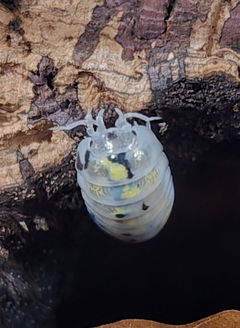
Shadow Cockroach (Pycnoscelus nigra)
Care Info:
 ORIGIN
 TEMP
TEMP
 HUMIDITY
 LENGTH
 DIFFICULTY
 RARITY
- Free shipping over £65
- Low stock - 1 item left
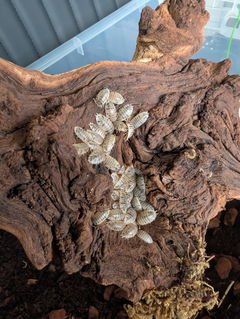
Every Shadow Cockroach in our tubs is female. Pycnoscelus nigra is parthenogenetic, so hobby stock is all-female and clonal, unfertilised eggs developing into daughters that are copies of their mother with no male involved at any stage. One hedge is fair, which is that bisexual strains somewhere in the wild range cannot be ruled out, but everything moving through the trade is female. The rest of it is practical. A single animal is a colony waiting to happen. There is no sex ratio to get right and no pairing to arrange, and that is why the numbers climb the way they do.
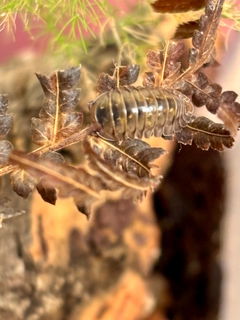
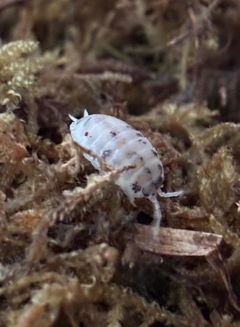
Adults are jet-black and glossy, a hard wet-looking shine over a rounded body, with red-orange legs carrying the contrast. Females run around 24 to 30mm. Nymphs come out browner and darken through successive moults, so a young group looks flatter in colour than it will be in a few months. Brunner von Wattenwyl described the species in 1865. It belongs to the family Blaberidae and comes from South East Asia. Like other blaberids it is ovoviviparous, the female carrying her egg case inside her body and giving birth to live young, so no egg case ever turns up lying on the substrate.
Not the Surinam roach
This one gets confused with P. surinamensis more often than anything else in the genus, and the two are close in shape, size and habits. Three things separate them. Ours is darker overall, jet-black where the Surinam is brown. Its legs are red-orange, which the Surinam's are not. The last ventral abdominal segment is also more distinct, if you want a third check under a lens. Ours are captive-bred, and being tropical this species has no route to establishing outdoors in a British climate.
Depth, leaves and a lid that shuts
It is a burrower, down in the substrate for most of the day rather than out on show, so expect to see less of it than of a surface species. Anyone who wants animals in view all evening is better served by the Cuban cockroach, which flies and sits up on the glass. This one cannot fly at all. It can climb smooth surfaces, adults and large nymphs both, and although they are not often caught doing it the ability is real, so the lid has to seal or the rim needs a barrier. Fine mesh over the vents holds the smallest nymphs in, and moderate airflow is all the species asks for.
Give them a soil-based substrate laid deep enough that an adult can bury itself and still have room underneath, with dead oak leaves and rotting wood worked through it and layered over the top. That last part is not a refinement. Colonies have failed without leaf litter and rotten wood in the box, so treat both as a requirement, and replace the litter before it is eaten down to nothing. Magnolia leaves hold their shape well once damp and make a durable top layer. Bark slabs laid flat, or a stack of egg-crate, give cover to whatever is up.
Run them warm, 24 to 29°C, with the upper end giving the fastest growth. Humidity is not a fight with this species. Keep part of the substrate damp to the touch, leave the rest of it drier, and the job is done. Litter and rotting wood do most of the feeding, with vegetables, a little fruit, dried protein twice a week, and cuttlebone or crushed limestone left in permanently. Nothing about the species is fragile, and it breeds fast enough that a starter group fills a tub inside a season, which makes it a sound first cockroach. The Indian spotted cockroach is the other beginner I point people at, while the Centurion porcelain and the Simandoa cave roach sit further along our cockroach range.
Live arrival is guaranteed on every order, and the rest of the packing exists to make that promise easy to keep. The colony travels in a ventilated deli tub bedded on damp sphagnum, and that tub is packed inside a double-walled outer. Royal Mail carry it tracked, next-day, due before 1pm, and we hand orders over Monday to Thursday and on no other day. There are always a few more animals in the tub than the count you asked for.
Use collapsible tabs for more detailed information that will help customers make a purchasing decision.
Ex: Shipping and return policies, size guides, and other common questions.