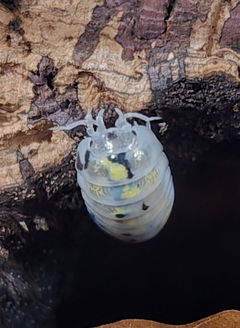
Armadillidium klugii 'Yellow Fellow' Isopods for Sale
Care Info:
 ORIGIN
 TEMP
TEMP
 HUMIDITY
 LENGTH
 DIFFICULTY
 RARITY
- Free shipping over £65
Two awkward things about this listing before you read further, because you will not find them anywhere else and you ought to have them.
The first: as far as I can establish, this page is the only place on the indexed web using the name 'Yellow Fellow' for an Armadillidium klugii. No European breeder lists it, no American vendor lists it, no hobby database records it. That does not make the line fake, but it does mean we appear to be its primary source rather than a shop passing on an established morph, and you should weigh it accordingly.
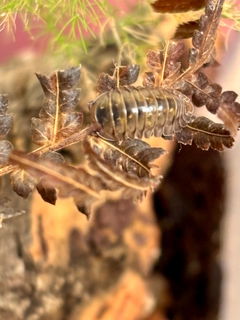
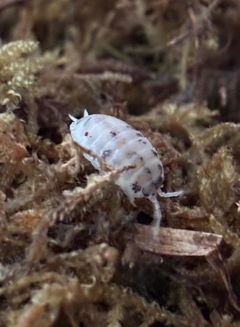
The second is about the yellow. This species wears three rows of pale spots along the back, and the central row deepens to yellow with age. So a klugii line selected on yellow spotting is partly selecting for age. A tub of mature animals will look yellower than their own offspring did at the same stage. Our stock does run yellow and we keep it apart from the other lines, but I am not going to attach a genetic claim to it that I cannot support.
What that means when your animals arrive
Practically, expect the colour to develop rather than to be there on day one. Juveniles arriving paler than the photographs is not a mis-shipment, it is the normal course of the species, and the same thing happens on every klugii line whatever it is called. Judge what you have bought at adult size, not at week one.
Underneath the naming question this is a good-looking animal by any measure: black ground, banded spotting, warm edging down the sides, adults at 14 to 18mm. Brandt described the species in 1833 and it lives along the eastern Adriatic under stones and in rock crevices.
Keeping them
Everything here matches the rest of the species, and our guide to klugii sets it out in full. The short version is that it wants a drier and better ventilated enclosure than the standard pill woodlouse advice implies, because it comes from a hot limestone coastline rather than a woodland floor.
Chalk deserves a specific mention on this page. If you are selecting animals on how their markings develop, you want every one of them to reach adult size in good condition, and a shortage of calcium during growth costs you exactly that. Cuttlebone or crushed limestone belongs in there permanently.
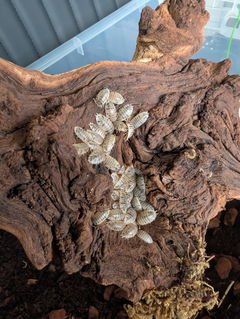
Warmth is the other lever. They persist at British room temperature and increase slowly; bring them into the low twenties and they get on with it. If you are hoping to select from a large group, that difference decides how long you wait.
Who it suits
Not a first isopod, though not a hard one. It suits somebody who has kept a hardier colony, understands why ventilation matters, and is interested enough in this genus to want a line that nobody else is offering, with the caveats above understood.
For the better-documented alternatives, Dubrovnik is the locality line with real literature behind it and the standard Clown is the broader label. The rest of the genus sits in our Armadillidium range.
Bred here and kept separate. Every group ships on wetted moss inside a vented pot, packed within a doubled carton, sent Monday through Thursday only so nothing waits out a Sunday. Next-day tracked before 1pm, spares tucked in above your count, live arrival guaranteed.