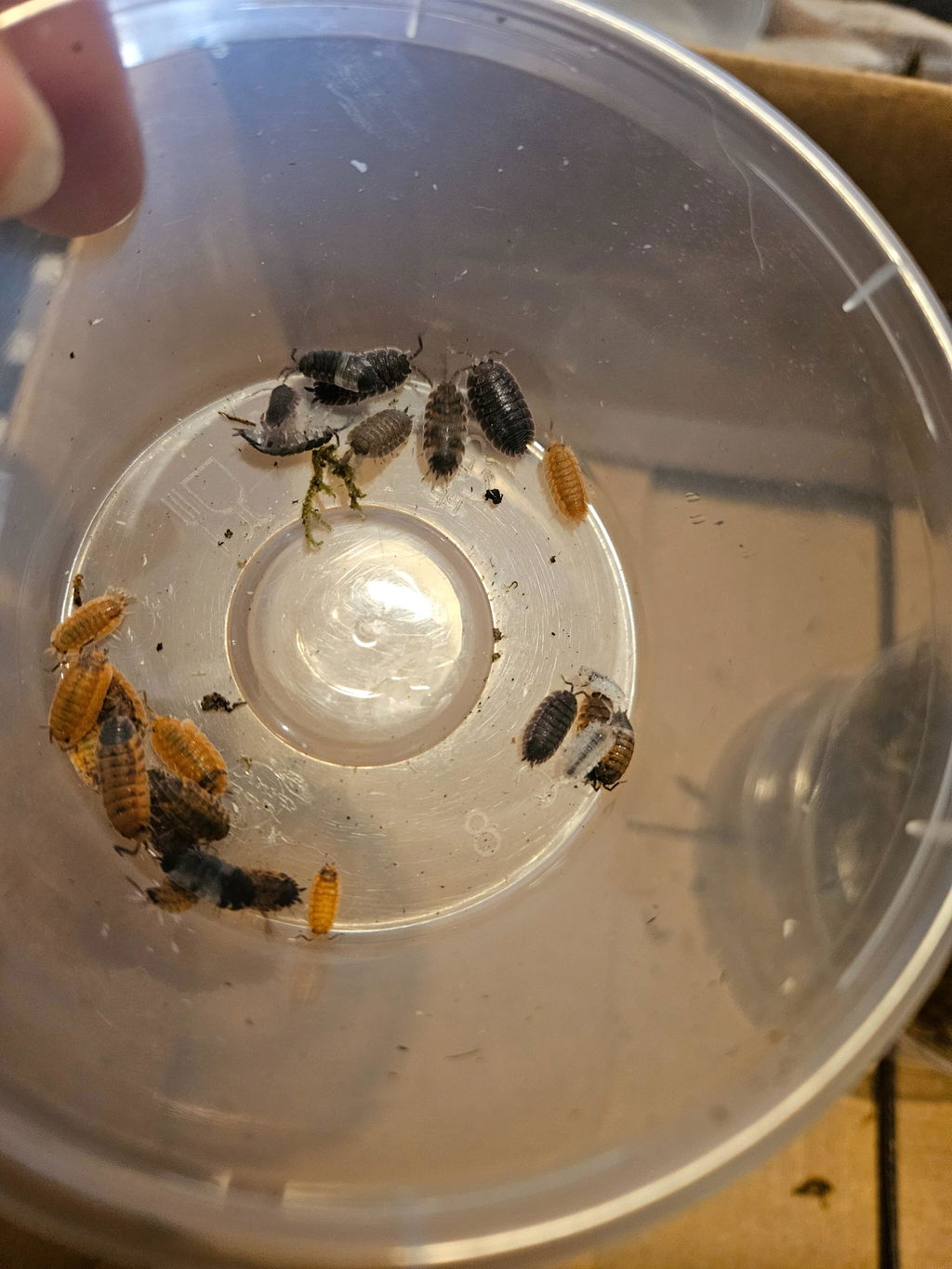
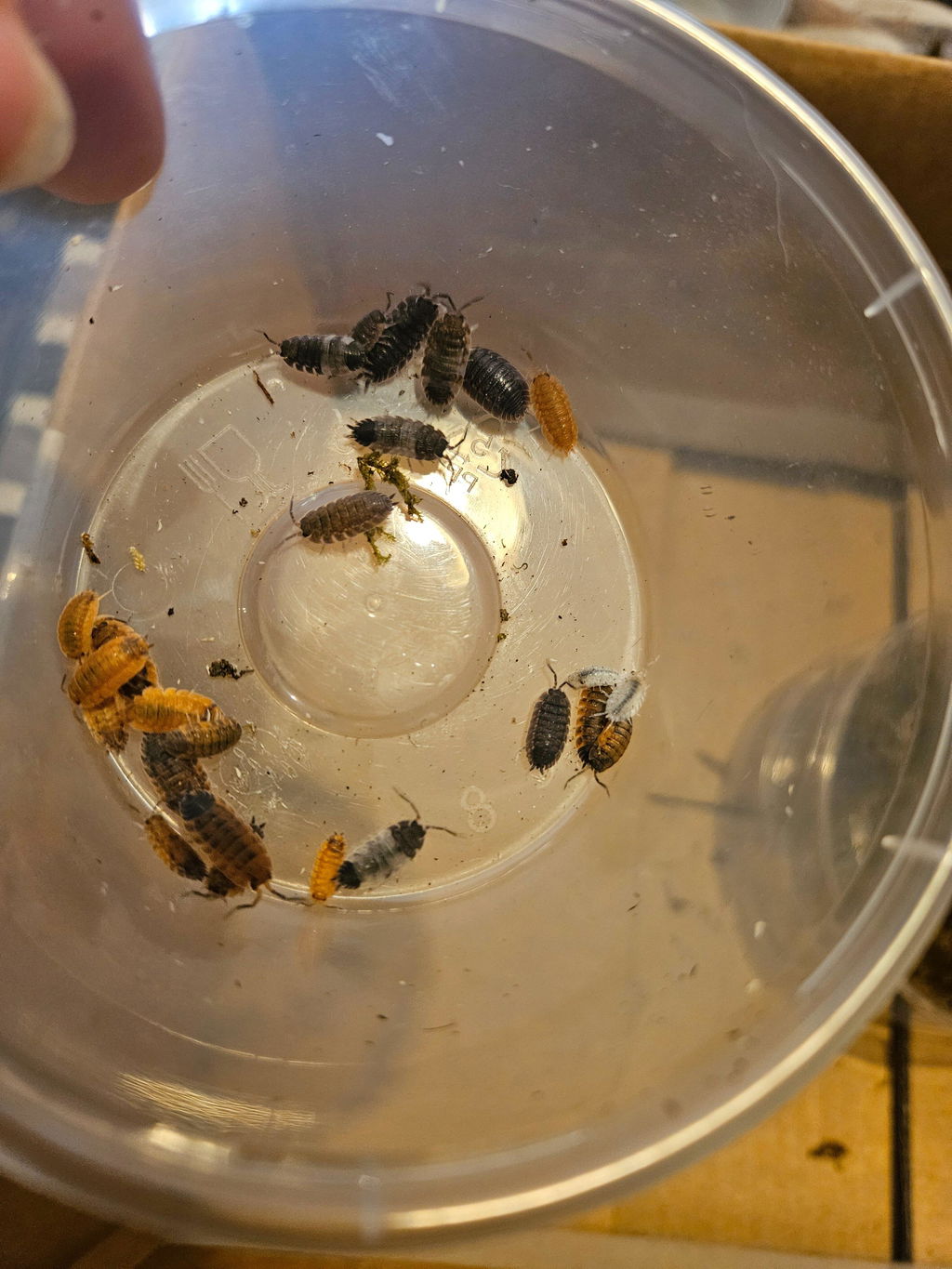
Porcellio Scaber Mix Isopods
Care Info:
- Free shipping over £65
- Low stock - 2 items left
- Backordered, shipping soon
Porcellio scaber Mix Isopods are properly the most accessible entry into the colour morph world — a mixed batch of established Porcellio scaber colour morphs in a single starter group, suitable for beginners learning the hobby, established keepers building bioactive cleanup crews, and intermediate keepers interested in breeding genetics and developing their own colour lines. At 17–18 mm adult size with UK-friendly room temperature tolerance, this is genuinely one of the right beginner Porcellio species to start with.
This is part of our wider Porcellio collection. Where our premium Porcellio products like Porcellio nicklesi Orange Blaze, Porcellio werneri Silverback, and Porcellio expansus Prades are Mediterranean dry-loving specialist species, P. scaber is the cosmopolitan European native that thrives at standard UK room conditions without specialist setup. For first-time Porcellio keepers, this is the right starting point before stepping up to more demanding species.
One honest framing point up front. The "Mix" designation means you receive a properly variable batch — combinations of orange, dalmatian, orange dalmatian, lava, calico, ghost, and other established P. scaber morphs, plus occasionally specials. Specific morph composition varies between batches. If you want guaranteed exact morphs, the single-morph products in our catalogue let you choose specifically; the Mix is for keepers who appreciate variety and want to experiment with genetics. To set things up properly from the start, browse our accessories collection for substrate components, leaf litter, and other items this species depends on.
Quick Care Summary
- Scientific Name: Porcellio scaber Latreille, 1804 — multiple captive-bred colour morphs supplied as a mix
- Common Names: Common Rough Woodlouse, Common Woodlouse, Garden Woodlouse, Rough Woodlouse
- Family: Porcellionidae (order Isopoda, suborder Oniscidea) — same family as our other Porcellio products
- Genus context: Porcellio is a properly large genus of European and Mediterranean isopods. P. scaber is the most widespread and best-known member of the genus — native to Europe but naturalised across most of the world through trade
- Origin: Native to Europe; now globally distributed through historical trade. UK gardens contain wild P. scaber populations widely. The captive-bred colour morphs sold here trace back to European wild-caught founder stock
- Adult Size: 17–18 mm — properly medium for hobby isopods
- Lifespan: 2–3 years typical in good captive conditions
- Difficulty: Easy — properly the most beginner-friendly Porcellio species available. Forgiving of moderate husbandry variation
- Temperature: 15–27 °C — properly suits UK ambient room temperature throughout the year; supplementary heating rarely needed
- Humidity: 50–60% — moderate; properly tolerant of fluctuation
- Ventilation: Moderate — enough to prevent stagnation
- Body shape: Standard Porcellio morphology — oval, segmented, properly textured ("scaber" = Latin for "rough" referencing the textured exoskeleton)
- Appearance (Mix): Variable — colony contains multiple established morphs. Typical composition includes orange, dalmatian (spotted), orange dalmatian, lava, calico, ghost (pale), and occasional specials. Exact composition varies between batches
- Behaviour: Surface-active and visible; not particularly shy. Standard nocturnal-preference with daytime activity if conditions are right
- Diet: Detritivore — decaying plant material, rotten wood, vegetables, occasional protein supplements
- Rarity: Common — properly the most readily-available Porcellio species in the UK hobby
What Makes Porcellio scaber Mix Special
The variety in a single purchase. Where buying individual morphs separately would require several orders of multiple products, the Mix delivers properly diverse morph representation in one starter group. Typical batches include orange, dalmatian, orange dalmatian, lava, calico, ghost, and occasional specials. The genetic mix means you can observe how different morphs look and behave alongside each other, learn to identify them, and develop preferences for which colour lines interest you most.
The genetic experimentation potential. P. scaber morph genetics are properly well-documented — orange is single-gene recessive to wild-type grey, dalmatian is similarly recessive on a different gene, and combinations like Orange Dalmatian arise from crossing the two recessive lines. For keepers interested in basic Mendelian inheritance, breeding genetics, or selective line development, the Mix gives you working stock to experiment with. The classic Orange Dalmatian morph was originally created by Ryan Orr crossing Spanish Orange with Dalmatian — keepers can replicate this work or develop new combinations from the established morphs in our Mix.
The beginner-friendly husbandry. Unlike our premium Mediterranean Porcellio species (P. werneri, P. nicklesi) which require properly specific dry-habitat husbandry, P. scaber is genuinely forgiving. Standard room temperature, moderate humidity, moderate ventilation, basic substrate — the species tolerates a wide range of conditions without difficulty. For first-time isopod keepers, this is the right entry point before moving to more demanding species.
The UK native heritage. P. scaber is one of the most common UK garden invertebrates — properly the same species you'd find under any rotting log in your garden. The captive morphs are selectively-bred from wild populations and remain biologically the same species. For keepers interested in working with familiar British natives in hobby contexts, this is one of the right choices.
The cleanup crew utility. P. scaber is properly the foundational bioactive cleanup crew species — efficient detritivores that process leaf litter, decaying wood, and organic waste in vivarium setups. The Mix gives you a colourful colony that doubles as a functional ecosystem component for tropical vivariums, bioactive enclosures, or paludariums.
The Spanish Orange historical significance. Spanish Orange (the orange morph of P. scaber) is reportedly the first established hobby isopod morph — predating the modern premium Cubaris craze by decades. In the dart frog hobby specifically, Spanish Orange is sometimes still called the "Giant Orange" because it's properly larger than the tiny tropical species dart frog keepers had previously used. The Mix often contains Spanish Orange or its derivatives, putting you in touch with the original hobby isopod morph history.
The properly textured exoskeleton. The species name "scaber" is Latin for "rough" — referencing the textured, tubercled surface of the body that distinguishes P. scaber from smoother species like P. laevis. Under good lighting, the texture catches the light in ways smooth-bodied species can't, adding visual depth to whatever colour morph the animal expresses. The Orange Dalmatian morph particularly benefits from this — the orange spots stand out against textured tubercles rather than smooth shell.
About the Name and the P. scaber Morph Family
The morph naming situation has properly substantial hobby history worth understanding.
- Porcellio scaber: Described by Latreille in 1804. The species epithet "scaber" means "rough" in Latin, referring to the textured dorsal surface. Wild-type colouration is grey with subtle patterning — what UK keepers see in their gardens
-
Mix product: Hobby trade designation for a multi-morph starter batch. Composition varies between supply runs, typically including:
- Orange: The original hobby morph — solid orange body, possibly the first established P. scaber colour line
- Dalmatian: Pale body with dark spotted pattern, named for the Dalmatian dog appearance
- Orange Dalmatian: Created by Ryan Orr crossing Spanish Orange × Dalmatian; orange spots on pale base
- Lava: Solid orange-red colouration without spotting
- Calico: Multi-tone patterning, sometimes with red skirt
- Ghost: Pale/white body with reduced pigmentation
- Specials: Occasional additional morphs or unusual individuals
- Genetics overview: Multiple P. scaber morphs follow simple Mendelian inheritance — orange and dalmatian are both single-gene recessive to wild-type grey, on different genes. This means crossing two recessive lines (like orange × dalmatian) produces F1 generation that looks like wild-type grey but carries both recessive genes; F2 generation then produces 1/16 individuals showing both traits (the original creation method for Orange Dalmatian)
- Family Porcellionidae: Distinct from family Armadillidae (Cubaris, Ardentiella) and Oniscidae (Oniscus). Porcellionidae species don't conglobate — they rely on flat body shape and quick cover-seeking for defence rather than rolling into balls
- Distinguishing from P. scaber Dalmatian: The Dalmatian product gives you specifically the pattern morph; the Mix gives you Dalmatian plus several other morphs in one colony
- Distinguishing from premium Porcellio: P. scaber is genuinely more forgiving than our premium products like P. nicklesi or P. werneri — different humidity profile, easier care overall, beginner-suitable rather than experienced-keeper territory
Setting Up the Enclosure
A modest enclosure works for a starter group — a 5–10 litre plastic tub or small glass enclosure suits 10–20 animals comfortably. Both plastic and glass enclosures work; the moderate humidity requirements (50–60%) are genuinely achievable in standard setups without specialised humidity engineering.
Provide proper structure:
- Cork bark slabs in various sizes — both flat hide pieces and vertical surfaces
- Pieces of decaying hardwood — both food and habitat
- Generous layer of hardwood leaf litter on the surface — properly essential
- Optional: sphagnum moss patches for moisture variation
Browse our accessories range for cork bark, leaf litter, and natural cover options.
Escape-proofing is straightforward — P. scaber aren't notable climbers on smooth surfaces. A properly fitting lid with normal ventilation provisions is sufficient.
Important husbandry note: Substrate depth doesn't need to be extreme — 3–5 cm is sufficient. P. scaber aren't deep burrowers; they spend most time under surface cover and in the upper substrate layers.
Substrate
Standard isopod substrate works properly well — no specialist mix required:
- Coconut fibre (coir) or organic topsoil as the moisture-retaining foundation
- Organic compost (pesticide-free) mixed throughout
- Crumbled decaying hardwood mixed in
- Generous surface layer of hardwood leaf litter — properly essential. Oak and beech work properly well. Browse our accessories collection for ready-prepared leaf litter
- Springtails inoculated to consume excess moisture and prevent mould
- Calcium sources — cuttlebone, crushed eggshell, limestone. Always available. Our calcium options cover the full range
Substrate depth: 3–5 cm minimum. Maintain a moisture gradient with one end slightly damper than the other — animals choose their preferred moisture level naturally.
Humidity and Temperature
Maintain humidity at 50–60% — properly moderate, achievable in standard UK rooms without specialist humidity engineering. Light misting once or twice weekly maintains moisture levels; the substrate provides longer-term humidity buffer.
Temperature should be 15–27 °C — properly matching UK ambient room temperature throughout the year. UK winter living rooms (typically 18–22 °C) are genuinely within the species's preferred range. No supplementary heating is typically needed.
If your home runs cooler than 15 °C consistently, a low-wattage heat mat on a thermostat, mounted on the side of the enclosure, provides supplementary warmth. Through UK summers, the species tolerates warm conditions well — brief excursions above 27 °C are properly fine.
Diet
Porcellio scaber accepts a properly wide range of foods — one of the most dietarily flexible isopod species:
- Hardwood leaf litter — the dietary foundation; should always be available. Oak, beech, magnolia all work. Browse our accessories collection for ready-prepared leaf litter
- Decaying hardwood — both food and habitat
- Fresh vegetables — courgette, cucumber, carrot, sweet potato, squash. Properly well-received
- Fresh fruit occasionally — banana, apple, peach. Replace within 24–48 hours
- Protein supplements regularly — fish flakes, dried shrimp, freeze-dried bloodworm. Porcellio are properly protein-hungry; offer 1–2 times weekly. Browse the protein options in our accessories collection
- Commercial isopod foods — Repashy and similar work well
- Calcium sources — cuttlebone, crushed eggshell, limestone. Always available. Our calcium options cover the full range
Remove uneaten fresh food within 24–48 hours to prevent mould.
Breeding and Genetics
P. scaber breeds prolifically in captivity given proper conditions — properly one of the more reliable breeding hobby isopods. Generation time is around 6–9 months, and brood sizes are moderate to large. Established colonies grow steadily.
The Mix product genuinely opens up properly interesting breeding possibilities:
- Pure-line maintenance: Separating individual morphs into their own enclosures preserves the colour lines for selective breeding
- Hybrid creation: Crossing different morphs can produce novel combinations (like the original Orange Dalmatian from Orange × Dalmatian)
- Genetic experimentation: Working with documented recessive traits to track inheritance patterns through generations
- New morph development: Selectively breeding from individuals showing particularly intense or unusual colouration can establish new lines over multiple generations
For keepers interested in this aspect, our article on isopod genetics, colours and morphs covers the underlying inheritance patterns in more detail.
For basic breeding success:
- Stable temperature in the 18–24 °C range works well
- Consistent moderate humidity
- Continuous leaf litter and rotten wood supply
- Calcium consistently available
- Adequate space — overcrowding suppresses breeding
Who Should Buy Porcellio scaber Mix?
Ideal for:
- First-time isopod keepers wanting the easiest possible starter species
- Keepers interested in colour variety without committing to specific morphs upfront
- Anyone interested in genetics experimentation and selective breeding
- Bioactive vivarium builders needing reliable cleanup crew species
- Dart frog keepers using P. scaber as feeder stock (adult size suits medium-large frogs)
- Educators interested in demonstrating Mendelian inheritance with hobby invertebrates
- Display enthusiasts wanting a colourful colony without premium pricing pressure
- Keepers in UK homes that maintain standard room temperature without specialist equipment
Not ideal for:
- Keepers wanting guaranteed specific morph composition — buy the individual morph products instead
- Bioactive setups where mixing of morphs is problematic for breeding line preservation
- Anyone wanting truly exotic-looking species — P. scaber is properly the common woodlouse
- High-humidity tropical setups (80%+) — the species tolerates lower humidity but doesn't need or prefer high moisture
Realistic Expectations
The Mix composition varies. Different batches contain different morph proportions — some batches may be heavier on orange variants, others on dalmatian patterns, others on ghost or lava forms. We don't guarantee specific morph counts per starter group. If you need exact morph composition, buy individual morph products. The Mix is for keepers who appreciate variety and discovery.
This isn't dramatic exotic visual character. P. scaber morphs are properly attractive but they're not at the visual extremes of premium tropical isopods. If you're expecting Cubaris-tier showmanship, the Mix delivers more modest aesthetic appeal — variety and pattern interest rather than dramatic individual specimens. The appeal lies in the colony as a whole rather than individual photogenic animals.
Maintaining pure lines requires deliberate effort. If you want to preserve specific morphs from the Mix, you'll need to separate them into individual enclosures and avoid crossbreeding. Left together, generations will produce mixed offspring that may or may not express the original parent morph colouration reliably. This is properly normal for selectively-bred colour lines, but worth understanding before assuming a Mix colony will stay visually consistent over time.
Some morphs intensify with age. Many P. scaber morphs (particularly Dalmatian and Orange Dalmatian) show stronger pattern expression in mature adults than in juveniles. Newly-released mancae may appear largely uniform or show only subtle patterning that develops through successive moults. Don't be disappointed by initially understated juveniles; the adult appearance develops with maturation.
The species is genuinely common. Wild P. scaber populations live throughout UK gardens, woodlands, and urban areas. The captive morphs are selectively-bred from this background rather than being properly rare or exotic. If wild-caught woodlice fascinate you, the captive morphs offer the same species in more colourful expressions.
Working with the genetics requires patience. If you want to develop new morphs or stable colour lines, multi-generation breeding work is required. A single generation won't produce dramatic new colour combinations from the Mix; properly established new morphs typically take 3–5 generations of selective breeding from carefully chosen parent animals. The Mix provides the working material; the breeding work itself takes time.
UK escape isn't an environmental issue. P. scaber is already native to UK environments — escapees are returning to their natural habitat. The captive colour morphs would likely interbreed with wild populations if they survived outdoors, but ongoing selection for wild-type colouration would dilute morph traits over generations. No environmental concerns either way.
Use collapsible tabs for more detailed information that will help customers make a purchasing decision.
Ex: Shipping and return policies, size guides, and other common questions.