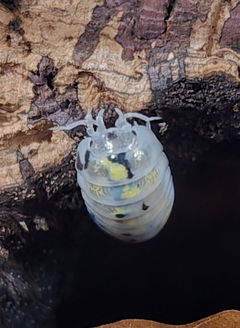
Chrome Cockroach (Gyna Caffrorum)
Care Info:
- Free shipping over £65
- Low stock - 2 items left
- Backordered, shipping soon
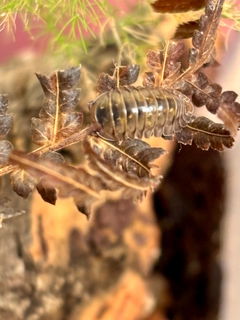
The Chrome Cockroach is one of the more visually transformative species available in the UK hobby — a southern African porcelain roach that goes through a dramatic colour progression as it develops, ending in a metallic blue-grey to silvery-white adult that justifies the "Chrome" common name. The vivid orange-red legs and abdomen persist throughout life and provide constant high contrast against whichever wing colouration the animal is currently showing. Combined with relatively forgiving husbandry and visible nymphs (genuinely unusual for the genus), this is one of the right entry points into the broader Gyna genus.
This is part of our wider cockroach collection and shares genus-level heritage with our Centurion Porcelain Cockroach (G. centurio) — both are African porcelain roaches in subfamily Gyninae, both are ovoviviparous live-bearers, and both have the same general husbandry profile. The meaningful differences: G. caffrorum is slightly more forgiving on humidity, has visible nymphs (rather than purely burrowing ones), and shows a more dramatic colour progression through development. For collectors building a focused Gyna display, the two species work well together — visually distinct enough to differentiate but biologically similar enough that one set of husbandry skills covers both.
One honest framing point up front. Like all hobby Gyna, adults can climb smooth surfaces AND fly. Multiple hobby sources note that G. caffrorum is somewhat less flighty than its relatives — they prefer burrowing to flight, taking off mainly when stressed or at very warm temperatures — but the capability is genuinely there. Escape-proofing is non-negotiable rather than a minor precaution. To set things up properly from the start, browse our accessories collection for substrate components, leaf litter, and other items this species depends on.
Quick Care Summary
- Scientific Name: Gyna caffrorum (Stål, 1856); originally described as Panchlora caffrorum; the synonym Gyna stridulans Karny 1908 was based on now-discredited observations that the species stridulates (it doesn't make sound)
- Common Names: Chrome Cockroach, Chrome Roach, Chrome Porcelain Roach, Ghost Porcelain Cockroach, Pink Cockroach
- Family: Blaberidae (subfamily Gyninae); genus Gyna established by Brunner von Wattenwyl, 1865
- Genus context: Gyna contains 31 accepted species, all native to Africa; collectively known as "porcelain roaches" for their smooth elegant wing appearance
- Origin: Southern Africa — documented from South Africa (Cape, Natal, Orange Free State, and Transvaal regions), Mozambique, Botswana, Namibia, Angola, and Eswatini (Swaziland); commonly cited also from Zimbabwe in hobby sources
- Adult Size: 30–35 mm overall; males approximately 29–30 mm, females approximately 34–35 mm — properly noticeable sexual dimorphism
- Lifespan: Adults live 4–5 months; total lifecycle approximately 10–12 months; females slightly longer than males
- Difficulty: Easy — one of the more forgiving species in the genus
- Temperature: 21–29 °C; 25–28 °C optimal for breeding; tolerates UK room temperature better than many Gyna species; survives 18–20 °C through winter without issues
- Humidity: 50–70% — moderate; avoid excessive moisture, which causes moulting problems
- Ventilation: Moderate to high — important for the species's preference for non-stagnant conditions
- Climbing: Adults climb smooth surfaces; nymphs cannot
- Flying: Adults can fly but tend to prefer burrowing — flight typically a last-resort response to stress rather than spontaneous behaviour
- Activity: Nocturnal primarily, though may emerge during day; nymphs are properly visible compared to other Gyna species
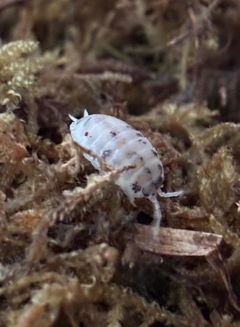
- Appearance changes through life: Nymphs are black-and-white peppered (similar to G. lurida); young adults show metallic blue-grey chrome-like wings; mature adults develop silvery-white wings with mottled patterning; orange-red legs and abdomen persist throughout all life stages
- Wings: Fully developed, patterned to camouflage with leaf litter
- Reproduction: Ovoviviparous — females retain egg cases internally and give birth to live nymphs
- Brood size: Large — up to approximately 200 nymphs per female lifetime produced in several smaller litters rather than all at once; one internal ootheca per female lifetime
- Rarity: Common in international hobby; reasonably accessible in UK
What Makes Chrome Cockroaches Special
The colour transformation is genuinely the species's standout feature. Nymphs start as small black-and-white peppered animals that look similar to G. lurida nymphs — not particularly distinctive. Young adults emerge with stunning blue-grey metallic wings that look almost like polished chrome under good lighting (hence the common name). Mature adults transition to silvery-white wings with mottled patterning — softer and more porcelain-like than the early adult phase. Throughout all of this development, the orange-red legs and abdomen colouration persists and provides a properly striking contrast against whatever wing colouration the animal currently displays. Few hobby invertebrates deliver this kind of multi-phase visual development.
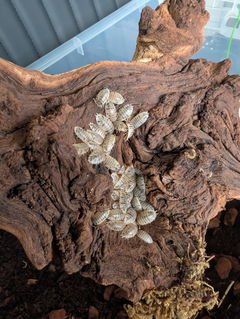
The visible nymphs. This is the genuine differentiator from other Gyna species. Most Gyna nymphs are dedicated burrowers — you won't see much of them until they reach adulthood. G. caffrorum nymphs are less shy and routinely visible on the substrate surface, particularly during cooler periods or at night. For keepers paying premium prices for an ornamental species, visible juveniles add real ongoing display value rather than the long "wait until they're adults" period that other Gyna species require.
The forgiving husbandry. Compared to other Gyna species, G. caffrorum is the most accessible. More humidity-tolerant than the demanding G. capucina (Pink Roach), more temperature-flexible than G. centurio, and just as straightforward to breed as G. lurida. For first-time Gyna keepers, this is the right starting species — successful colony establishment doesn't require precise environmental control.
The relatively less-flighty temperament. While G. caffrorum adults can fly, multiple keeper accounts note they prefer burrowing to flight and only take off when stressed or when no alternative is available. This makes the species somewhat easier to manage than the more readily-flighty G. centurio. Escape-proofing is still essential (the flight capability is genuine), but day-to-day enclosure work is less anxiety-inducing than for the more eager fliers in the genus.
The prolific live-bearing reproduction. Like all Gyna, G. caffrorum is ovoviviparous — females retain egg cases internally and give birth to live nymphs over several months rather than depositing oothecae. Total brood size per female lifetime can reach approximately 200 nymphs, produced in multiple smaller litters. Combined with the visible juvenile behaviour, this means observable colony expansion — properly satisfying compared to species where you only realise breeding has succeeded months after the fact.
The Gyna cluster connection. Within our cockroach collection, G. caffrorum pairs naturally with our Centurion Porcelain Cockroach (G. centurio) for collectors wanting genus-level diversity. Both species share the broader Gyninae husbandry, both are live-bearers, and both show the porcelain-like wing texture that defines the genus aesthetic. Acquiring both gives a properly varied Gyna display.
About the Name and Taxonomy
A few notes on the species's nomenclature and naming history.
- Gyna caffrorum: Described by Carl Stål in 1856, originally as Panchlora caffrorum; subsequently moved to Gyna. The species epithet "caffrorum" derives from "Cafferland" — the historical Latin name used in Stål's 1856 paper for the eastern Cape region of South Africa where the type specimens were collected. The scientific name persists by nomenclatural priority.
- Synonyms: Panchlora scripta Walker, 1868 (original alternative description); Gyna stridulans Karny, 1908 (named in error — based on now-discredited observations that the species produces sound by stridulation; it doesn't make sound).
- Genus etymology: "Gyna" derives from Greek "gyne" (woman); type species is G. capucina (the Pink Roach). Genus established by Brunner von Wattenwyl, 1865, with 31 currently accepted species.
- The "Chrome" naming confusion: Both G. caffrorum AND G. centurio are routinely sold under "Chrome" or "Chrome Porcelain" common names in international hobby culture, despite being clearly different species. G. caffrorum has silvery-white to blue-grey mature adults with orange-red legs and visible nymphs; G. centurio has cream-maroon-brown mature adults with hidden nymphs. If you're researching care online, check the scientific name rather than relying on the trade name.
- "Ghost Porcelain" alternative: Sometimes preferred in UK hobby usage to distinguish from G. centurio. References the silvery-white mature adult colouration.
- "Pink Cockroach" alternative: A misnomer that occasionally appears, probably referring to the orange-red leg colouration. The actual Pink Roach is G. capucina, which has properly pink wings — a genuinely different species.
Setting Up the Enclosure
A 4–10 litre plastic container or glass terrarium suits a starter colony of 5–10 Chrome Cockroach nymphs; scale up as the colony grows. Containers wider than tall work better than the reverse — nymphs and gravid females spend time at substrate level, and the surface-active behaviour of nymphs uses floor space rather than vertical space. Both plastic tubs and glass terrariums work; plastic with clip-locked lids is generally easier for escape-proofing.
Escape-proofing is genuinely the critical setup feature. Adults climb smooth surfaces and can fly. The right combination:
- A properly tight-fitting lid with no gaps
- Fine mesh on all ventilation holes
- A petroleum jelly or silicone grease barrier (~5 cm wide) around the inside upper rim
- Some keepers prefer front-opening enclosures — when adults fly, they fly upward, so a top-opening lid presents an immediate escape route on opening
- Be particularly careful at higher temperatures, when flight becomes more likely
The good news: even if an adult escapes, UK household conditions are too cool and dry for long-term survival. Recapture quickly and tighten enclosure security; don't worry about establishing wild populations.
Provide moderate surface structure. Cork bark slabs in horizontal and vertical orientations work well — adult males and visible nymphs will use them for climbing and exploration. Don't overcrowd the enclosure with vertical décor; leave open floor space for substrate access. Branches and leaf litter complete the cover options. Browse our accessories range for cork bark and natural cover options.
Ventilation matters genuinely for this species. Good airflow prevents the stagnant moist conditions that cause moulting problems. Mesh-covered ventilation holes across opposing sides of the enclosure provide cross-ventilation; mesh-topped lids work for additional top airflow.
Important husbandry note: Skip the standing water dish. Substrate moisture and occasional misting provide all the hydration this species needs. The moderate humidity preference (50–70%) means open water can actually create excess humidity.
Substrate
Substrate depth matters genuinely — nymphs and adults both burrow, and the substrate also serves as supplementary food:
- Coconut fibre (coir) as the foundation
- Decaying hardwood pieces mixed throughout — provides supplementary food and substrate variety
- Composted hardwood leaf litter mixed throughout and layered generously on top — browse our accessories collection for properly prepared options
- Optional: flake soil mixed with leaf litter — reported by some keepers to increase breeding success and speed nymph development
- Cork bark pieces on the surface for hides
- Springtails inoculated to consume droppings and food waste, preventing mould
Substrate depth should be 5–10 cm. Maintain a moisture gradient — one side damper than the other — to give females a choice of conditions for birthing while keeping the dry side genuinely dry. The substrate should be slightly moist but never wet.
Top layer: a generous covering of hardwood leaf litter plus cork bark for surface cover.
Humidity and Temperature
Maintain humidity at a moderate 50–70%. This is properly important — G. caffrorum doesn't thrive in very humid conditions and can experience moulting problems if kept too wet. The species's southern African origin includes both humid and seasonally dry habitats; moderate humidity reflects this. Maintain a humidity gradient with roughly half the substrate moist and half drier; mist lightly once or twice weekly, allowing partial drying between mistings.
Temperature should be 21–29 °C, with 25–28 °C optimal for breeding. G. caffrorum is more tolerant of cooler conditions than other Gyna species — it can be kept as low as 18–20 °C through UK winter months without issues, though breeding will slow significantly. UK average room temperature is acceptable for maintenance; supplementary warmth supports productive colonies.
A low-wattage heat mat on a thermostat, mounted on the side of the enclosure rather than underneath, provides ideal supplementary warmth. Side-mounted heating creates a thermal gradient and avoids overheating substrate where burrowing animals spend their time. Critically, for any fossorial species, never use under-substrate heating — it traps animals between heat and dry surface conditions.
Note that higher temperatures (upper 20s °C) increase the likelihood of adult flight. There's a real trade-off between optimal breeding rates and manageable flight behaviour — many keepers settle on the middle of the range (24–26 °C) as a practical compromise.
Diet
Chrome Cockroaches are omnivores and not particularly fussy eaters. They're also not heavy feeders compared to some cockroach species — don't expect them to demolish food overnight:
- Hardwood leaf litter — the main food source in the wild and the dietary staple in captivity. Oak, beech, magnolia preferred. Browse our accessories collection for ready-prepared leaf litter.
- Dry roach chow or dog/cat biscuits — available constantly, doesn't spoil. Useful protein source.
- Fresh fruit — particularly fond of soft sweet fruits like banana, apple, mango. Replace within 24–48 hours.
- Fresh vegetables — carrot, courgette, cucumber. Replace before mould develops.
- Protein sources — fish flakes, bee pollen, dried shrimp. Important for proper development; inadequate protein can slow growth.
- Insect/beetle jelly — clean, doesn't spoil, well-received
- Calcium sources — cuttlebone, crushed eggshells. Supports healthy moulting. Our calcium options cover the full range.
Foods to avoid: Solanaceous plants (potato, tomato, pepper) and very acidic fruits (lemon, grapefruit, pomegranate). These are either potentially harmful or poorly received.
Position fresh food on shallow dishes or directly on leaves rather than in deep bowls — nymphs may not be able to access deep containers. Remove uneaten fresh food within 24–48 hours to prevent mould in the warm setup.
Breeding
Chrome Cockroaches breed readily in captivity — considered one of the more reliable Gyna species for first-time genus keepers. Females are ovoviviparous, retaining egg cases internally and giving birth to live nymphs over multiple smaller litters from a single ootheca. Total brood size per female lifetime can reach approximately 200 nymphs, though typical numbers are lower.
Females typically produce only one internal ootheca during their lifetime, with nymphs released gradually over several months rather than all at once. Nymphs take approximately 4–6 months to reach adulthood.
For breeding success:
- Stable temperature in the optimal range (25–28 °C)
- Adequate protein in the diet — reproducing females have higher protein demands
- Don't overcrowd — give them space
- Maintain the humidity gradient — half moist, half drier
- Adequate substrate depth (5–10 cm) for nymph burrowing
- Mixed-age starter group — males typically mature before females (normal for the genus), so a starter group of 10+ animals improves the odds of overlapping maturation timing
- Springtails inoculated to manage waste during the rapid colony expansion
Using flake soil in the substrate has been reported by some keepers to increase breeding success and speed up nymph development. This isn't required for successful breeding but can be worth experimenting with if you want to optimise production rates.
Who Should Buy Chrome Cockroaches?
Ideal for:
- First-time Gyna keepers — more forgiving than other species in the genus
- Display enthusiasts drawn to the multi-phase colour transformation through development
- Keepers wanting visible juvenile activity (uncommon for the genus)
- Collectors building a focused Gyna display alongside the Centurion Porcelain Cockroach
- Anyone interested in live-bearing cockroach species
- Bioactive vivarium setups where the burrowing detritivores contribute to substrate processing
- Keepers comfortable managing climbing and flying species (with proper escape-proofing)
Not ideal for:
- Keepers without proper escape-proofing — the climbing and (occasional) flight is genuine
- Setups that can't maintain moderate ventilation — stagnant conditions cause moulting problems
- Anyone uncomfortable with insects that might occasionally fly
- Tropical-style high-humidity setups — this species prefers moderate humidity
- Pure feeder production — Dubia roaches and similar species are more efficient
Realistic Expectations
The colour transformation takes time. New keepers buying nymphs see black-and-white peppered juveniles for several months before the dramatic adult colouration emerges. The blue-grey young-adult phase and the silvery-white mature-adult phase only appear in the final stages of development. Don't expect "chrome" appearance from juveniles; expect to wait several months for the adult transformation. The orange-red legs and abdomen are visible from earlier life stages, providing some visual interest during the long nymphal period.
The flying ability is real but limited. Multiple sources note that G. caffrorum adults prefer burrowing to flight — they'll take off when stressed or at high temperatures, but they're not constantly airborne. Compared to G. centurio, this species is somewhat less flighty in practice. That said, "less likely to fly" isn't "won't fly" — proper escape-proofing remains non-negotiable.
The nymph visibility is genuine but partial. G. caffrorum nymphs are properly more visible than other Gyna nymphs, but they're still substrate-active animals that burrow regularly. Don't expect constant nymph display; do expect to see nymphs surface occasionally rather than the "complete invisibility" of other genus members.
The "Chrome" name overlap is confusing. Both G. caffrorum and G. centurio are routinely sold under "Chrome" common names, and the two species are visually distinguishable. If you've researched "Chrome Cockroach" care online, double-check which scientific species the source was actually describing — the husbandry is broadly similar but the visual identification is different.
Population growth is properly observable. Combined with visible nymphs, the prolific brood sizes mean Chrome Cockroach colonies show visible expansion within a few months of establishing. This is a meaningful contrast with slow-breeding species where colony dynamics take 12+ months to become observable. Plan for properly growing populations and be prepared to thin numbers or upgrade enclosure size over time.
They need protein but not too much. Inadequate protein slows nymph development and can lead to cannibalism in stressed colonies; excessive protein can cause similar cannibalism issues. Offer protein supplements 2–3 times weekly as part of a varied diet rather than as a daily staple.
Humidity is more important than people expect. The species's preference for moderate (not high) humidity is one of the most common new-keeper mistakes — applying "tropical roach" assumptions and keeping things too damp. The moulting problems that result aren't always immediately obvious; they manifest as deformed adults or failed moults months after the husbandry mistake. Get the moisture gradient right from the start.
UK escape isn't an environmental risk. As with the other Gyna species in our catalogue, UK household conditions are too cool and dry for G. caffrorum to establish long-term outside an artificial enclosure. Recapture escapees promptly but don't worry about establishing wild populations.
Use collapsible tabs for more detailed information that will help customers make a purchasing decision.
Ex: Shipping and return policies, size guides, and other common questions.