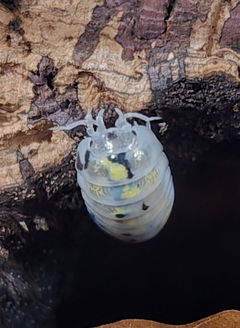
Emerald Cockroach (Pseudoglomeris magnifica) for Sale
Care Info:
- Free shipping over £65
- Low stock - 3 items left
- Backordered, shipping soon
The Emerald Cockroach is one of the most genuinely spectacular invertebrates available in the UK hobby — a metallic emerald-green species from Vietnam and southern China that shimmers like polished jade in any decent light. The iridescent body finish is unlike anything else on offer in the cockroach world: a clean, jewel-toned metallic green that holds its colour through every life stage. Combined with the species's calm, diurnal temperament and arboreal lifestyle, this is properly a display animal rather than a feeder or cleanup-crew roach — the kind of species you keep specifically to be seen rather than to do a job.
This is part of our wider cockroach collection and sits alongside our other premium display roaches — the Giant Flower Cockroach (Eucorydia dasytoides) for those drawn to iridescent metallic blue-green species, and the Cuban Banana Cockroach for keepers wanting an active green species at an entry-level price point. For collectors building a focused display-roach collection, the Emerald is the centrepiece species — visually striking, behaviourally interesting, and properly rare in UK culture.
One honest framing point up front. Pseudoglomeris magnifica is a slow-breeding, intermediate-difficulty species. It's not difficult in the sense of being delicate, but the husbandry needs to be right and the breeding pace is genuinely slow — females gestate young for up to six months. This is a long-term project species rather than a quick colony to establish. To set things up properly from the start, browse our accessories collection for the leaf litter, sphagnum moss, cork bark, and supplementary foods that make the difference between a colony that ticks over and one that thrives.
Quick Care Summary
- Scientific Name: Pseudoglomeris magnifica (Shelford, 1907); now also classified taxonomically as Corydidarum magnifica
- Common Names: Emerald Cockroach, Asian Emerald Cockroach, Emerald Roach
- Family: Blaberidae (subfamily Perisphaerinae)
- Origin: Vietnam and southern China — typically found under leaf litter or on tree bark in tropical to subtropical forest
- Adult Size: Up to 30 mm; females larger and thicker than males
- Lifespan: Approximately 2 years for females; males meaningfully shorter
- Difficulty: Medium — intermediate care, slow-breeding, needs proper specialist setup
- Temperature: 22–28 °C
- Humidity: 70–80% with daily misting to provide water droplets for drinking
- Ventilation: Moderate
- Activity: Diurnal (day-active) — unusual for cockroaches; surface-active and observable
- Appearance: Iridescent metallic emerald-green body; jewel-like quality across all life stages; sexual dimorphism with winged males and wingless neotenous females
- Sexual dimorphism: Adult males have wings and can glide short distances when startled; adult females remain wingless and retain a juvenile-like body form (neoteny)
- Behaviour: Calm, non-aggressive, arboreal climbers; can climb smooth vertical surfaces — escape-proof lid essential
- Breeding: Slow — females gestate young for up to six months; viviparous (give birth to live young)
- Rarity: Very Rare in UK culture
What Makes the Emerald Cockroach Special
The iridescent emerald colouration. This is the single most striking feature of the species and the main reason it commands premium prices. The body has a genuine metallic finish — properly jewel-like, not just a brighter shade of green. Under good lighting the entire animal looks polished, with the metallic surface catching light at different angles. Importantly the colour holds across all life stages: nymphs already show the emerald base, and it intensifies through successive moults into adulthood rather than fading. For keepers used to dull brown cockroaches, the visual difference is genuinely transformative.
The diurnal activity. Most cockroaches are strictly nocturnal — they hide all day and emerge only after dark, making them properly difficult to observe. Pseudoglomeris magnifica breaks that mould: it's diurnal, active during the day, and surface-visible in a way that makes the species genuinely rewarding to watch. Combined with the iridescent body, this means you actually see them using the enclosure rather than just knowing they're in there somewhere.
The arboreal lifestyle. Unlike most pet cockroaches that scuttle along substrate, Emerald Cockroaches are climbers. In the wild they're found on tree bark and in elevated leaf litter, and in captivity they use the full vertical space of a tall enclosure — climbing cork bark, exploring branches, resting on the upper walls. This is a genuinely different husbandry profile from substrate-dwelling species and lets you build a properly three-dimensional display setup. A taller-than-wide enclosure with multiple vertical climbing structures is the right approach.
The neotenous females. Female P. magnifica have evolved an unusual trait — they retain a juvenile-like body form into adulthood (neoteny), with no wings developing at maturity. Adult males by contrast develop functional wings and can glide for short distances when startled. The result is a colony where the two sexes look distinctly different at maturity, with the chunkier wingless females and the slimmer winged males showing clear visual sexual dimorphism. This is unusual among cockroaches and adds genuine biological interest to the species.
The display-roach cluster. The Emerald sits at the top tier of the UK display-roach hobby alongside the Giant Flower Cockroach (Eucorydia dasytoides) — another iridescent metallic species but with a transformative juvenile-to-adult colour change. For collectors building a focused premium roach collection, both species belong together. The Cuban Banana Cockroach rounds out the green-roach options at an entry-level price.
About the Name
A brief clarification on the species's taxonomy, which has shifted recently.
- Pseudoglomeris magnifica: The name used in the international hobby and the historical scientific binomial. Most keeper sources and breeder listings use this form.
- Corydidarum magnifica: The currently accepted scientific binomial following taxonomic revision. Both names refer to the same species — they're synonyms, not different animals.
- Trichoblatta magnifica, Pseudoglomeris dubia: Older synonyms occasionally seen in historical literature.
- Emerald Cockroach / Asian Emerald Cockroach: The standard common names. Don't confuse with the unrelated "Emerald Cockroach Wasp" (Ampulex compressa), which is a parasitoid wasp that hunts other cockroaches.
- Original description: Described by Shelford in 1907 from specimens collected in Southeast Asia.
Setting Up the Enclosure
Use a taller-than-wide enclosure to suit the arboreal lifestyle — vertical orientation matters more for this species than floor space. A 10–20 litre vertical container with a secure clip-lock lid works well for a starter group of 5–10 animals. P. magnifica can climb smooth vertical surfaces including glass and plastic, so the lid seal is genuinely critical. Many keepers add a foam seal strip around the top edge of the enclosure to prevent escapes — newly-hatched nymphs are only around 3 mm and can squeeze through tiny gaps.
Drill ventilation holes generously, covered with fine mesh. Moderate ventilation works well — enough airflow to prevent stagnation, without compromising the high humidity the species needs.
Vertical climbing structure is the central design feature. Provide multiple branches, cork bark in vertical orientations, and rotten wood pieces that span the height of the enclosure. Browse our accessories range for cork bark, branches and other natural climbing options. Position hides at multiple heights — some at substrate level for moulting and gravid females (who prefer humid conditions), others elevated for general resting. The differentiation matters: animals choose hides based on their current state.
Important husbandry note: Skip the standing water dish. P. magnifica drink primarily from water droplets on glass and leaves after misting, which is the species's natural drinking behaviour in the wild. Daily misting provides hydration without the drowning and mould risks of open water.
Substrate
Use a moisture-retentive forest-soil-style substrate:
- Organic topsoil or forest humus (pesticide-free) as the foundation
- Sphagnum moss for moisture retention in the lower layers — available in our accessories range
- Composted hardwood leaf litter mixed through and layered on top — browse our accessories collection for ready-prepared options
- Larger pieces of rotten hardwood incorporated into the substrate and standing as part of the climbing structure
- Springtails inoculated into the substrate are highly recommended — they consume droppings and food waste, preventing mould in the warm humid setup
Substrate depth around 5–10 cm gives enough buffer for moisture retention and lets the substrate absorb daily misting without going waterlogged. Avoid coco coir as the primary substrate.
Humidity and Temperature
Maintain humidity around 70–80% with daily light misting. The misting serves two purposes: maintaining humidity, and providing drinking water as droplets on glass and leaves. This is genuinely important — P. magnifica drink almost exclusively from misted droplets in the wild and have evolved to depend on this water source. Don't skip the daily spraying.
Substrate height (5–10 cm) absorbs the daily moisture and prevents waterlogging. If you see standing water collecting on the substrate surface, the substrate is too shallow or the misting too heavy.
Temperature should be 22–28 °C, warmer than UK room temperature for most of the year. Most UK keepers maintain Emerald Cockroach colonies in a heated room or with mild supplementary warming via a low-wattage heat mat on a thermostat set to one side of the enclosure, creating a thermal gradient alongside the moisture gradient. Avoid placement near radiators or windows where temperatures fluctuate dramatically.
Diet
P. magnifica are primarily fruit-eaters in the wild, with a varied supplementary diet that distinguishes them from typical detritivorous cockroaches:
- Fresh fruit — the dietary mainstay. Apple, banana, melon, mango, pear, soft pears in particular work well. Replace within 24–48 hours to prevent mould.
- Hardwood leaf litter (oak, beech, hazel) — important secondary nutrition source, always available. Our accessories range includes properly prepared leaf litter.
- Rotting hardwood pieces — eaten and used as climbing structure
- Bee pollen — a particularly well-received supplementary food for this species; offer occasionally as part of a varied diet
- Fish food (flake or pellet) — provides protein and additional micronutrients, offered 1–2x weekly. Browse the protein options in our accessories collection.
- Vegetables occasionally — sweet potato, courgette, butternut squash — though less critical than fruit for this species
- Calcium sources — cuttlebone, crushed limestone, oyster shell as background availability. Our calcium options cover the full range.
Position fresh food on dishes or leaves rather than directly on substrate to make removal of uneaten portions easier and reduce mould risk in the warm humid setup.
Breeding
Breeding P. magnifica is genuinely a long-term commitment. Females are viviparous — they give birth to live young rather than laying eggs — and gestation lasts up to six months. Combined with a moderate clutch size and the species's overall slow life cycle, colony expansion is properly slow. Even successfully established colonies expand modestly over years rather than weeks.
Sexual maturity comes earlier in males (around one month before females), which can complicate breeding planning since male lifespan after maturity is short. The practical solution is keeping mixed developmental stages in the same colony — newly-maturing males can fertilise females that are still developing, and older females (who live up to two years) can be fertilised multiple times across their lifespan.
For breeding success:
- Stable temperature in the comfort range (24–27 °C is ideal)
- Consistent daily misting maintained — don't let the routine slip
- Multiple curved cork bark hides offered at different heights, including some at substrate level for gravid females and moulting animals (who prefer the more humid lower zone)
- Mixed-age colony rather than single-cohort groups — supports the offset male-female maturation timeline
- Springtails inoculated to manage waste and prevent mould
- Minimal disturbance — like most arboreal cockroaches, P. magnifica settle better when left undisturbed
- Patience — accept that colony expansion takes years, not months
Who Should Buy Emerald Cockroaches?
Ideal for:
- Experienced invertebrate keepers ready to add a properly stunning display species to their collection
- Display enthusiasts drawn to iridescent metallic species — combined with the Giant Flower Cockroach they make a focused jewel-roach cluster
- Keepers who appreciate diurnal, observable species rather than secretive nocturnal animals
- Anyone interested in arboreal husbandry and three-dimensional enclosure design
- Long-term project keepers comfortable with slow breeding and gradual colony development
- Collectors of rare and taxonomically interesting species
Not ideal for:
- Complete beginners — start with hardier cockroach species like Madagascar Hissers or Cuban Banana first
- Keepers wanting rapid colony expansion — six-month gestation makes breeding genuinely slow
- Anyone wanting an enclosure they can leave unmaintained — daily misting is genuinely necessary
- Setups in unheated UK rooms during colder months — supplementary warmth is realistically required
- Keepers without an absolutely secure escape-proof enclosure — climbing ability is exceptional
- Anyone needing feeder insects — this is a display species, far too valuable and slow-breeding for feeding purposes
Realistic Expectations
The colour is properly stunning. New keepers occasionally underestimate just how iridescent the body is — photos online vary in quality, but the metallic emerald finish in person is more impressive than most images suggest. Under decent lighting this is a genuinely show-stopping species. Under dim lighting the colour reads as more matte green; good ambient light brings out the full effect.
Breeding is slow enough to require patience. The six-month gestation period is well-documented and not a husbandry failure if you don't see young emerging quickly. Established breeding colonies expand over years rather than months. Plan accordingly — this isn't a species for keepers who want to see fast colony growth.
The escape risk is real. Newly-hatched nymphs (around 3 mm) can squeeze through small gaps that would contain adult animals comfortably. Foam-sealed lids, fine mesh on ventilation, and careful enclosure inspection before introducing animals are all standard precautions for this species. Treat escape-proofing as a setup requirement, not an afterthought.
Sex differences are visually obvious at maturity but subtle in nymphs. Distinguishing male and female nymphs requires examining the subgenital plate (the plate below the genitalia): a single large segment at the tip indicates female, two smaller segments indicate male. This matters if you're trying to balance sex ratios for breeding before animals mature; in mixed-sex starter groups, both sexes are normally present without active sexing.
They're not aggressive or smelly. New keepers sometimes carry assumptions from pest-cockroach associations — the household cockroach reputation that has nothing to do with this species. P. magnifica is calm, non-aggressive, doesn't carry odour issues in a properly maintained setup, and can't infest UK homes (they need the warm humid conditions of their native climate). The species is meaningfully closer to keeping an unusual beetle than a pest insect.
Use collapsible tabs for more detailed information that will help customers make a purchasing decision.
Ex: Shipping and return policies, size guides, and other common questions.