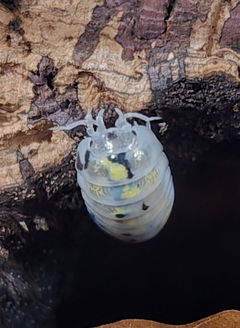
Indian Spotted / Domino Cockroach (Therea petiveriana)
Care Info:
 ORIGIN
 TEMP
TEMP
 HUMIDITY
 LENGTH
 DIFFICULTY
 RARITY
- Free shipping over £65
Hand someone a Domino Cockroach and watch the face they were pulling disappear. This is the roach I reach for when a visitor tells me they cannot stand cockroaches, because the Indian Spotted Cockroach, Therea petiveriana, looks nothing like the picture in their head. Adults are glossy black scattered with crisp white spots laid out like the pips on domino tiles, and unlike almost every roach people have met, it is out during the day rather than hiding after dark.
The pattern is the draw, and it is why most keepers use the name Domino rather than the drier Indian Spotted, Seven-spotted or Desert Cockroach labels. The rounded, faintly beetle-like body gives it a tidy, ornamental look, with a hidden flash of orange-yellow on the upper abdomen that you only catch when the wings lift. Those bold spots are not decoration for our benefit; they mimic a toxic ground beetle, Anthia sexguttata, so predators that shun the beetle tend to leave the harmless roach alone too. It comes from the dry scrub of semi-arid southern India, which shapes how you keep it: think seasonal and dry rather than steamy rainforest.
Containment is straightforward with this one, as long as you know what you are containing. Therea does not fly, which takes away the escape route that makes most ornamental roaches a handful. Adults do climb smooth glass, though, so fit a close-fitting lid from the outset. Nobody has established whether the nymphs climb, and since they take two years or more to mature, the tub you buy for nymphs is the one the adults will be living in. Keep the substrate on the drier side with a decent depth for burrowing, around 5 to 8 cm, using coconut fibre with some leaf litter worked through it. Air humidity wants to stay modest, roughly 40 to 60 per cent, with moderate to good ventilation to keep things fresh, while one damper corner gives the females somewhere to lay. Room temperature suits them across 21 to 29°C; UK rooms sit at the cooler end and that is fine for ticking over, though the warmer half encourages faster growth and breeding.
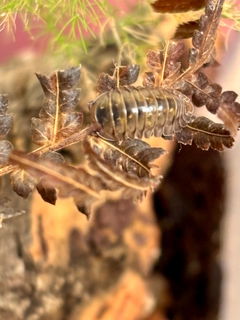
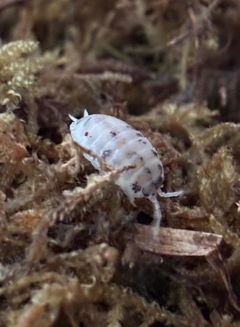
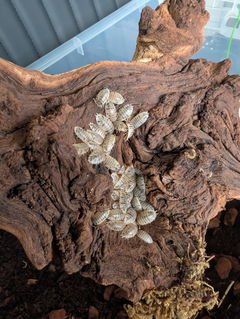
Adult males, the smaller sex at around 25 mm, are the ones you will see most, out on the surface in daylight. Females are broader, closer to 35 mm, and spend more of their time burrowed. The nymphs are a surprise in waiting: plain brown, hairy and almost always underground, they give no hint of the black-and-white adults they become at the final moult, so do not be put off by a tub that looks quiet. They are sociable animals and settle far better in a group, so a starter colony of five or more establishes more reliably than a pair.
Feeding is simple. Leaf litter, oak for preference, is the backbone of the diet rather than an extra, because the gut microbes that break down cellulose depend on a steady supply. Add fresh veg and fruit such as carrot, courgette and apple, the occasional bit of protein food, and a little cuttlebone or crushed eggshell to support clean moults. Breeding tends to follow on its own once conditions are stable and warm: females tuck their egg cases into damp leaf litter, and a mated female will see off further suitors, storing sperm to keep producing from a single pairing.
If the bug bites, you can see how it sits among the rest of the cockroach collection.
Common questions
Do Domino Cockroaches climb or fly out? They do not fly, but adults climb smooth glass, so the lid needs to fit closely rather than rest on top. Fit it for the adults from the start.
Why are my nymphs plain brown? That is normal. The domino pattern only appears at the final adult moult, and development takes two years or more, so the tub you buy for nymphs is the one the adults will live in.
Are they the same as Therea bernhardti? Possibly. A 2009 revision suggests much hobby stock may be T. bernhardti, but care and behaviour are identical either way.
They arrive as captive-bred stock, packed with care for the journey, and settle in quickly. For anyone convinced they dislike cockroaches, this is the one I would put in front of them first.
Nymphs and adults ride together in a ventilated tub on damp substrate, cased inside twin-wall card. Posting runs Monday to Thursday, tracked and overnight, so no parcel of ours stands through a Sunday. The tub holds a fifth more animals than your order says, and every one is guaranteed to reach you alive.
Use collapsible tabs for more detailed information that will help customers make a purchasing decision.
Ex: Shipping and return policies, size guides, and other common questions.