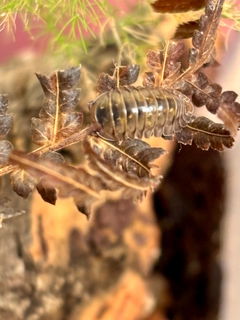
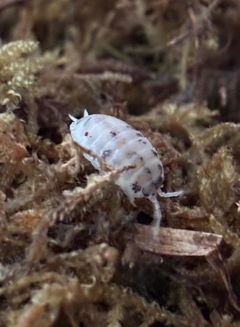
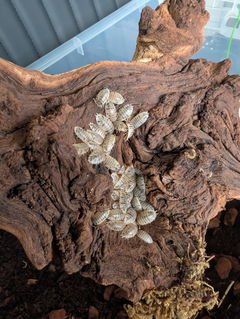
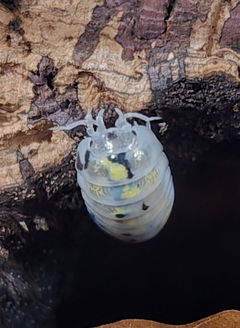
Oniscus Asellus Occidentalis Isopods
Care Info:
 ORIGIN
 TEMP
TEMP
 HUMIDITY
 LENGTH
 DIFFICULTY
 RARITY
- Free shipping over £65
This is a British native that is losing ground, and you should know that before buying one. In Great Britain the subspecies is assessed as Near Threatened - the ordinary form of the same species is Least Concern. The man who described it in 1994 went further and suggested that this was the original British and Irish animal, now being genetically swamped by the more competitive continental form spreading into its range. Where the two meet they interbreed freely, and across a wide area of southern England and western France, intermediate populations dominate most semi-natural habitats.
Which means two things for us. Everything we sell is captive-bred and stays that way, and nothing on this page should be read as an invitation to go and collect them. If you keep these, keep them contained.
What it is
Oniscus asellus occidentalis Bilton, 1994, described in a revision that also fixed a reference specimen for the ordinary form from Uppsala. Bilton called it a relict Atlantic taxon, largely restricted to damp woodland, occurring in the far west of the species' range. British records are scattered across south-west England and south Wales, with more along the south coast of Ireland. South-west Britain, Ireland and western France is what this page has always said, and it is right.
The rank is a judgement, and we would rather you knew that than not. A 1999 study found the two forms genetically further apart than subspecies usually are - far enough to suggest an ancient split - and simultaneously found no gene that reliably separated them and free interbreeding wherever they meet. The authors concluded subspecies. Nobody has revisited it with modern sequencing.
You cannot identify this from a photograph
Compared with the ordinary form it is smaller, more brightly coloured and more highly arched. That is real but not diagnostic. The character that actually separates them is the tip of the first pleopod in an adult male, forked here and simple in the nominate, and the British recording group rates the identification difficulty four out of five. A female cannot be determined at all.
So the label on this tub rests on lineage and provenance, not on anything you can check by looking. We think saying that is better than pretending otherwise.
On size we have had to retreat. The listing said up to about 16mm, which is a figure for the species as a whole - and both Bilton and the recording group describe this subspecies as smaller than the ordinary form. No measurement has ever been published for it specifically.
Keeping them
Cool and damp. 15 to 25°C, and they will take British winter room temperatures without complaint. Humidity 60 to 75% with a damp end they use heavily. Those are our shelf figures, not measured tolerances, but the reason we lean wet is sourced: the recording group records this subspecies in semi-natural damp woodland while the ordinary form takes drier and more synanthropic sites. Never standing water - woodlice drown in it.
Substrate 5cm, deep leaf litter, plenty of white-rotted hardwood, bark to hide under, calcium permanently in. Easy, slow-moving, undemanding.
No rolling - Oniscus cannot close into a ball.
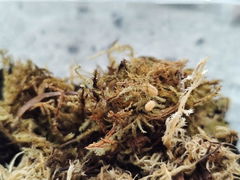
Because of everything above, these go out captive-bred only and we would ask you to keep them that way. Sending happens Monday to Thursday for pre-1pm next-day arrival, in a punched tub on moist moss inside doubled board, with 20% over your count and a guarantee they land alive. The genus is under Oniscus.
Use collapsible tabs for more detailed information that will help customers make a purchasing decision.
Ex: Shipping and return policies, size guides, and other common questions.