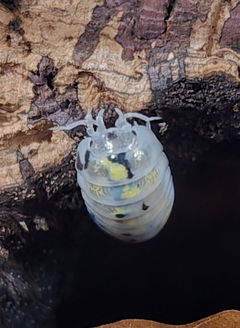
Cubaris sp. 'Snow Queen' Isopods
Care Info:
 ORIGIN
 TEMP
TEMP
 HUMIDITY
 LENGTH
 DIFFICULTY
 RARITY
- Free shipping over £65
- Low stock - 2 items left
Cubaris sp. 'Snow Queen' is a calm, gregarious isopod that lives well in a group and keeps well in captivity, and it dehydrates quickly when conditions shift underneath it. That is the trait worth knowing before any of the others. It will sit happily at any point across its range. What it cannot take is being moved between those points in a hurry. A tub held steadily at the low end of its range does better than one that passes through the ideal figure twice a day on its way somewhere else. What this animal asks of a keeper is steadiness, not precision.
Hold it steady before you hold it exact
In practice that means 22 to 26°C in a position that holds, so not a windowsill, not beside a radiator and not a room that falls away overnight. Humidity belongs between 60 and 80 per cent, built as a gradient with a damp end and a drier one, which lets the colony choose for itself. Roughly a third of my tub is given over to the damp end and the remainder is left drier. Ventilation stays modest, enough that the air turns over without pulling the moisture out of the enclosure, and misting is better little and often than an occasional soak that dries back over the following week.
Substrate goes down 5 to 8cm, which is deep enough to burrow into and to carry moisture from below. Work forest moss and pieces of rotting white wood through the mix, both of which hold water and both of which get eaten, then lay a generous hardwood leaf litter layer over the top. Litter and white wood are the base of the diet, with a soft vegetable now and then, a little protein, and cuttlebone or crushed limestone permanently in one corner, since any shortage of it shows at the following moult.
The colouring is not agreed on
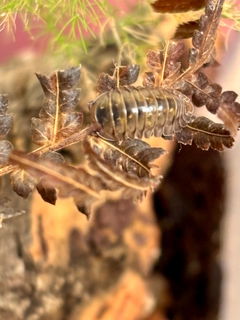
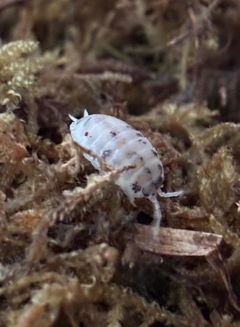
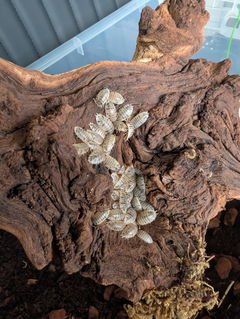
Descriptions of this animal contradict each other, and it is fairer to say so than to pick the flattering one. Some accounts have it as a uniform pearl white with translucent shading through the body. Others describe obvious variation, a warm candy-orange rim running round the edge of the animal and a more transparent centre inside it. Both are attached to stock sold under this name, so expect a group to vary rather than match one photograph. Juveniles are born white and darken slightly as they mature. Adult size is quoted anywhere from about 15 to 22mm depending on who is measuring, so treat the top of that spread as the optimistic reading.
The animal itself is Cubaris sp. 'Snow Queen', family Armadillidae, with no species name attached to it yet. It comes out of South East Asia and no country of origin is on record, so I am not going to invent one. It conglobates, shutting into a tight ball when startled, and nearly all of its activity happens after dark, so the tub can look empty for most of the daylight hours. Growth runs normal to slow, reproduction is fair rather than quick, and adults live two to three years. Difficulty is moderate. Ours are captive-bred.
It suits someone with a stable shelf and no particular hurry, which is a different requirement from experience. If you are building out the paler end of the genus, Ice Flower carries a white bloom over brown, Black Pearl is the solid black one at the far end of the tonal range, Cappuccino sits between the two, and White Shark, whatever the name suggests, is a tricolour dwarf rather than another white animal. Our Cubaris guide takes in the whole genus, and the wider Cubaris range holds everything else.
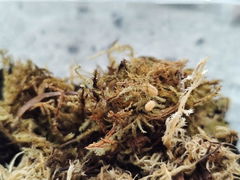
Groups travel bedded on damp sphagnum, inside a vented tub, inside a box with two walls. Posting days are Monday to Thursday and no later, tracked Royal Mail next-day for delivery before 1pm, which puts every parcel safely clear of a Saturday. There are extras in the tub beyond the number ordered, and every group is covered by our live-arrival guarantee.
Use collapsible tabs for more detailed information that will help customers make a purchasing decision.
Ex: Shipping and return policies, size guides, and other common questions.