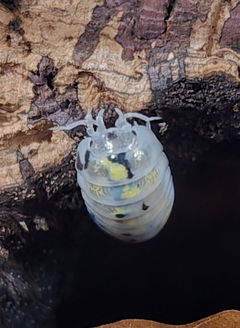
White Spotted Assassin Bug (Platymeris biguttatus)
Care Info:
 ORIGIN
 TEMP
TEMP
 HUMIDITY
 LENGTH
 DIFFICULTY
 RARITY
- Free shipping over £65
- Low stock - 8 items left
Everything else we sell waits for something to die. This one hunts. A white-spotted assassin bug crosses open substrate like a small wolf spider, takes a roach in about a second, and drains it through a beak kept folded beneath the head like a flick knife. If you have kept detritivores for a while and want to watch predation rather than decomposition, this is the animal that changes the room.
Introduction
This is Platymeris biguttatus, a large African reduviid sold as the White Spotted Assassin Bug, the White Spot Assassin or the Two-Spotted Assassin Bug. The species name does the describing: biguttatus translates as two-spotted, for the pair of clean white marks on the wings. Museum records run from Senegal and Gambia across to Somalia and down to Zimbabwe and Mozambique, so it is a tropical sub-Saharan species, not a West African one. It reaches around 3 to 4 cm as an adult, and wears matt black with those two spots and black and yellow banded legs. As a true bug it has no jaws at all. The rostrum carries fine stylets that pierce an insect's shell, inject saliva that liquefies the tissue inside, and then draw the whole lot back out.
Safety, before anything else
This is not an animal to handle, and it is worth being blunt about why rather than burying it. The defensive bite is widely reported as worse than a bee sting, with the site sore for days. More unusually, a frightened assassin bug can spit droplets of venom. The 30cm range you will see quoted everywhere was measured in the red-spotted Platymeris rhadamanthus, not in this species, so treat it as an indication and not a figure for this animal. On unbroken skin it does nothing. Against an eye or the inside of the mouth it is severely painful. What happens next in a person is not documented anywhere I can find, so treat it as a chemical splash: irrigate with clean water and ring 111 rather than waiting to see. None of this makes them difficult to keep, because a bug in a tub is no threat to anyone, but it does set some rules: no handling, keep your face well back when the lid is off, work with tongs or by encouraging them onto bark rather than fingers, and treat it as an adults-only animal in a household with young children. They can also produce a foul smell and an audible rasping sound when alarmed, which is usually the warning that comes first.
The full husbandry reference, the five nymph instars and what the venom research actually shows are in the white spotted assassin bug care guide.
Housing
Simple, and the priorities are ventilation and cover rather than size. A well-ventilated enclosure with a secure lid does the job, floored with a few centimetres of substrate kept lightly damp at one end and drier at the other, then furnished heavily with bark slabs, cork and hollow pieces so they can tuck out of sight. Flake soil, hardwood leaf litter and organic topsoil all work as a base and our flake soil and the botanicals in our accessories range cover it. Keep them warm, somewhere around 22 to 26°C, which for most UK homes means a thermostat-controlled mat on the side of the enclosure for part of the year. They are fast, so open the lid deliberately rather than casually. Adults are fully winged, and nobody has established whether they fly readily or climb smooth glass, so build for both: a lid that fastens, and ventilation holes small enough that a young nymph cannot walk out.
Feeding
Live prey only, since this species will not touch anything it has not killed. Crickets, locusts, mealworms and roaches all work, offered every few days and scaled to the size of the bug, and our cockroach range makes a convenient standing feeder colony if you would rather not buy livefood weekly. One point that matters: keep them well fed. Assassin bugs turn on each other when prey runs short, so an underfed group thins itself out. Fed generously they are perfectly happy communally, and nymphs will often share a kill rather than squabble over it.
Breeding, and a myth worth correcting
You will still read that this species reproduces parthenogenetically, without males. It does not, and that belief has been overturned in recent years. What happens is that females live a long time and can store sperm for months, so a colony that has lost its males carries on producing nymphs and looks asexual from the outside. Unmated females do lay eggs, but nothing hatches from them. If you want successive generations, you need both sexes in the group. Given that, breeding is undemanding: keep them warm, keep the substrate lightly damp, and feed well.
Who is this for?
An experienced keeper who wants an active predator and will respect the venom. It is a superb display animal, out and hunting rather than hidden, and unlike a tarantula it feeds in the open where you can actually watch it work. It is not a first invertebrate, not a pet for a child, and not for anyone who wants to hold their animals. If that rules it out, our isopods and millipedes are the gentler end of the same hobby. Otherwise the rest of the predators and oddities sit in our other invertebrates range.
Stock is captive-bred and sent under our live arrival guarantee in a securely sealed pot inside a double-walled box. Open the pot indoors, over a table and at arm's length, rather than up close. Orders leave Monday to Thursday on Royal Mail next day before 1pm.
Use collapsible tabs for more detailed information that will help customers make a purchasing decision.
Ex: Shipping and return policies, size guides, and other common questions.