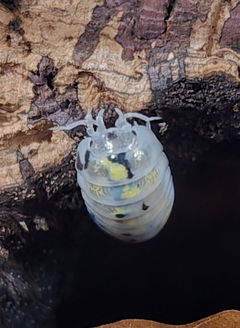
Cubaris sp. 'Yellow Tiger' Isopods
Care Info:
 ORIGIN
 TEMP
TEMP
 HUMIDITY
 LENGTH
 DIFFICULTY
 RARITY
- Free shipping over £65
- Low stock - 1 item left
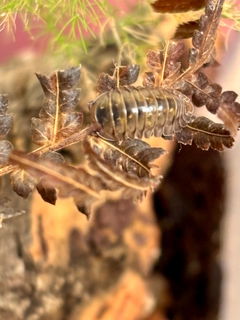
The name gives it away. Cubaris sp. 'Yellow Tiger' wears bold black banding over a bright yellow body, and that high-contrast tiger stripe is what draws the eye the moment you lift the lid. It's a Thai cave Cubaris, sometimes traded as the Honeymoon Tiger, and while it flies under the radar next to the famous Rubber Ducky, I'd argue it's every bit as striking. The pattern holds whether the animal is ambling across the leaf litter or rolled into a ball, so it earns its place as a display species rather than a background clean-up crew.
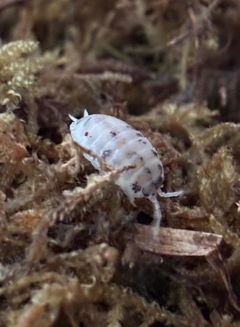
These are substantial isopods for the genus, with adults reaching around 22 mm, larger than many Cubaris, which makes the markings easy to appreciate. They keep the rounded duck-face head the genus is loved for, and they conglobate into a tight defensive ball when startled. Juveniles arrive a little muted and deepen into the full yellow-and-black contrast as they mature. If you're building a collection of bold Thai Cubaris, the Yellow Tiger sits happily alongside the panda markings of the Panda King, the warm glow of the Amber Firefly and the cool tones of the Thai Blue Angel.
Like most cave-adapted Thai Cubaris, they want warmth and steady humidity. I aim for roughly 21 to 26°C and a humid gradient rather than a uniformly wet box, with a damp end at around 75 to 85% and a drier far end so the colony can choose its comfort zone. Good cross-ventilation matters just as much, since it keeps the air fresh rather than stagnant while the substrate holds its moisture underneath.
Substrate does most of the work here, so I build it deep, 10 to 15 cm, over a living base of flake soil, rotted hardwood and organic topsoil. I'd avoid a plain coco-coir base, which offers little to feed on and breaks down into a sour mush. A mixed, living substrate stays active and gives them room to burrow when they breed or moult. Keep plenty of calcium and crushed limestone worked through it, since they draw on it for their moults, and layer magnolia leaf litter generously on top with cork bark and decaying wood for cover.
Feeding is simple. Leaf litter and rotting wood make up the everyday diet, topped up with a little protein such as fish flakes or dried shrimp a couple of times a week, and calcium always left available. The one rule I'd stress is moist, not wet. High humidity keeps them thriving, but waterlogged substrate is the quickest way to lose a colony, so mist to top up rather than soak. A springtail culture is worth adding from the start to clear mould around protein foods before it takes hold.
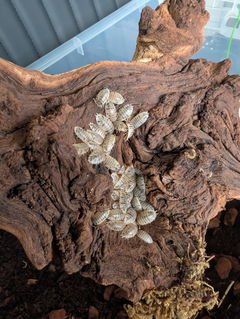
Yellow Tigers are a steady breeder once settled. Females carry their young in a brood pouch, and growth is slow to begin with before it picks up as the colony finds its feet, so it pays to start with the largest group you can and leave them undisturbed. They're a step up from the hardy Mediterranean species I'd point a beginner towards, but they're far from unmanageable, and they reward a little Cubaris experience. Expect them to be shy at first and to spend time burrowed out of sight. Both are normal, and they grow bolder as numbers build.
Every order is captive-bred, boxed double-walled around a ventilated tub of damp sphagnum and posted Monday to Thursday by tracked next-day Royal Mail, with a live-arrival guarantee and a 20% overcount as standard.
Use collapsible tabs for more detailed information that will help customers make a purchasing decision.
Ex: Shipping and return policies, size guides, and other common questions.