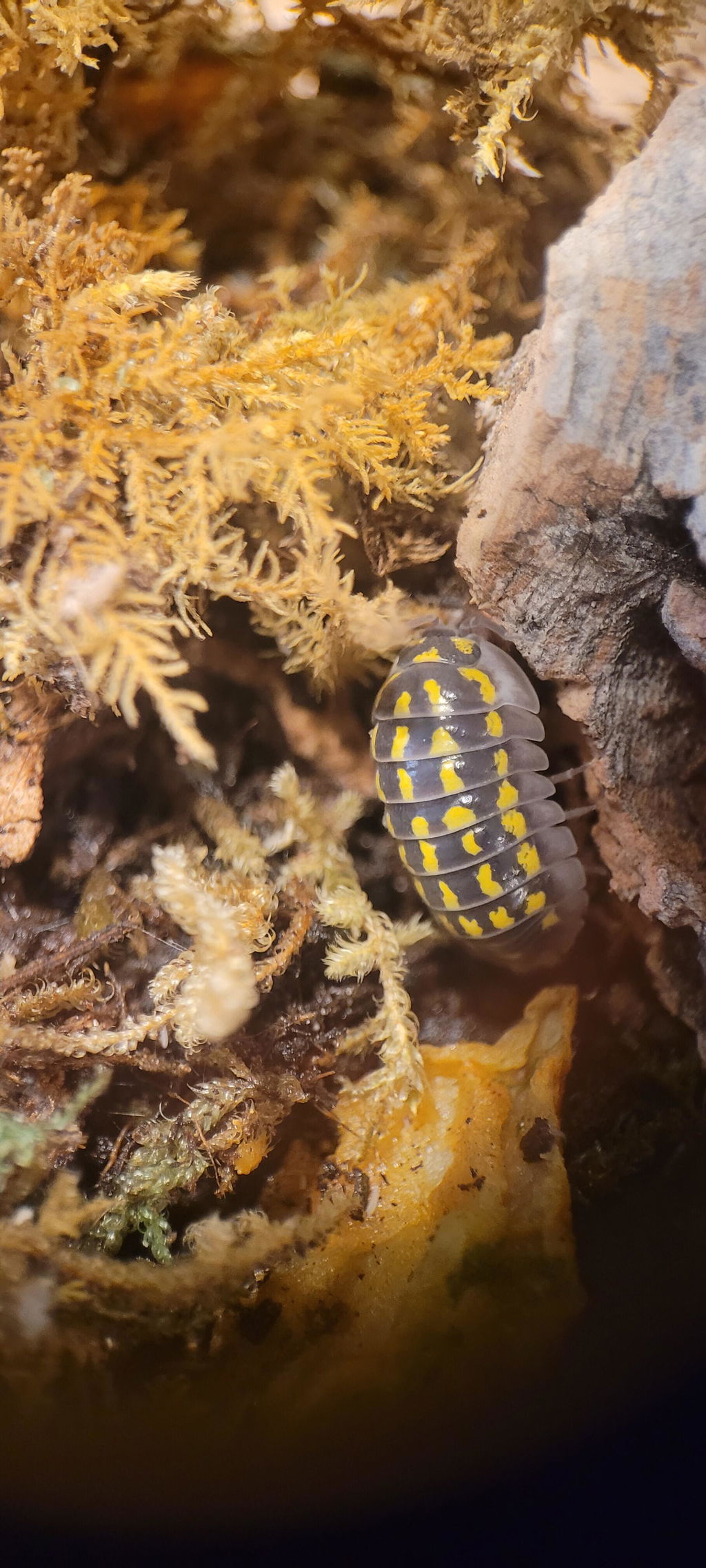
JUMBO High Yellow Spotted Giant Isopods (Armadillidium Gestroi)
Care Info:
- Free shipping over £65
- Low stock - 2 items left
- Backordered, shipping soon
The Jumbo Gestroi is one of the most visually striking Armadillidium morphs in the UK hobby — a selectively-isolated line of Armadillidium gestroi bred for intense neon-yellow spotting and approximately 20% larger size than standard gestroi. Where regular gestroi already display attractive yellow spots on dark Mediterranean bodies, the Jumbo High Yellow variant takes both colour intensity and physical size further. The bright neon yellow markings appear genuinely radiant against the dark base colouration, and some individuals display additional pale or white accents that add visual depth. Combined with the larger Jumbo size (up to 20 mm), they're substantial display animals that genuinely stand out from common Armadillidium species.
What makes Jumbo Gestroi particularly worth keeping is the combination: bold visual appeal paired with the bulletproof hardiness that A. gestroi is known for. Underneath the premium colouration, they share the same accessible care requirements as standard gestroi — making them genuinely beginner-friendly despite their designer appearance. They're also notably hardy and adaptable, tolerating the kinds of husbandry variations that would damage more sensitive species.
This is a selectively-bred line rather than a random colour variant. The "Jumbo High Yellow" designation refers to deliberate isolation of larger individuals with intense yellow expression, maintained over generations to preserve both the size advantage and the bright neon colouration. Keeping Jumbos connects you to genuine selective breeding work — and gives you a step up from standard gestroi if you already keep that species.
Available in groups of 5, 10, or 20. Captive-bred stock from established UK colonies. Low stock — only 2 items left. 6 customer reviews with 100% 5-star rating consistently describe them as healthy, well-packaged, and impressively-sized.
Quick Care Summary
- Scientific Name: Armadillidium gestroi 'Jumbo High Yellow'
- Common Names: Jumbo Gestroi, High Yellow Spotted Giant Isopods, Jumbo High Yellow Gestroi
- Family: Armadillidiidae
- Origin: Southern France — Mediterranean coast and Provence region (not "tropical" France)
- Adult Size: Up to 20 mm — approximately 20% larger than standard gestroi (around 15 mm)
- Lifespan: 2–3 years typical
- Difficulty: Easy — genuinely beginner-friendly
- Temperature: 20–25°C (UK room temperature works year-round)
- Humidity: 70–80% with moisture gradient
- Ventilation: Medium — balance airflow with humidity retention
- Conglobation: Yes — rolls into a tight ball when disturbed (classic pillbug defence)
- Behaviour: Active, social, hardy, primarily nocturnal but visible in dim conditions
- Breeding: Prolific — reliable colony growth under proper conditions
What Makes Jumbo Gestroi Special
Several factors have made Jumbo Gestroi one of the more sought-after selectively-bred Armadillidium variants in the UK hobby:
The neon yellow colouration is genuinely intense. Where standard A. gestroi show attractive but moderate yellow spotting, Jumbos display significantly brighter, more saturated yellow that appears almost neon under good lighting. The colour catches the light beautifully against the dark Mediterranean base, creating high-contrast visual appeal that lifts them above most beginner Armadillidium.
Approximately 20% larger than standard gestroi. At up to 20 mm, Jumbo Gestroi are substantially bigger than the 15 mm typical of standard gestroi. The size combined with the intensified colour makes them genuinely substantial display animals — observable from across a room rather than requiring close inspection. This isn't marketing inflation; the size difference is real and reflects the selective breeding for larger individuals.
Selectively-bred line, not random morph. The "Jumbo High Yellow" designation refers specifically to populations selectively isolated for both size and yellow intensity over multiple generations. This kind of dedicated line-breeding work delivers consistent results — you receive animals that genuinely express both the larger size and brighter colouration rather than variable mixed offspring.
Hardy A. gestroi genetics underneath. Despite the premium appearance, Jumbos retain the bulletproof hardiness of standard gestroi. They're among the most adaptable and forgiving Armadillidium species — tolerating temperature variation, humidity fluctuations, and minor husbandry mistakes that would devastate more sensitive species.
Active and visible temperament. Unlike many shy nocturnal species, Jumbo Gestroi are reasonably bold and often visible during ambient lighting conditions. The combination of bright colour and visible behaviour makes them genuinely engaging pets rather than secretive substrate dwellers.
Prolific breeding. Once established, Jumbo Gestroi breed reliably with substantial brood sizes. Sub-adults often begin breeding before reaching full size when well-fed. A starter colony establishes quickly and produces consistent population growth over months.
Some individuals show pale or white accent markings. Beyond the bright yellow spotting, occasional individuals display additional cream or white markings that add visual variety to the colony. This natural pattern variation gives serious keepers something to selectively breed for if they want to push the morph in particular directions.
Conglobation. Like all Armadillidium, they roll into tight defensive balls when disturbed — the classic pillbug behaviour that adds character to colony observation. The bright yellow spots remain visible in conglobated form, creating an attractive defensive display.
How Jumbo Gestroi Compares to Other Armadillidium
If you're choosing between Armadillidium species, here's how Jumbo Gestroi fits in:
- vs Standard Gestroi (A. gestroi): Same species, different selectively-bred lines. Standard Gestroi are 12–15 mm with moderate yellow spotting. Jumbos are 18–20 mm with intense neon yellow spotting. Identical care requirements — choose Jumbos for premium size and colour, standard Gestroi for accessible introduction to the species.
- vs Yellow Spanish (A. granulatum): Granulatum are Spanish species with granulated texture and yellow spots. Jumbo Gestroi are French Mediterranean species with smoother carapace and bolder yellow markings. Both are hardy beginner-friendly Armadillidium with similar care requirements — different aesthetic preferences entirely.
- vs Naranjito (A. granulatum Orange): Naranjito offer vivid orange Spanish colouration with yellow spots. Jumbo Gestroi offer bright yellow on dark French bodies. Different colour schemes for different visual preferences.
- vs Jelly Bean Isopods (A. vulgare 'St. Lucia'): Jelly Beans show natural multi-colour polymorphism (burgundy, orange, yellow, grey individuals within one colony). Jumbo Gestroi show consistent intense yellow on dark across the colony. Different scientific interests — Jelly Beans for genetic puzzles, Jumbo Gestroi for cohesive bright display.
- vs Zebra Isopods (A. maculatum): Zebras have crisp black-and-white striping. Jumbo Gestroi have intense yellow spots on dark bodies. Both are hardy beginner-friendly Armadillidium — different visual styles for different preferences.
Browse the full Armadillidium collection to compare all species and morphs.
Setting Up the Enclosure
A 6–10 litre plastic container or small glass terrarium suits a starter colony of 5–10. Given their larger size and prolific breeding, scale up to 15 litres for established colonies. Plastic tubs with clip-lock lids work particularly well — the 3L Braplast tub is suitable for starter cultures, though established colonies will benefit from upgrading to larger housing as populations grow.
For ventilation, drill multiple small holes on opposite sides of the container for cross-ventilation. Medium ventilation works well — enough airflow to prevent stagnation but not so much that humidity drops below their preferred range. Cover holes with fine mesh to prevent escapes.
Browse our accessories collection for appropriate enclosures, vents, and other essentials.
Substrate
Use organic topsoil (pesticide-free) as a base, with at least 5 cm depth. Mix in flake soil for added nutrition. Jumbo Gestroi aren't heavy burrowers, but adequate depth gives them options for moulting and security.
Mix sphagnum peat moss throughout the substrate for moisture retention. Add crushed limestone or eggshells incorporated throughout — Jumbo Gestroi benefit from constant calcium availability for healthy moulting and shell development.
Top layer: Generous hardwood leaf litter — magnolia leaves for long-lasting cover and bamboo leaf litter for additional structural variety. Add multiple cork bark pieces and decaying wood pieces spread throughout the enclosure. Multiple hiding options support their social behaviour while leaving open spaces for their active daytime activity.
Humidity and Temperature
Maintain humidity at 70–80% with a moisture gradient — one side damper with sphagnum moss patches and damp leaf litter, the other slightly drier. The substrate should be visibly damp throughout but never waterlogged. Mist regularly to maintain humidity, and watch for signs of overwetting (standing water at the bottom of the enclosure causes problems).
Temperature should be 20–25°C, which is typical UK room temperature year-round in most homes. They appreciate gentle warmth but supplementary heating isn't essential in most heated UK homes. Their Mediterranean origins mean they tolerate moderate seasonal variation well — actually preferring slight seasonal fluctuation over constant conditions.
Diet
Jumbo Gestroi are unfussy detritivores with broad appetites typical of Armadillidium:
- Primary diet (always available): Hardwood leaf litter (oak, magnolia, beech), decaying rotting wood, lichens, dried plant matter
- Vegetables (1–2x weekly): Carrot, courgette, sweet potato, butternut squash, cucumber, mushrooms. Replace within 24–48 hours.
- Fruit (occasionally): Apple, banana, melon — small amounts
- Protein (essential — 1–2x weekly): Fish flakes, dried daphnia, silkworm pupae, freeze-dried peas, dried shrimp, dried mealworms. Browse our accessories collection for the full range of protein supplements.
- Calcium (always available): Cuttlefish bone, crushed limestone, eggshells. Their larger size means slightly higher calcium demands than smaller Armadillidium — provide multiple sources distributed throughout the enclosure.
- Repashy supplements: Morning Wood works well as a regular calcium-fortified supplement, particularly during breeding seasons.
Important: don't overfeed. In the humid conditions Jumbo Gestroi require, excess food creates mould blooms faster than the colony can consume them. This is one of the most common mistakes new keepers make with humid Armadillidium setups. Less is more — feed small amounts more frequently rather than larger portions occasionally. Remove uneaten fresh food within 24–48 hours.
Breeding
Jumbo Gestroi breed prolifically once established — one of their major selling points alongside the visual appeal. Their bulletproof A. gestroi genetics translate directly into reliable breeding behaviour under proper conditions.
Breeding observations:
- Sub-adults often begin breeding before reaching full adult size
- Multiple broods possible per year under stable conditions
- Substantial brood sizes typical of A. gestroi
- Females carry developing eggs in a marsupium (brood pouch)
- Live mancae (fully-formed juveniles) emerge from the marsupium
- Colonies establish over approximately 2–3 months before breeding really accelerates
For breeding success:
- Stable temperatures within the comfort range
- Adequate calcium availability throughout enclosure
- Regular protein supplementation
- Generous leaf litter and hides
- Multiple individuals (10+ provides good genetic diversity and ensures both sexes)
- Minimal disturbance during establishment
Maintaining the Jumbo line: If you want to preserve the larger size and intense yellow expression over generations, selectively breed from your largest and brightest individuals. The "Jumbo High Yellow" traits are maintained through careful selection — random colony management may gradually drift toward more typical gestroi appearance over multiple generations.
Pair With Springtails
Add a thriving springtail culture to any Jumbo Gestroi setup. Springtails handle mould and microbial growth at a scale isopods can't manage, particularly important around protein foods in humid Armadillidium setups. They coexist peacefully with Jumbo Gestroi and form an essential cleanup partnership.
Who Should Buy Jumbo Gestroi Isopods?
Ideal for:
- Beginners wanting attractive, easy-care isopods with serious visual impact
- Keepers wanting visible, active species that don't hide constantly
- Anyone seeking selectively-bred lines rather than random morphs
- Existing Gestroi keepers wanting to upgrade to the larger, brighter variant
- Display setup enthusiasts where appearance matters
- Bioactive vivariums needing visually appealing cleanup crew
- Educational settings (schools, families) — bold visible isopods that respond to feeding
- Photographers wanting subjects with striking colour contrast
Not ideal for:
- Arid or low-humidity setups (they need consistent moisture)
- Setups where temperature falls below 18°C consistently
- Very small enclosures that won't accommodate prolific breeding
- Anyone wanting subtle naturalistic colouration over bold yellow contrast
Realistic Expectations
Newly arrived Jumbo Gestroi may take 2–3 weeks to acclimate before showing their full active behaviour. During this initial period they'll likely remain hidden more than established colonies — this is normal acclimation, not a sign of poor health.
Yellow spot intensity develops with age and good nutrition. Newly arrived juveniles may show less vivid yellow than mature adults — pattern intensity and colour saturation deepen with age. Given 2–3 months of stable conditions, juveniles develop into the bright-spotted adults you see in marketing photos.
Size advantage is real but not immediate. Jumbos grow to approximately 20 mm as adults, but mancae and sub-adults are similar in size to standard gestroi at the same life stage. The size differentiation becomes apparent as the colony matures over months — patience pays off.
Customer feedback consistently describes them as "healthy" and "great size" — backing up the species' reputation for delivering on both the visual appeal and substantial size claims. Multiple 5-star reviews mention "rich colours" and impressive appearance, supporting the description's accuracy.
Pattern variation across the colony is natural. Some individuals will display particularly bright neon yellow; others will show more muted golden tones. Some may show additional pale or white accent markings. This natural variation gives serious keepers something to selectively breed for if they want to push the morph further.
Building Your Setup
A complete Jumbo Gestroi setup needs basic substrate components, calcium sources, leaf litter, and protein supplements. Browse our accessories collection for everything you need — enclosures, ventilation, leaf litter, calcium (cuttlebone, limestone), and protein supplements (daphnia, fish flakes, freeze-dried peas, Repashy Morning Wood).
Browse the full Armadillidium collection for related species and morphs. For background on isopod selective breeding and morph development, see our blog post on isopod genetics, colours, and morphs.
Use collapsible tabs for more detailed information that will help customers make a purchasing decision.
Ex: Shipping and return policies, size guides, and other common questions.