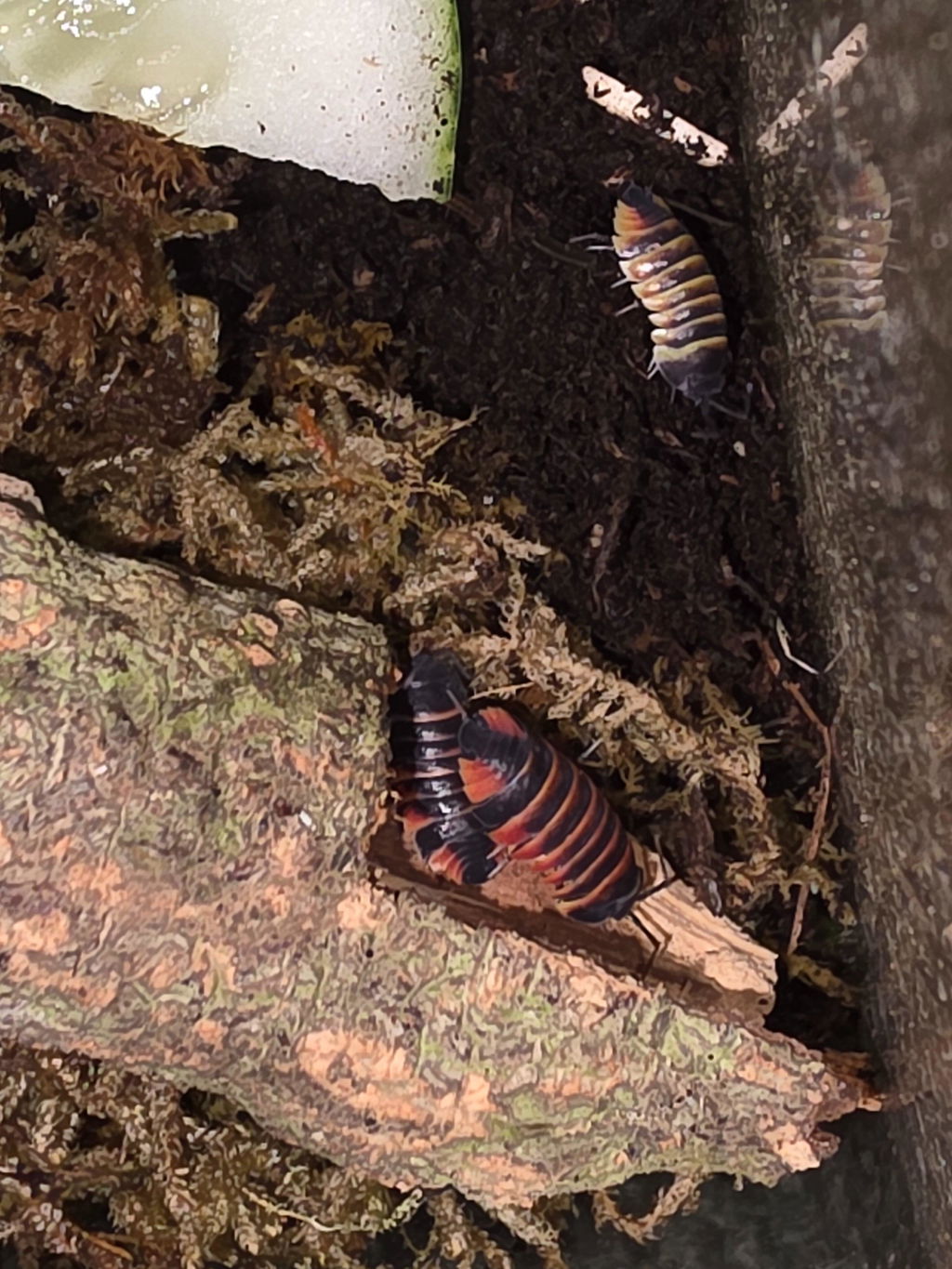
Ember Bee Isopods (Ardentiella sp.)
Care Info:
 ORIGIN
 TEMP
TEMP
 HUMIDITY
 LENGTH
 DIFFICULTY
 RARITY
- Free shipping over £65
- Low stock - 1 item left
Walk past most isopod enclosures in daylight and you see substrate. Walk past this one and you see animals. Ember Bees are out and moving by day as readily as after dark, gathered in loose groups on the bark, and among isopods that is rare enough to be the main reason to keep them. Most of what we sell rewards patience. This one rewards a glance.
The colouring earns the name. Legs and underside are jet black; above that the shell runs yellow into orange into red, so a group crossing leaf litter reads as bees rising out of embers. Markings differ from animal to animal. Adults land at about 20mm, which makes this one of the biggest members of the group, ahead of our Red Diablo and well ahead of Tri Colour. Most figures in print fall between 19 and 23mm.
What the animal is
Ours are Ardentiella sp. 'Ember Bee', from Vietnam, and you will still meet the same isopod under the older label Merulanella. A 2025 paper split that genus up and the trade has not finished catching up, so both names sit on shelves side by side. 'Ember Bee' is a breeder's line name, not a species anyone has described, and nothing about it has been formally published. Ours are captive-bred, which matters more here than the label does, because wild-caught stock in this group is markedly harder work. Everything else we keep from the group sits in our Ardentiella range.
Air that moves
These want the air both wet and in motion, two things that pull against each other, because most ways of holding humidity up will shut ventilation down. Mesh one wall, then mesh the wall facing it, so a current runs right through rather than stalling in one corner. Still, wet, warm air is what empties colonies in this group, and it does it quietly. Humidity sits in the 60s and low 70s, with one end of the box held wetter than the far end. Wet the substrate, never soak it.
Temperature is simpler than the internet suggests: an ordinary heated room does it. They do best at 20 to 23°C, and cope from 19 up to 26°C. Summer is the danger in a British house and winter is not. No heat mat. We used to advise one on this page and that advice was wrong, because a mat under a small enclosure dries the substrate and leaves a warm patch that a non-burrowing animal cannot escape.
The lid, and what goes in the box
They climb sheer glass and smooth plastic without slowing down, and the young are every bit as capable as the adults. Anything unsealed is a way out, so check the clips, the seams and the edges of the vents. They will roll into a ball if pushed, though mine seldom bother. Since they go up rather than down, a tall container beats a wide one, and cork bark set upright, with side routes branching away, keeps most of the colony where you can see it.
A living substrate of five to eight centimetres does the job, built on topsoil and sphagnum with white rotten wood and leaf mould through it. Load the top with hardwood leaf litter and more rotten wood, which together are most of the diet. Leave calcium in permanently, cuttlebone or crushed limestone, and expect it to go faster than seems reasonable for the size of animal. Vegetables in small amounts, the odd pinch of fish flake, and clear away whatever is left uneaten by the next day.
This is the gentlest introduction to the group and it is still not a first isopod. Anyone who has kept a tougher species and grasps ventilation will cope. Our Ardentiella care guide works through the husbandry for the whole group.
And for this line specifically, our Ember Bee care guide covers the husbandry in depth.
Every colony leaves here bedded on wet sphagnum, sealed into a vented deli pot, packed within a box built of two walls. Nothing posts later than a Thursday, and no parcel of ours spends a Sunday sitting in a depot. The service is tracked and next-day, delivered before 1pm. We count extras in above the tally you paid for, and we guarantee the animals reach you alive.