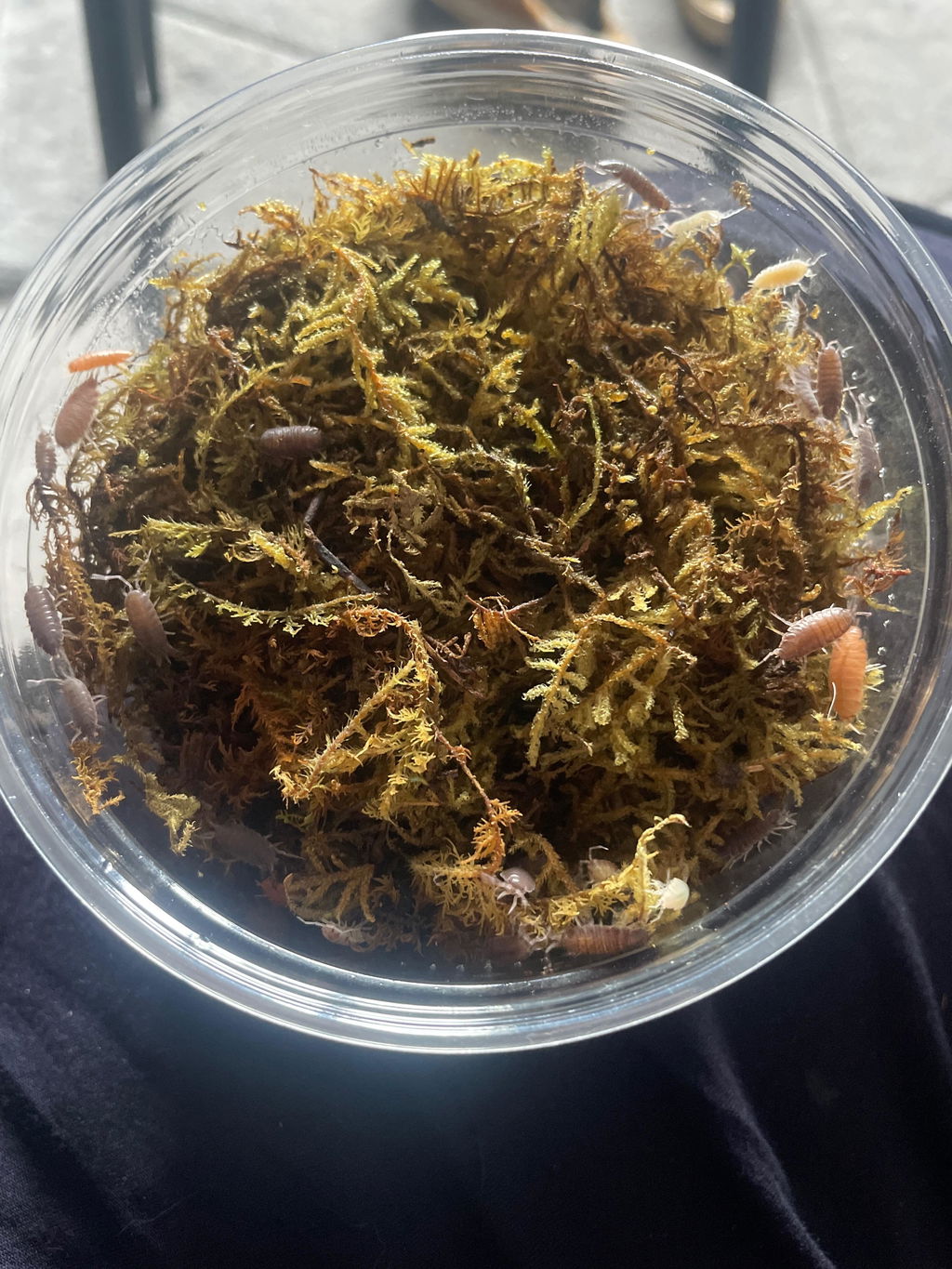
Rainbow Mix Powdered isopods (Porcellionides Pruinosus)
Care Info:
- Free shipping over £65
- Low stock - 7 items left
- Backordered, shipping soon
The Rainbow Mix is the easiest and most affordable way to start with isopods in the UK — a mixed-morph colony of Porcellionides pruinosus (the "Powder" isopod) that combines several distinctive colour lines in a single starter pack. Instead of choosing between Powder Blue, Powder Orange, Whiteout, Oreo Crumble, and the other established morphs, the Rainbow Mix gives you a varied colony from day one — properly visually interesting as a display group, and ideal as a fast-multiplying cleanup crew for any bioactive setup.
This is the entry-level listing for the catalogue, and that's the point. Porcellionides pruinosus is widely considered the easiest isopod to keep — hardy, prolific, forgiving of beginner mistakes, tolerates UK room temperature without supplementary heating, and breeds reliably under almost any reasonable conditions. If you're starting your first bioactive vivarium, building a cleanup crew for a dart-frog enclosure, or just want to learn the basics before moving on to premium Cubaris or rare Porcellio, the Rainbow Mix is the obvious starting point.
Note up front: like all Porcellionides, the Powder isopod cannot conglobate — they scurry rather than rolling into a ball. If you want a roller, look at Armadillidium instead.
What's in the Mix
The Rainbow Mix combines individuals from across our current Porcellionides pruinosus morph range — six established colour lines:
- Powder Blue — the classic foundation morph that gave the whole "Powder" group its name; pale grey-blue with the distinctive powdery wax bloom
- Powder Orange — bold orange with the same powdery dusting; among the most popular individual isopods in the UK hobby
- Orange Dalmatian — orange base with dark spotting; the "spotted" variant of the orange line
- Powder White / Whiteout — clean cream-white morph with the powdery bloom (PostPods catalogue alongside the others)
- Oreo Crumble — distinctive dark-and-light marbled patterning resembling crushed Oreo biscuits
- Wild Type Powdered (Guadeloupe) — the natural foundation form before selective breeding; subtle naturalistic appearance
Each pack arrives as a mixed-morph colony so you can watch the variation across individuals from the moment they're released into the enclosure. Browse the full Porcellionides collection if you want to add more of a specific morph, or to start individual pure-line colonies separately.
An Important Honest Note: They Will Interbreed
The Rainbow Mix is one mixed-species housing arrangement, and as such has one important caveat: all the morphs in the mix are the same species (Porcellionides pruinosus) and will happily interbreed. Over successive generations, the colony will gradually homogenise — colour lines will blur, intermediate forms will appear, and after a year or two the colony will look less varied than at the start.
This is fine for the bioactive-cleanup use case where you just want a thriving working colony of varied isopods. It's also fine if you appreciate the natural breeding-experiment aspect — watching genetic combinations emerge over generations is interesting in its own right. But if you want to maintain pure colour lines for selective breeding or for distinct display colonies, the Rainbow Mix is not the right purchase — buy single-morph cultures (Powder Blue, Powder Orange, etc.) and keep them in separate enclosures.
Honest framing matters here. The Rainbow Mix is a variety-pack starter colony, not a pure-line breeding stock.
Quick Care Summary
- Scientific Name: Porcellionides pruinosus (Brandt, 1833)
- Common Names: Powder Isopod, Pruinose Woodlouse, Mediterranean Powdered Isopod
- Family: Porcellionidae
- Origin: Native to the Mediterranean; now established worldwide (cosmopolitan distribution)
- Adult Size: 10–12 mm — small, dwarf-Porcellio sized
- Lifespan: 1.5–2 years typical (fast-breeding offsets shorter lifespan)
- Difficulty: Very Easy — the recommended starter species for new keepers
- Temperature: 18–26°C (UK room temperature works year-round without supplementary heat)
- Humidity: 40–60% — drier than most tropical isopods; this matters
- Ventilation: High — important; airflow critical for this species
- Conglobation: No — flat-bodied; scurries rather than rolling
- Appearance: Varied across the mix — pale blue-grey, orange, white, marbled, and spotted morphs all in one colony, each with the distinctive powdery wax bloom
- Behaviour: Very active; fast-moving; sociable in colonies
- Breeding: Prolific — among the fastest-breeding isopods in the hobby
- Escape risk: High — climb well; need a properly secure lid
- Rarity: Common — the most established beginner-friendly isopod
What Makes the Rainbow Mix Special
Several factors make the Rainbow Mix the right starter purchase for most UK keepers:
Maximum variety at minimum cost. Six colour morphs in one starter pack at the catalogue's entry-level price. For a first colony, getting to observe Powder Blue alongside Orange Dalmatian alongside Oreo Crumble alongside Whiteout gives you a much richer first experience than a single-morph culture.
Properly easy care. P. pruinosus is forgiving of almost every beginner mistake — wrong substrate? They cope. Slightly too dry? They cope. Slightly too humid? Less ideal, but they cope. Forgot to mist for a week? They cope. This is the species that builds husbandry confidence before you move to demanding Cubaris or rare Porcellio.
Fast results. Among the fastest-breeding isopods in the hobby. A colony that starts at a few dozen individuals can multiply into hundreds within months. Genuinely satisfying for first-time keepers who want to see real progress quickly, and essential for the bioactive cleanup-crew use case.
Genuinely useful as cleanup crew. Hardy, prolific, varied in colour for visual interest — and ecologically effective at breaking down waste, dead plant matter, and uneaten food in vivariums. Particularly popular for dart frog, crested gecko, and bearded dragon setups.
The powdery bloom. The "Powder" name refers to a fine wax bloom on the exoskeleton that gives the species its distinctive matte-dusted appearance across all morphs. Properly attractive in good light — and a useful identification feature that distinguishes Porcellionides from the smoother-bodied Porcellio.
Cosmopolitan natural history. Native to the Mediterranean but now established worldwide as one of the most successful colonising terrestrial isopods. Documented as Porcellio pruinosus Brandt, 1833 — properly Victorian-era scientific provenance with nearly two centuries of taxonomic documentation.
How the Rainbow Mix Compares to Other Beginner Options
- vs single-morph Powder Orange or Powder Blue: The natural choice point. Rainbow Mix gives variety from day one but homogenises over generations; single-morph pure cultures preserve the distinct colour line indefinitely. Buy Rainbow Mix for varied display/cleanup; buy single morphs for pure-line breeding.
- vs Wild Type Powdered (Guadeloupe): Wild Type is the foundation form before selective breeding — subtler, more naturalistic. Rainbow Mix is the bright colour-variety experience. Same species, very different aesthetic.
- vs Dairy Cow (P. laevis): Both are beginner-tier non-conglobating isopods. Dairy Cow is the bold black-and-white smooth Porcellio at slightly larger size (18-22mm); Rainbow Mix is the small dusty multi-coloured Porcellionides (10-12mm). Both excellent starting points; Rainbow Mix is faster-breeding and more visually varied.
- vs Porcellio scaber Mix: Both are mixed-colour starter packs. P. scaber Mix is the European rough woodlouse with five different colour morphs (Lava, Yin Yang, Rust, Whiteout, Ghost); Rainbow Mix is the Mediterranean Powder Porcellionides with six different colour morphs. Same conceptual purchase (variety pack starter colony), different species.
Browse the full Porcellionides collection for individual morph options.
Setting Up the Enclosure
A 6–10 litre plastic container with a secure clip-lock lid suits a starter colony. Critical: the lid must be properly secure — Porcellionides are excellent climbers and will escape through any gap. Use a clip-lock box or weighted lid, not a loose-fitting one.
Drill ventilation holes on opposite sides for cross-ventilation, covered with fine mesh. Aim for high ventilation — these aren't humid-tropical isopods, and stagnant moisture is a more common problem than insufficient moisture. Provide cork bark flats, leaf litter, and a few flat hides. The 3L Braplast tub works well for small starter groups; larger Braplast or similar containers suit growing colonies. Browse our accessories collection for appropriate enclosures, vents, and other essentials.
Important husbandry note: P. pruinosus do not need a standing water dish. Light misting in one corner provides all the moisture they need — open water risks drowning small individuals and is unnecessary for a species comfortable at 40-60% humidity. Skip the water dish.
Substrate
Use a substrate mix that retains a little moisture but drains well — these are drier-tolerant isopods:
- Organic topsoil base (pesticide-free) as the foundation
- Sphagnum peat moss mixed lightly throughout
- Composted hardwood leaf litter (oak, beech, sycamore)
- Flake soil mixed in for added nutrition
- Crushed limestone or eggshells distributed throughout for calcium
- Rotting hardwood pieces (nutrition source)
We recommend a topsoil and sphagnum-based mix rather than coco coir. Substrate depth: 3–5 cm — these are small isopods that don't need deep substrate, and shallow setups stay better-ventilated.
Top layer: Generous hardwood leaf litter — magnolia leaves, oak, and beech all work well — plus a few flat cork bark hides. The varied colour morphs show particularly well against dark substrate.
Humidity and Temperature
Maintain humidity around 40–60% with a clear moisture gradient — keep a small damp corner using sphagnum moss, while the rest stays drier with leaf litter coverage and excellent airflow. P. pruinosus are properly drier-leaning compared to most hobby isopods, and overwetting is more likely to cause issues than underwetting. If your other isopods complain about how dry the room is, the Rainbow Mix will be most comfortable.
Temperature should be 18–26°C — comfortably within UK room temperature year-round. They handle the cooler end without difficulty and don't need supplementary heating in heated UK homes. Avoid sustained extremes.
One useful framing from a returning PostPods customer in their reviews: getting the moisture right is the key to keeping isopods successfully — and for the Rainbow Mix specifically, "the right moisture" means drier than your instinct suggests for a tropical-looking species.
Diet
The Rainbow Mix are unfussy detritivores happy with a broad diet:
- Primary diet (always available): Mixed deciduous leaf litter (oak, beech, magnolia), rotting hardwood, decaying organic matter
- Vegetables (1–2x weekly): Carrot, courgette, sweet potato, squash, cucumber. Replace within 24–48 hours.
- Fruit (occasionally): Small amounts of soft fruit (apple, pear, banana — avoid citrus)
- Protein (1x weekly): Fish flakes, dried shrimp, dried daphnia. Browse our accessories collection for the full range of protein supplements.
- Calcium (essential — always available): Cuttlefish bone, crushed limestone, oyster shell, eggshells. Important for healthy moulting.
Feeding approach: Maintain a base of leaf litter and rotting wood as the foundation, supplementing with occasional vegetables, fruit, weekly protein, and a constant calcium source. These are forgiving feeders — variety helps but consistency is more important than precision.
Breeding
The Rainbow Mix breeds prolifically once established — among the fastest-breeding isopods in the hobby. Settled colonies can multiply rapidly from dozens to hundreds within months.
Breeding basics:
- Females carry developing young in a marsupium (fluid-filled brood pouch) and release fully-formed live juveniles
- Young reach maturity in roughly 2-3 months — much faster than most isopods
- Breeding is continuous in stable warm conditions rather than seasonal
- The mixed colony will produce mixed-morph offspring, with all combinations and intermediate forms appearing across generations
For breeding success:
- Stable temperature within range (22–25°C is ideal for peak breeding)
- Moderate moisture with proper gradient
- Adequate calcium for breeding females
- Regular protein supplementation supports population growth
- Don't overcrowd — split colonies into multiple enclosures as numbers grow
If you want to maintain pure colour lines from the Rainbow Mix, separate individuals of the same morph into pure-line enclosures before they breed. Otherwise, embrace the natural genetic mixing.
Pair With Springtails
Add a thriving springtail culture to any Rainbow Mix setup. Springtails handle mould and microbial growth at a scale isopods can't manage — and the springtail-Porcellionides combination is the classic bioactive cleanup partnership that powers most successful vivarium ecosystems.
Who Should Buy the Rainbow Mix?
Ideal for:
- Complete beginners — this is genuinely the easiest starting point
- Bioactive vivarium builders needing a working cleanup crew (dart frogs, crested geckos, bearded dragons)
- Anyone wanting maximum colour variety at minimum cost
- Keepers learning isopod husbandry before moving to premium species
- People who want a fast-multiplying colony that produces visible results quickly
- Display keepers who appreciate the natural mixed-colony aesthetic over single-morph purity
Not ideal for:
- Anyone wanting to preserve pure colour lines (buy single morphs in separate enclosures instead)
- Keepers wanting an isopod that conglobates — Porcellionides don't roll (try Magic Potion or other Armadillidium instead)
- People wanting larger display animals (these are 10-12mm small isopods)
- Setups without secure-lid enclosures (Powder isopods escape readily)
Realistic Expectations
They're small. 10-12mm — properly dwarf-Porcellio sized. Don't expect large dramatic display animals; expect a fast-moving busy colony of small varied isopods.
They will interbreed. Over generations, the colour variety will blur. This is fine for cleanup-crew or naturalistic-mix purposes; not fine if you want pure lines.
They breed fast. Within months you'll have far more isopods than you started with. Plan for colony expansion — additional enclosures or splitting cultures.
They escape. Use proper clip-lock or weighted lids. The "found one in the bathroom three rooms away" experience is common with this species.
They want it drier than you expect. The 40-60% humidity recommendation is the actual care requirement, not a guideline. Don't overdo the misting.
They don't conglobate. Like all Porcellionides, they scurry rather than rolling.
Building Your Setup
A complete Rainbow Mix setup needs a properly-sealed enclosure with high ventilation, a moisture-retentive but well-draining substrate, calcium sources, generous leaf litter, and a few cork bark hides. Browse our accessories collection for everything you need — enclosures, ventilation, leaf litter, calcium (cuttlebone, limestone, oyster shell), and protein supplements.
Browse the full Porcellionides collection for individual colour morphs to add separately — including Powder Blue, Powder Orange, and the foundation Wild Type Guadeloupe — or pick up Dairy Cow for a fellow beginner-tier non-conglobating species at slightly larger size.
Use collapsible tabs for more detailed information that will help customers make a purchasing decision.
Ex: Shipping and return policies, size guides, and other common questions.