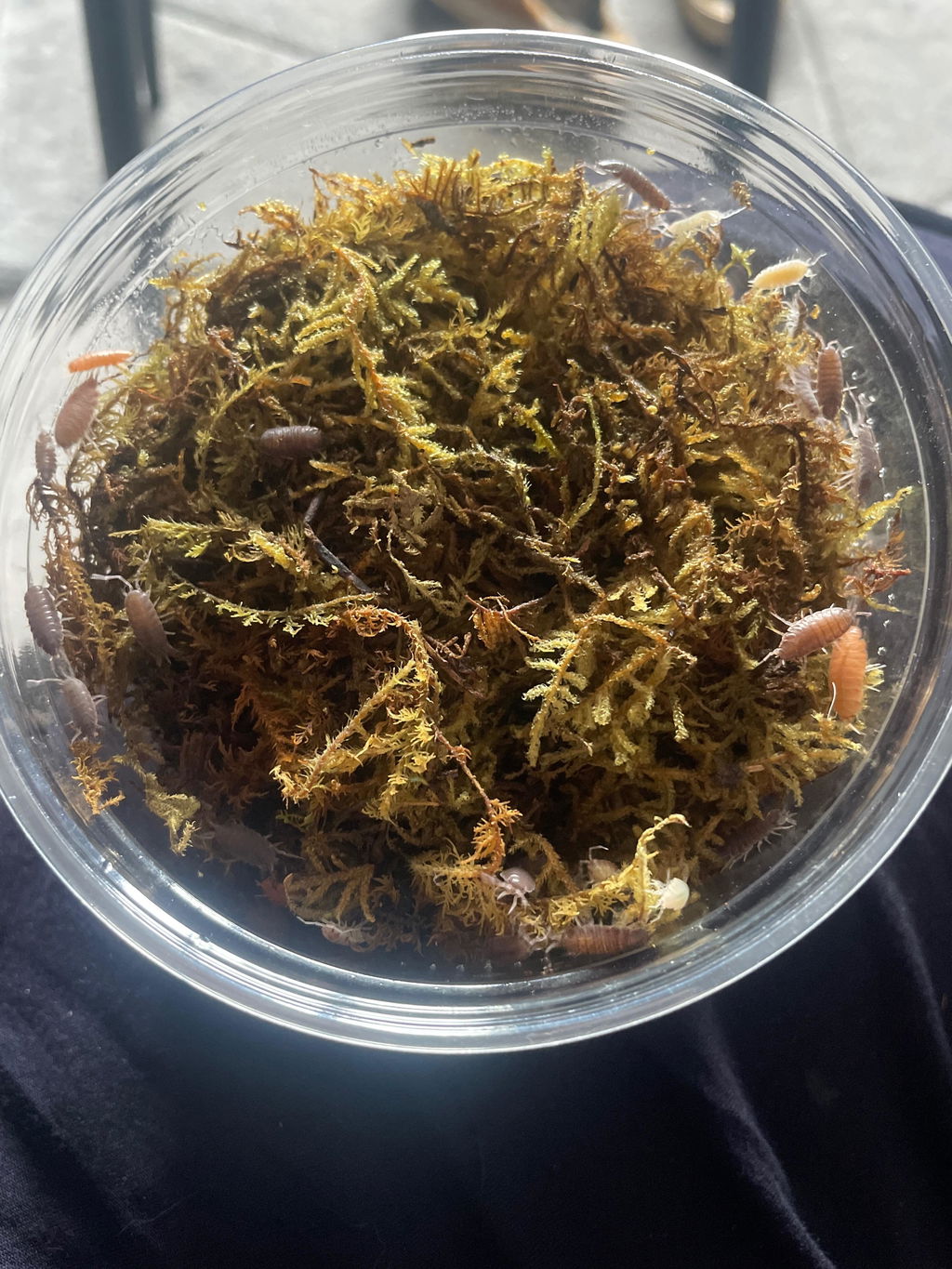
Rainbow Mix Powdered Isopods (Porcellionides pruinosus)
Care Info:
 ORIGIN
 TEMP
TEMP
 HUMIDITY
 LENGTH
 DIFFICULTY
 RARITY
- Free shipping over £65
- Low stock - 6 items left
If you want the least fussy way into isopods, this is where I point people first. The Rainbow Mix is a mixed-colour starter culture of Porcellionides pruinosus, the isopod the hobby calls the Powder, and instead of committing to a single morph you get a lottery of the Powder lines dropped into one tub. You might get Powder Blue next to Powder Orange, a scatter of Whiteout, the odd Oreo Crumble, and whatever the colony holds it is the cheapest, most forgiving first colony I recommend.
The Powder name comes from a fine bloom that sits over the shell and gives every morph a soft, matte, dusted finish. Across the mix you will see pale blue-grey, bold orange, spotted orange, clean cream-white and dark marbled individuals, all small and busy at around 10 to 12 mm as adults. That bloom is also a handy way to tell Porcellionides from the smoother-shelled Porcellio. These are flat, quick animals that scurry and hide rather than roll, so if you want a woodlouse that balls up, look to Armadillidium instead.
Porcellionides pruinosus is Mediterranean by origin but has spread across most of the world, and that adaptability is why it copes so well on a shelf in a British home. It does best at 20 to 26°C. A normally heated house keeps it going all year but sits just under that band in winter, so a small heat mat on a thermostat, fixed to the side of the tub, keeps a colony breeding through the colder months. The one thing people get wrong is moisture. This is a drier-leaning isopod, happiest at around 50 to 70% humidity with plenty of airflow, so give it a damp corner of sphagnum and keep the rest of the tub drier under leaf litter. Stagnant, sodden substrate causes far more trouble than a tub that runs slightly dry.
A 6 to 10 litre tub with a secure clip-lock lid makes a fine home, and it needs to clip shut, because these are strong climbers that slip through any gap. Drill cross-ventilation holes on opposite sides to keep the air moving. I use a topsoil and sphagnum base rather than coir, about 3 to 5 cm deep, under a generous layer of hardwood leaf litter and a few cork bark hides. Keep crushed limestone, eggshell or cuttlebone available at all times for healthy moulting. Feeding is simple: leaf litter and rotting hardwood as the base, a little veg such as carrot or courgette once or twice a week, occasional soft fruit and a weekly pinch of protein. Skip the water dish; light misting in one corner gives them all the moisture they need.
This is one of the fastest-breeding isopods in the hobby, which is a big part of why it works so well as a cleanup crew in a bioactive vivarium. Females carry their young in a brood pouch and release live juveniles that reach maturity in roughly two to three months, so a starter group of a few dozen becomes hundreds within a season. One point worth stating plainly: every morph in the mix is the same species, and they will interbreed, so the colours blur towards intermediate forms over a year or two. For a working cleanup colony that is no bad thing. If you want to hold a pure line, buy a single morph and keep it on its own.
It helps to know what this mix is not. It is not the Armadillidium vulgare Gem Mix and it is not the rougher Porcellio scaber Mix; both are different species sold as their own variety packs. This one is Porcellionides, the dusty Mediterranean Powder. If you would rather begin with the natural form, the wild-type Powder is the foundation behind all these morphs, and you can browse the single colour lines across the Porcellionides collection.
Common questions
Will the colours stay separate? No. They all interbreed, so expect the mix to drift towards blended forms over the generations. Keep single morphs apart if you want pure lines.
Do they need heating? Not to keep them alive. A normally heated British home keeps them going year round, and a small heat mat on a thermostat keeps them breeding through winter.
Whichever colours turn up in your tub, the care is identical across the species, and our Powder isopod care guide covers the setup, feeding and breeding in detail.
Each culture is bred here in the UK and packed with care for live arrival. Get the moisture and airflow right, and this little mix looks after itself.