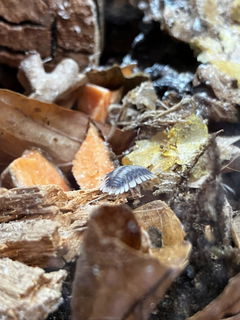
Armadillidium depressum 'Magic Potion' Isopods
Care Info:
 ORIGIN
 TEMP
TEMP
 HUMIDITY
 LENGTH
 DIFFICULTY
 RARITY
- Free shipping over £65
- Low stock - 4 items left
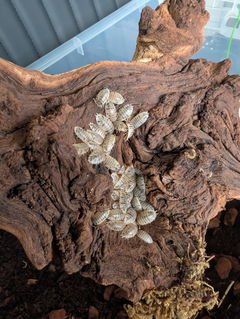
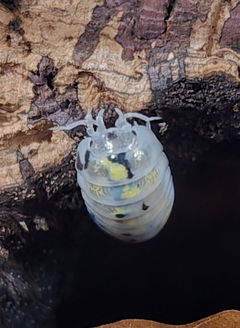
Two different woodlice go by the name Magic Potion, and it is worth knowing which one you are looking at. The familiar version is a morph of the common pill bug, Armadillidium vulgare. This is the other one: Armadillidium depressum 'Magic Potion', the same soft, milky-pale look with scattered yellow markings, carried on a flatter, slightly larger European species. The result is a gently translucent, cream-and-gold animal that stands apart from the usual grey-brown run of native isopods, with a shape all its own.
A. depressum, the Southern Pill Woodlouse, is a hardy western European species found across the UK, France and neighbouring regions, which makes it well suited to keeping here without any fuss over heating. Compared with the high-domed vulgare it is noticeably flatter and more splayed across the back, a body built for squeezing into cracks in old stone walls. That flatter build changes one behaviour worth flagging: where A. vulgare seals into a perfect ball, depressum only rolls part of the way, leaving a small gap between head and tail. It is normal for the species, not a fault, and a handy way to tell the two Magic Potions apart.
The care is where this one earns its keep, because it pairs an unusual look with an easy temperament. It sits among the more collectable Armadillidium alongside the marbled Espanyoli and the boldly striped Zebra, and if you want to compare it directly you can see the standard vulgare Magic Potion and the plain Southern Pill Woodlouse too. One husbandry point matters more than any other with this species: despite what some care charts suggest, depressum is a European animal that prefers drier, airy conditions, not constant tropical damp.
Aim for a moderate humidity around 50 to 65% with a clear moisture gradient and decent airflow. In practice that means one lightly misted corner under sphagnum where moulting animals can retreat, and the rest of the tub left to dry between waterings. They struggle to moult in a stagnant, sodden setup, so if you have kept tropical species before, err drier here and keep the ventilation up. Normal UK room temperature, roughly 17 to 23°C, suits them the year round, and they shrug off the seasonal ups and downs that would trouble a warm-climate isopod.
Give them a five to ten litre tub with cross-ventilation, then a living substrate of flake soil, well-rotted hardwood and organic topsoil about five to eight centimetres deep for burrowing and moulting. I would skip a pure coco-coir base, which holds damp but feeds nothing; the wood-and-leaf mix doubles as food as it rots down. Top it with magnolia and oak leaf litter, add cork bark and a few pieces of white-rotted wood, and keep calcium, cuttlebone, crushed limestone or eggshell, available throughout for firm moults.
Feeding is straightforward. Leaf litter and rotting wood stay down as the staple; add soft veg such as carrot, courgette and squash once or twice a week, lift out what is not eaten, and offer a little protein now and then, keeping in mind that Armadillidium need far less of it than the hungry Porcellio do. Breeding takes care of itself once the drier gradient is right: females carry young in the brood pouch and release live miniatures in good-sized broods, and the pale colouring fills in as they mature, so a settled colony grows into a striking, self-sustaining display.
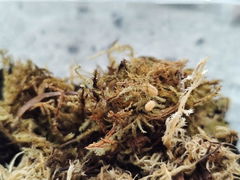
Pair them with a springtail culture to handle mould in the damp corner, or browse the wider Armadillidium collection to build out the genus. Every order is captive-bred, packed in a double-walled box around a ventilated tub of damp sphagnum and posted Monday to Thursday by tracked next-day Royal Mail, with a modest overcount and a live-arrival guarantee on every parcel.
Use collapsible tabs for more detailed information that will help customers make a purchasing decision.
Ex: Shipping and return policies, size guides, and other common questions.