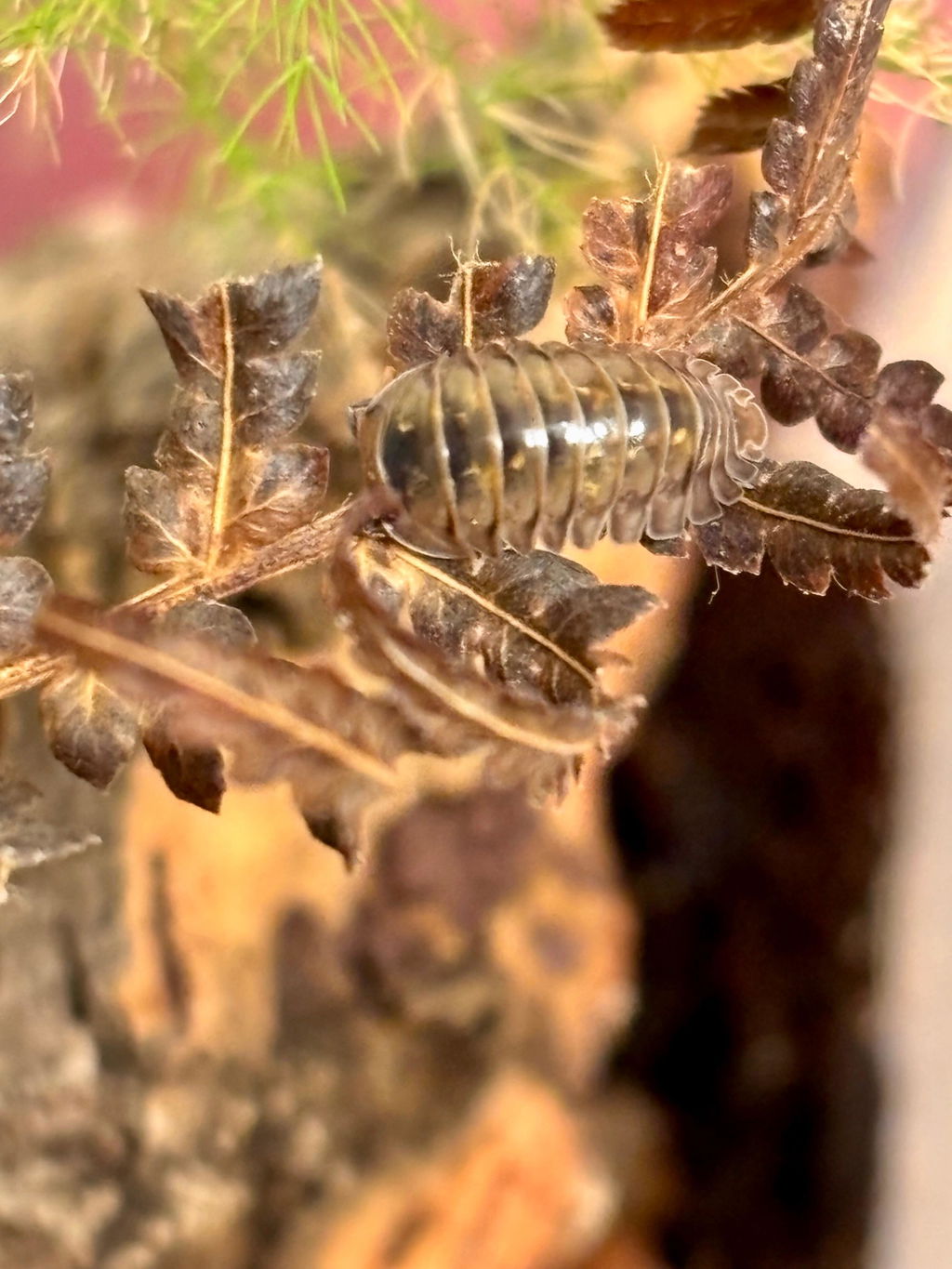
Spherillo sp. "Dream" Isopods
Care Info:
 ORIGIN
 TEMP
TEMP
 HUMIDITY
 LENGTH
 DIFFICULTY
 RARITY
- Free shipping over £65
The single most useful thing I can tell you about the Dream is that it does not want a swamp. For all its jungle looks, Spherillo sp. 'Dream', traded as Vietnamese, wants moderate humidity and moving air rather than a closed box of sodden moss, and one seller warns that it suffers, and can even die, in extremely high humidity. Get that one idea right and most of the rest of its care falls into place.
The Dream travels the hobby under an unusually long list of names. You will see it sold as Spherillo sp. 'Dream', as Cubaris sp. 'Dream' or 'Shrub', and, as the trade has moved it between labels, as Dryadillo sp. 'Dream' and, in older listings, Merulanella sp. 'Dream'. Hobby name lists treat them all as one animal, which has no formal description that we could find, and every genus it is sold under belongs to the family Armadillidae. I list it as Spherillo sp. 'Dream', and our Dream isopod care guide goes through the names, the sellers' figures and its care in more depth.
In the photographs on this listing the shell runs from a glossy, silvery blue-grey to a darker bronze-brown, with two rows of small yellow spots down the back, a pale, slightly translucent rim and, on the paler animals, orange at the front. Sellers describe a wider range again, from almost white through light brown to dark brown, and one says every animal seems to wear its spots a little differently. The 12 to 15mm on our care panel is our own figure, and some sellers quote up to 20mm; either way it is a mid-sized isopod rather than a dwarf. Two sellers call it mostly active at night, and one of our customers finds them quite active and keen climbers, often as high up as they can get. One seller says they roll up for a moment when startled and are soon on the move again.
The care, then, is about balance rather than moisture for its own sake. Aim for a humidity of roughly 55 to 70 per cent, damp at one end of the enclosure and drier at the other, with air moving through: stagnant, humid air kills isopods that need airflow, so fit fine mesh in two opposite walls and never seal the box. It likes to be kept warm, in the region of 22 to 26°C, held steady inside that band rather than pushed to the top of it. An English home averages about 19°C through the heating season, below that range, so fit a heat mat or cable on a thermostat to the side of the tub through the colder months at least, and keep it off windowsills, which run cold in winter and overheat in the sun. Never stand the enclosure on a heat mat, which dries and overheats the substrate from below.
Build the floor on a hardwood base of decaying leaf litter and crumbling white-rotted wood, with a little sphagnum worked into the damp end. That leaf and wood layer is food as much as flooring, and it wants topping up as the colony grinds through it. Beyond the substrate they take the usual isopod extras in small amounts, soft vegetables and the occasional pinch of protein such as fish flake or dried shrimp, and they need a steady source of calcium, so keep crushed oyster shell or limestone in the enclosure: woodlice build their shells from calcium carbonate.
If the Dream draws you into the Asian exotics, the Sinodillo 'China' is another to look at, and you will find the whole range on our isopods for sale page.
The Dream you receive is captive-bred rather than wild-collected, and the earliest record of this animal in the hobby that we found is from 2021. I count every culture generously, adding around a fifth again over the number you order, and send them out in a ventilated tub with damp sphagnum inside an insulated, double-walled box, dispatched Monday to Thursday by Royal Mail Tracked 24, or Next Day Delivery if you choose it at checkout, with a heat pack tucked in when the weather is cold and a live arrival guarantee on every order. I have kept isopods since January 2021 and exotic animals since 2003, and I still rate the Dream among the prettier exotics you can keep, as long as you resist the urge to keep it wet. Give it warmth, airflow and a deep bed of leaf and wood, and let the colony build at its own pace.