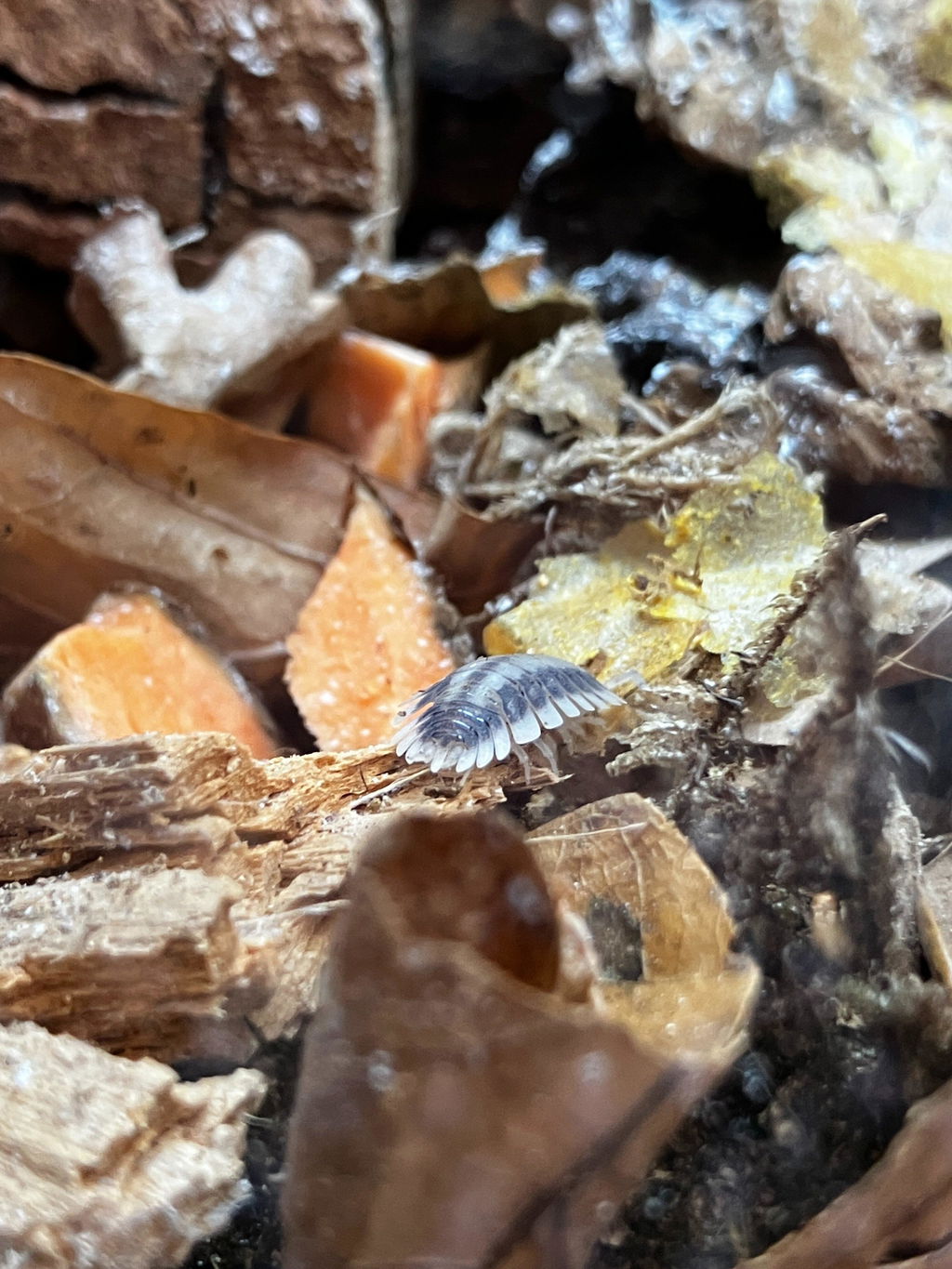
Porcellio Werneri Silverback Isopods (Greek Shield Isopod)
Care Info:
- Free shipping over £65
- Low stock - 4 items left
- Backordered, shipping soon
Porcellio Werneri Silverback Isopods are one of the more distinctive Mediterranean species in the UK hobby — a Greek limestone-cave specialist with a properly flat shield-like body and (in the Silverback morph specifically) a striking silvery-white stripe running down the centre of the dorsum. At around 20 mm adult size, these are properly substantial isopods, and the dry-loving Mediterranean husbandry profile makes them genuinely different to keep from the tropical species that dominate most isopod collections. For UK keepers especially, the species's temperature preferences (17–26 °C) match British room conditions better than most popular hobby isopods.
This is part of our wider Porcellio collection, alongside our other Mediterranean species in the genus — including our Porcellio expansus Prades and Porcellio Red Uropods Orange Stick. All three are dry-tolerant Mediterranean species that share fundamental husbandry approaches — properly different from the tropical Cubaris and Ardentiella morphs that dominate much of the modern hobby. For keepers building a focused Mediterranean Porcellio display, these species together cover much of the genus's range across Greek and Spanish dry-rocky habitats.
One honest framing point up front. The "Silverback" designation refers to a specific captive-bred morph line of P. werneri — not the wild-type animal. The Silverback lineage was developed from a distinct wild population separate from the standard grey form, and produces the characteristic silvery-white dorsal stripe through selective breeding. The husbandry is identical to standard P. werneri; what you're paying for is the visual distinction of the morph rather than a different species. The "Greek Shield Isopod" common name applies to all P. werneri regardless of morph. To set things up properly from the start, browse our accessories collection for substrate components, calcium sources, and other items this species depends on.
Quick Care Summary
- Scientific Name: Porcellio werneri — captive-bred "Silverback" morph line
- Common Names: Greek Shield Isopod, Werner's Isopod, Werner's Woodlouse; informally "Pancake Isopod" or "Limpet Isopod" for the flat clinging body shape
- Family: Porcellionidae (order Isopoda, suborder Oniscidea)
- Genus context: Porcellio is a properly large genus of mainly Mediterranean and European isopods. Many species are dry-tolerant rocky-habitat specialists — distinct from the tropical Cubaris that dominate the modern premium hobby. P. werneri is among the more visually distinctive species in the genus due to the extreme dorsoventral flattening
- Origin: Greece — Aegean islands and mountainous areas of the Balkan Peninsula. In nature, the species is restricted to dry calcareous (limestone) rocky habitats, often around limestone caves and rocky crevices. The Silverback morph specifically traces to a distinct Greek wild population
- Adult Size: Up to approximately 20 mm length, with a properly wider body proportion than typical Porcellio — the flat shield shape gives the species its visual character
- Lifespan: 2–3 years typical in good captive conditions
- Difficulty: Medium — properly more demanding than beginner species like P. scaber or P. laevis, but achievable for experienced keepers with proper setup. CB stock is more forgiving than wild-caught
- Temperature: 17–26 °C — properly suits UK room temperature for much of the year
- Humidity: 50–65% — low compared to tropical isopods; properly Mediterranean. Don't try to maintain rainforest-style humidity
- Ventilation: Medium-high — properly critical. Inadequate airflow combined with high humidity is the most common cause of colony failure for this species
- Body shape: Properly the flattest isopod commonly in the hobby — broad, oval, dorsoventrally compressed. Adapted for crevice-dwelling, clinging to vertical surfaces, and wedging into narrow gaps
- Appearance (Silverback morph): Dark grey base body with a distinctive silvery-white stripe running down the centre of the dorsum. Mancae and juveniles emerge with brown base colouration that transitions to grey at maturity; the Silverback stripe develops as the animals mature
- Activity: Primarily nocturnal and early-morning active; reclusive and wary during daylight hours. Wedges into narrow crevices for defence
- Social structure: Group-living; coexists peacefully in groups given adequate space and cover
- Rarity: Rare in UK hobby — the Silverback morph specifically is less commonly available than wild-type P. werneri
What Makes Porcellio werneri Silverback Special
The extreme body flatness. P. werneri is genuinely the flattest isopod commonly available in the hobby — properly different in body proportions from the typical rounded Cubaris or even from other Porcellio species. The flattened shield shape isn't subtle; it's an immediately visible morphological adaptation. Multiple hobby sources compare the species to limpets, hovercraft, Roombas, or flying saucers — the visual character is properly unusual. For keepers building diverse-looking isopod collections, the body shape alone differentiates these animals from anything else in your enclosures.
The Silverback-specific morph appearance. Beyond the standard P. werneri flat body, the Silverback morph adds a distinctive silvery-white dorsal stripe down the centre of the body. This creates a properly different visual character from the wild-type P. werneri (which has white serrated edges around a darker centre). The Silverback's reversed colour distribution — dark edges, light centre — gives the morph its visual identity. Under good display lighting, the silver stripe catches the light in ways the wild-type doesn't.
The Mediterranean dry-loving biology. Unlike most premium hobby isopods (which come from tropical rainforest environments), P. werneri evolved in dry Greek limestone habitats. This translates to genuinely different husbandry — lower humidity, higher ventilation, room-temperature preferences rather than tropical heat. For keepers comfortable with one husbandry profile, switching to P. werneri requires properly different setup logic. For UK keepers in drier homes, the species's natural preferences actually match British conditions better than tropical species do.
The UK temperature suitability. The 17–26 °C preferred range matches UK average room temperature for much of the year. Unlike tropical species that need supplementary heating through autumn-to-spring, P. werneri typically thrives at standard UK room ambient without dedicated heat — a properly practical advantage. Through UK winters, no supplementary heat needed. Through UK summers, the animals tolerate warm conditions better than the cooler-loving species like Ardentiella.
The Porcellio family connection. Within our Porcellio collection, this is one of the Mediterranean limestone-specialist species alongside our Porcellio expansus Prades (Spanish) and Porcellio Red Uropods Orange Stick. The three species share fundamental husbandry approaches — drier substrate, high ventilation, calcium-rich diet, Mediterranean room temperatures. For collectors building a focused dry-loving Porcellio display, these species are properly complementary.
The crevice-dwelling behaviour. The extreme flat body shape is an evolutionary adaptation for wedging into narrow rocky crevices — limestone cracks, fissures in cave walls, gaps under rocks. In captivity, this translates into properly distinctive enclosure preferences: the animals love egg crates, vertical cork bark slabs, narrow gaps under cover objects, and any structure that provides tight fits. Watching P. werneri wedge into impossibly narrow crevices is genuinely one of the more interesting behaviours in isopod keeping.
The captive-bred advantage. The Silverback morph is exclusively captive-bred — properly no wild-caught option exists for this specific colour line. CB stock is significantly more forgiving of hobby conditions than wild-caught P. werneri would be, and the morph stability through generations of selective breeding makes the appearance properly reliable.
About the Name and the Silverback Morph
The naming situation has a few subtleties worth understanding.
- Porcellio werneri: The accepted scientific species name. P. werneri is widely distributed across Greek Aegean islands and the Balkan Peninsula mountain regions, with multiple wild populations showing subtle morphological variation
- "Silverback" as a morph designation: The Silverback name refers to a captive-bred colour line specifically — derived from a distinct Greek wild population separate from the typical grey-with-white-edges form. The morph's defining feature is the silvery-white stripe running down the centre of the dorsum, reversing the colour distribution of the wild-type. "Silverback" is a hobby trade name rather than a formal taxonomic subspecies
-
Common names:
- Greek Shield Isopod: The most established hobby common name. References both the Greek origin and the broad shield-shaped flat body
- Werner's Isopod / Werner's Woodlouse: Direct translation from the species epithet, honouring whoever Werner was
- Pancake Isopod / Limpet Isopod: Informal names referencing the flat body shape and clinging behaviour
-
Distinguishing from other Porcellio species:
- vs P. expansus Prades: Both Mediterranean dry-loving Porcellio; expansus is Spanish, larger, and lacks the extreme flatness of werneri
- vs P. sp. Red Uropods Orange Stick: The Red Uropods morph emphasises colour features at the body extremities; Silverback emphasises the central dorsal stripe
- vs common P. scaber morphs: Scaber morphs are typical "rough woodlice" body shape; werneri is properly flatter, broader, and more shield-like
- Family Porcellionidae: Distinct from family Armadillidae (which contains our Cubaris and Ardentiella). Porcellionidae species generally don't conglobate (don't roll into tight balls); they rely on flat body shape and crevice-wedging for defence instead
Setting Up the Enclosure
The enclosure setup is properly different from tropical isopod species. Two key requirements: lower humidity than typical hobby setups, and crevice-rich structure that suits the species's natural flat-body biology.
A modest enclosure size works for a starter group — a 5–10 litre plastic tub or small glass enclosure suits 5–10 animals. Sealed-gasket food storage containers work properly well because they hold humidity precisely when modified with appropriate ventilation; you can manage moisture levels reliably.
Provide proper crevice-rich structure:
- Egg crate sections (cardboard or plastic) — properly loved by this species for the multiple narrow gaps they provide
- Cork bark slabs in various sizes, including vertical orientations — the flat body clings to vertical surfaces
- Layered cork bark pieces creating tight gaps between layers
- Limestone or sedimentary rock pieces — properly natural habitat material and provides calcium
- Multiple hide options creating gaps of different sizes
Browse our accessories range for cork bark and natural cover options.
Escape-proofing is generally straightforward — P. werneri aren't notable climbers on smooth surfaces. A properly fitting lid with adequate ventilation is sufficient. The species's flat body might wedge into small gaps around lid edges, so check for any openings.
Important husbandry note: The humidity-ventilation balance is properly the most common failure point. P. werneri need lower humidity AND high ventilation simultaneously — this is genuinely different from most hobby isopods. Mesh ventilation panels on opposing sides of the enclosure allow proper cross-airflow without trapping moisture. Don't seal up the enclosure to maintain humidity — for this species, more airflow is generally better than less.
Substrate
Substrate composition for P. werneri is properly different from tropical isopod species — drier overall with calcium-rich components matching the limestone habitat. The right mix:
- Coconut fibre (coir) or organic topsoil as the base — kept relatively dry rather than constantly damp
- Crushed limestone or eggshell mixed throughout — properly important. The natural habitat is calcium-rich and the animals benefit from constant access to calcium in the substrate
- Sandy soil components mixed in — better mimics the dry rocky Mediterranean habitat
- Decaying hardwood pieces mixed in — both food and habitat
- Modest leaf litter layer on top — properly less than tropical species need. Browse our accessories collection for ready-prepared leaf litter
- Sphagnum moss patches in one corner only — provides a moisture refuge, not full-substrate moisture
- Additional calcium sources on the surface — cuttlebone, larger limestone pieces. Our calcium options cover the full range
Substrate depth: 3–5 cm minimum. Maintain a clear moisture gradient — keep one fifth to one third of the enclosure moist (the moss-covered corner), with the rest of the enclosure substrate kept properly dry. Animals choose their preferred humidity level by moving between zones.
Humidity and Temperature
Maintain humidity at 50–65% — properly lower than most hobby isopods. The Mediterranean limestone habitat is genuinely dry, and these animals are adapted for it. Don't attempt rainforest-style humidity (80%+); consistently high moisture causes mould and stress in P. werneri.
Maintain the moisture gradient through targeted misting — light misting on the moss corner once or twice weekly maintains the moisture refuge without saturating the rest of the substrate. The bulk of the enclosure should be allowed to dry between any moisture applications.
Temperature should be 17–26 °C — properly matching UK ambient room temperature for much of the year. UK winter rooms often run at 18–22 °C, which is genuinely within the species's preferred range. No supplementary heating is typically needed.
If your home runs cooler than 17 °C in winter, a low-wattage heat mat on a thermostat, mounted on the side of the enclosure (not underneath), provides supplementary warmth. For UK summers, the species tolerates warm conditions reasonably well — brief excursions above 26 °C are properly fine, though sustained exposure above 30 °C causes stress.
Diet
Porcellio werneri accept a standard isopod diet but with properly more emphasis on calcium and protein than tropical species:
- Hardwood leaf litter — the dietary foundation; should always be available. Oak, beech, magnolia all work. Browse our accessories collection for ready-prepared leaf litter
- Decaying hardwood — both food and habitat; constantly consumed
- Fresh vegetables — courgette, cucumber, sweet potato, carrot in modest amounts
- Fresh fruit occasionally — banana, apple in small portions. Replace within 24–48 hours
- Protein supplements regularly — fish flakes, gammarus shrimp, similar. The Mediterranean species generally benefit from more frequent protein than tropical species; offer 2–3 times weekly. Browse the protein options in our accessories collection
- Calcium sources — cuttlebone, crushed limestone, oyster shell, eggshell. Properly critical given the limestone-habitat origin; always available. Our calcium options cover the full range
Remove uneaten fresh food within 24–48 hours to prevent mould — particularly important in the drier substrate where mould development can be a sign of conditions being out of balance.
Breeding
Porcellio werneri Silverback breed reliably in captivity given proper conditions. The species reproduces at the standard Porcellio pace — properly slower than the prolific tropical species but consistent across well-managed colonies.
The breeding sequence follows standard isopod patterns — females develop a marsupium (brood pouch) on the underside of the body where eggs develop and mancae are released. Mancae emerge as miniature versions of adults with brown base colouration; the adult grey base and Silverback dorsal stripe develop through successive moults.
For breeding success:
- Properly stable conditions — temperature, the humidity gradient, ventilation, substrate quality
- Mixed-age starter group of 5+ animals — provides best chance of having both sexes represented
- Continuous leaf litter and rotten wood supply
- Calcium consistently available — properly essential for healthy moulting
- Adequate crevice-rich structure — animals need cover during moults, particularly for vulnerable mancae
- Stable temperature in the 19–24 °C range works well
- Patience — Porcellio werneri are not rapid breeders
The Silverback dorsal stripe develops over successive moults rather than appearing at hatching — properly normal for this morph. Don't expect newly-released mancae to show the adult colour pattern immediately.
Who Should Buy Porcellio werneri Silverback?
Ideal for:
- Experienced isopod keepers wanting to expand into Mediterranean dry-loving species
- Display enthusiasts drawn to the dramatic flat body shape and distinctive Silverback stripe
- Keepers in drier UK homes where tropical humidity is challenging to maintain
- Collectors building a focused Porcellio display covering Mediterranean species
- Anyone with cooler UK home temperatures — the species's preferences actually match British conditions
- Patient keepers comfortable with moderate breeding pace and the species's reclusive nature
- Bioactive vivarium setups designed around dry rocky habitats rather than tropical rainforest
- Keepers interested in unusual isopod body morphology
Not ideal for:
- Complete beginners — start with easier species like P. scaber morphs or P. laevis
- Tropical-only setups that can't accommodate the lower humidity gradient
- Setups without crevice-rich structure — the species's behaviour properly depends on wedging opportunities
- Keepers wanting constantly visible isopods — P. werneri is reclusive by nature
- Anyone wanting prolific rapid breeding — these aren't P. laevis reproduction rates
Realistic Expectations
The humidity profile is genuinely different from tropical species. New keepers transferring habits from Cubaris or Ardentiella often instinctively keep P. werneri too wet — this is properly the most common cause of colony failure. The species needs drier substrate with a moisture refuge corner, not uniformly damp substrate. Customer feedback consistently mentions that careful adherence to the dry-with-gradient setup is critical; treating these animals like tropical isopods leads to deaths.
They're reclusive by nature. Don't expect constant surface activity like Ardentiella or some of the more active Cubaris morphs. P. werneri are properly wary and crevice-dwelling — they spend most of daylight hours hidden in narrow gaps. Activity peaks at night and early morning. For keepers wanting constantly visible isopods, this species can feel disappointing; for keepers who enjoy the puzzle of finding cleverly-wedged animals, the behaviour is genuinely interesting.
The Silverback stripe develops over time. Newly-released mancae are brown and don't show the adult Silverback dorsal pattern. The silver stripe develops through successive moults as juveniles mature. Don't be disappointed by initially understated juveniles — the morph appearance becomes properly distinctive after a few moults.
The flat body looks fragile but isn't. The dramatic flatness of P. werneri can look like the animals would be easily damaged, but the body shape is a properly robust evolutionary adaptation rather than a structural weakness. The animals handle being briefly turned over, gently manipulated, and normal enclosure activity without difficulty.
Captive-bred makes a real difference. We sell captive-bred Silverback specifically because the survival outcomes for new keepers are substantially better than for wild-caught P. werneri would be. The morph itself only exists through captive breeding from the distinct wild population it originated from.
UK temperatures genuinely suit this species. Unlike most premium hobby isopods (which need supplementary heating through UK winter), P. werneri typically maintains comfortable temperatures at standard UK room ambient. This is properly practical — fewer infrastructure requirements than tropical species.
Crevice structure is non-negotiable. The species's biology centres on wedging into narrow gaps — egg crates, cork bark layers, rock crevices. Setups without proper crevice structure don't give the animals their natural behavioural outlet. Build the enclosure around the crevice-dwelling behaviour rather than treating structure as decoration.
UK escape isn't an environmental risk. UK outdoor conditions are too cool and wet for Greek P. werneri to establish reliable wild populations — the species needs drier conditions than UK climate typically provides. Recapture escapees promptly but don't worry about establishing harmful feral colonies.
Use collapsible tabs for more detailed information that will help customers make a purchasing decision.
Ex: Shipping and return policies, size guides, and other common questions.