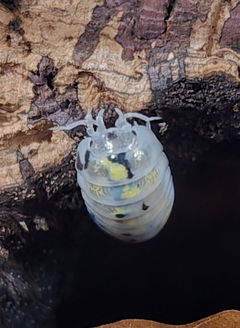
Giant Flower Cockroach (Eucorydia Dasytoides)
Care Info:
- Free shipping over £65
- In stock, ready to ship
- Backordered, shipping soon
The Giant Flower Cockroach is the largest Eucorydia species currently available in UK culture and one of the most spectacular display roaches in the hobby. Adults reach 15–20 mm — roughly twice the size of the more commonly seen Sapphire Flower Cockroach (E. yasumatsui) — and emerge from their final moult with the iridescent metallic blue-green colouration that defines the genus. The transformation from drab brownish nymphs to fully-coloured adults is genuinely dramatic; it's one of the more visually rewarding moments available in invertebrate keeping.
This is part of our wider cockroach collection and forms the natural large-format companion to our Sapphire Flower Cockroach for Eucorydia enthusiasts. Both species share the metallic colouration and flower-visiting heritage, but differ meaningfully in size, climbing ability, and adult behaviour. For collectors building a focused Eucorydia cluster, having both species together shows the genus's range — the small, non-climbing, diurnal E. yasumatsui alongside the larger, climbing, more active E. dasytoides. Both also pair naturally with our Emerald Cockroach (Pseudoglomeris magnifica) as part of a curated jewel-roach trio.
One honest framing point up front. E. dasytoides is genuinely rare in UK culture and adults can climb and fly — escape-proofing matters more than for the smaller E. yasumatsui. Nymph development is properly slow (7–10 months to reach adulthood), so this is a long-term display species rather than a fast-establishing colony. To set things up properly from the start, browse our accessories collection for the cork bark, leaf litter, and supplementary foods this species depends on.
Quick Care Summary
- Scientific Name: Eucorydia dasytoides (Walker, 1868); some recent taxonomic treatments place this as a subspecies of E. aenea (i.e., E. aenea dasytoides), but hobby usage and most current literature treat it as a full species
- Common Names: Giant Flower Cockroach, Giant Sapphire Flower Roach
- Family: Corydiidae (subfamily Corydiinae); historically classified under Polyphagidae
- Origin: Taiwan, China, and parts of Southeast Asia; UK stock currently in culture originates from Taoyuan, Taiwan
- Adult Size: 15–20 mm — roughly twice the size of E. yasumatsui; the largest Eucorydia currently available in culture
- Lifespan: Adults live a few months after maturity; nymph development takes 7–10 months
- Difficulty: Medium — manageable husbandry, but ventilation balance and patience with slow development matter
- Temperature: 20–27 °C; benefits from slight winter cooling (a few degrees drop) to support natural seasonal cycles
- Humidity: Moderate — 50–70%; drier conditions with good ventilation are preferred over wet humid setups
- Ventilation: High — critical and often underestimated; poor ventilation can collapse a colony
- Climbing: Nymphs cannot climb smooth surfaces; adults are capable climbers — escape-proofing required at adult stage
- Flying: Adult males fly readily when disturbed; secure lid essential
- Activity: Adults diurnal (day-active), with males actively exploring and females remaining more secretive
- Appearance: Adults metallic blue-green iridescent body and pronotum, often with orange or yellow accents on the wing covers (tegmina); nymphs drab brownish until the final moult
- Sexual dimorphism: Males more active and exploratory; females remain hidden, preferring to burrow or shelter under bark
- Reproduction: Oothecae (egg cases); eggs deposited in substrate or attached to bark
- Rarity: Rare in UK culture; relatively new to the UK hobby and highly sought after
What Makes the Giant Flower Cockroach Special
The transformation is the central appeal. Nymphs of E. dasytoides are properly drab — small, brownish, unremarkable insects with no hint of the colouration to come. After the final moult, adults emerge with full metallic blue-green iridescence, often with orange or yellow accents on the wing covers. The change is so dramatic that keepers occasionally don't recognise their own animals after that final moult. For display purposes, this transformation alone justifies the keeping commitment.
The size advantage. At 15–20 mm, E. dasytoides is roughly twice the size of Sapphire Flower Cockroaches. While 20 mm isn't large by general cockroach standards (Madagascar Hissers reach 60+ mm), within the metallic display-roach niche it's properly substantial — the colouration is more visible from a distance, the iridescent quality has more surface area to play across, and the animals are simply easier to observe in a planted setup.
The diurnal activity with sex-differentiated behaviour. E. dasytoides is genuinely day-active, but more than that, the sexes behave differently. Males explore the enclosure actively, walking across cork bark, climbing branches, and occasionally flying when disturbed. Females are more secretive, preferring to burrow into substrate or shelter under bark. This sex-differentiated behaviour mirrors the species's natural ecology — wild males are pollinators visiting flowers during daylight, while females remain near rotting wood and oviposition sites. In captivity, a sexed group provides much more visible activity than either sex alone.
The flower-visiting heritage. Like other Eucorydia, E. dasytoides has an unusual ecological history — males in the wild are observed visiting flowering plants, feeding on pollen and nectar in a beetle-like manner. This isn't shared with most cockroach species and gives the genus its "Flower Cockroach" common name. In captivity, the species responds well to pollen-based supplementary feeding, and offering bee pollen or pollen-containing foods is part of the right husbandry approach rather than just enrichment.
The Eucorydia cluster context. Within our roach catalogue, E. dasytoides is the larger half of the Eucorydia pair. Sapphire Flower Cockroach (E. yasumatsui) is smaller, non-climbing, and the more accessible starting point; E. dasytoides is larger, climbing-capable, more active, and more visually impressive at adult stage. For Eucorydia-focused collectors, keeping both is the natural progression — start with E. yasumatsui to learn the genus's husbandry, then add E. dasytoides once you're confident with the ventilation balance and slow development cycle.
About the Name and Taxonomy
A few notes on the species's nomenclature and current taxonomy.
- Eucorydia dasytoides: The scientific binomial under hobby and most current usage. Originally described by Walker in 1868.
- Eucorydia aenea dasytoides: Some recent taxonomic treatments (e.g., Wikipedia/Beier 1963) place dasytoides as a subspecies of E. aenea. The hobby trade continues to use the full-species name. Both refer to the same animal; the distinction is a taxonomic preference rather than a functional difference.
- Giant Flower Cockroach / Giant Sapphire Flower Roach: The standard hobby trade names, both referring to the species's size relative to other Eucorydia and the metallic colouration.
- Family Corydiidae vs Polyphagidae: The species is currently placed in family Corydiidae following revised taxonomy. Older literature classifies it under Polyphagidae — both names refer to the same family-level group; the change reflects accepted reclassification rather than a different organism.
- Genus context: Eucorydia contains 23 known species across Asia. E. dasytoides is one of the larger and more visually impressive species, alongside E. westwoodi, E. forceps, E. linglong, and others. Within hobby culture in the UK, E. dasytoides and E. yasumatsui are the most commonly available.
Setting Up the Enclosure
A 5–10 litre plastic container or glass terrarium suits a starter group of 5–10 nymphs; scale up to 10–20 litres for established colonies with adults. Ventilation is critical for this species — drill or cut ventilation holes generously, with mesh-covered ventilation on opposing sides and across the lid. As with E. yasumatsui, undersized ventilation is a documented colony-killer; the species genuinely prefers a slightly drier and well-ventilated setup over a humid stagnant one.
Escape-proofing matters more than for the smaller Eucorydia species. Nymphs cannot climb smooth surfaces, but adults are capable climbers and males fly readily when disturbed. A properly fitted lid is non-negotiable once nymphs reach maturity. Consider a smooth climbing barrier inside the rim of the enclosure (petroleum jelly or a strip of smooth plastic) as additional insurance. Cover ventilation holes with fine mesh — newly-emerged nymphs (2–3 mm) can squeeze through surprisingly small gaps.
Provide multiple hides distributed across the enclosure. Cork bark in both horizontal and vertical orientations, lotus pods, and decaying hardwood pieces all work well. Females in particular need shelter for oviposition; nymphs use cover during their long development. Browse our accessories range for cork bark, lotus pods and other natural cover options.
Lighting matters more than for most cockroaches. As a diurnal species, E. dasytoides benefits from a clear day/night cycle. Standard ambient room light works; direct bright lighting isn't necessary but a visible day-night rhythm supports natural behaviour and breeding cues.
Important husbandry note: Skip the standing water dish. Light misting and substrate moisture provide all the hydration this species needs. Open water adds mould risk in a setup that should lean dry rather than wet.
Substrate
Use a moderately moist forest-soil-style substrate that drains well:
- Organic topsoil or coco humus (pesticide-free) as the foundation
- Composted hardwood leaf litter mixed throughout and layered generously on top — browse our accessories collection for properly prepared options
- White rotten hardwood pieces — important for nymph hides and supplementary nutrition
- Orchid bark or fine wood chips for structure and drainage
- A small amount of sphagnum moss for moisture retention in one corner
- Springtails inoculated into the substrate — they consume droppings and food waste, preventing mould in the warm setup
Substrate depth around 5–8 cm gives nymphs room to burrow during development and supports females laying oothecae in the substrate. Top layer: a generous covering of hardwood leaf litter (oak, beech, magnolia) plus cork bark and lotus pods for surface cover.
Humidity and Temperature
Maintain humidity at 50–70% with the substrate kept lightly damp rather than wet. Mist every 2–3 days, allowing the enclosure to dry noticeably between mistings. This is genuinely important: E. dasytoides performs better in drier, well-ventilated conditions than in stagnant humid ones. Keeper experience across the Eucorydia genus consistently shows that overly wet, poorly ventilated setups can wipe out colonies within months. If you're erring in one direction, err on the side of drier and better-ventilated rather than the reverse.
Temperature should be 20–27 °C. The cooler end of this range works fine for steady maintenance; the warmer end (24–27 °C) supports faster nymph development. Unlike E. yasumatsui, E. dasytoides actually benefits from a slight winter cooling period — a few degrees drop during UK winter (say, 18–22 °C overnight) mimics the species's natural seasonal cycle and can support breeding by triggering natural reproductive cues. Don't drop temperatures dramatically; modest seasonal variation is the right approach rather than aggressive cooling.
UK room temperature in winter can drop below the species's preferred range — a low-wattage heat mat on a thermostat, mounted on the side of the enclosure rather than underneath, provides ideal supplementary warmth. Side-mounted heating creates a thermal gradient and avoids overheating the substrate where nymphs spend much of their time.
Diet
E. dasytoides shares the unusual Eucorydia dietary profile — flower-visiting heritage translates to a feeding programme more like a sap-feeding beetle than a typical scavenger roach:
- Fresh fruit — the dietary mainstay. Apple, pear, melon, banana, soft pears work well. Replace within 24–48 hours.
- Bee pollen — particularly important for this genus; offer constantly or refresh weekly. The flower-visiting ecology means pollen is genuinely part of the natural diet.
- Beetle jellies (the type used for stag beetles) — readily accepted and clean, providing balanced nutrition without the mould risk of fresh fruit. Honey jellies and protein-enriched jellies both work.
- Dried hardwood leaves and dead flowers (particularly from fruit trees) — eaten and useful as cover. Browse our accessories collection for properly prepared leaf litter.
- Rotting hardwood — used as cover and slowly consumed
- Fish flakes occasionally for protein, ground fine for nymphs. Our accessories range covers the full protein selection.
- Calcium sources — cuttlebone, crushed limestone as background availability. Our calcium options cover the full range.
Position fresh food on dishes or leaves rather than directly on substrate to make removal of uneaten portions easier. The combination of fruit, pollen, and jelly products is the right baseline; pure leaf-litter feeding (suitable for many cockroach species) doesn't work as well for Eucorydia.
Breeding
Breeding E. dasytoides is a long-term project. Females are oothecae-laying — they produce egg cases which they partially bury in substrate or attach to bark. Nymphs hatch as drab brownish small insects and progress through multiple instars before reaching the dramatic adult colouration at the final moult. Nymph development takes 7–10 months under good conditions; faster than the 18–22 months reported for some Eucorydia in cool conditions but still properly slow by cockroach standards.
For breeding success:
- Sexed group — sex-differentiated behaviour means a mixed-sex group provides much better display activity and breeding opportunities than single-sex stock
- Stable temperature in the warmer half of the range (24–27 °C) for active development, with modest winter cooling (a few degrees) to support natural seasonal cues
- Consistent moderate humidity without wet swings — let the enclosure dry between mistings
- High ventilation maintained — this is the husbandry feature most often missed
- Mixed-age colony — given the 7–10 month development cycle, maintaining nymphs at multiple instars alongside adults supports continuous breeding
- Springtails inoculated to manage waste and prevent mould during the long development phase
- Pollen and jelly products available consistently — these support both adult breeding condition and nymph development
- Patience — colony establishment takes a year or more
Nymphs are small and require fine foods initially — powdered pollen, finely-crushed fish flake, and similar small particles. The long nymph stage means the species is uncommon in culture despite being relatively hardy at adult stage.
Who Should Buy Giant Flower Cockroaches?
Ideal for:
- Display enthusiasts who already have Sapphire Flower Cockroaches and want to expand into the larger Eucorydia species
- Eucorydia-focused collectors building the complete genus pair
- Keepers interested in jewel-roach displays alongside the Emerald Cockroach and other metallic species
- Display-focused keepers wanting larger, more visible animals than E. yasumatsui
- Long-term project keepers comfortable with the 7–10 month development cycle
- Anyone seeking a rare species not commonly available in UK culture
Not ideal for:
- First-time cockroach keepers — start with the easier Cuban Cockroach or Sapphire Flower Cockroach
- Setups that can't maintain proper ventilation — this is the most common reason Eucorydia colonies fail
- Anyone expecting fast colony growth — the 7–10 month development means establishing a productive colony takes a year or more
- Keepers without supplementary warmth in colder UK homes during winter
- Setups without proper escape-proofing for the climbing-and-flying adult stage
Realistic Expectations
Ventilation is the husbandry detail that most often gets missed. Keeper accounts of Eucorydia colony losses consistently point to inadequate ventilation as the cause. Treat ventilation as more important than humidity — this species is genuinely better off slightly dry and well-ventilated than properly humid and stuffy.
The transformation takes time. New keepers wanting to see the famous metallic colouration need to be patient — nymphs take 7–10 months to reach the final moult. Don't panic if nymphs seem to be making slow progress or look unimpressive; the dramatic colouration only appears after the final moult, and there's no shortcut. If you're buying starter nymphs, expect to wait the better part of a year before seeing full adult colouration.
Climbing and flying ability changes at maturity. This is a quirk specific to E. dasytoides: nymphs cannot climb smooth surfaces, but adults can. This means your escape-proofing requirements step up at the moment your animals are most valuable as fully-coloured adults. Plan for the adult-stage escape-proofing from the start; don't retrofit after nymphs start moulting.
Sex-differentiated activity is real. Males explore actively and may fly when disturbed; females remain hidden under bark or in substrate. A single-sex group will look much less active than a mixed-sex group, regardless of population numbers. If you're buying for display purposes, prioritise sexed stock or buy enough nymphs to ensure both sexes reach maturity.
Adults are short-lived relative to the long nymph stage. Once animals reach maturity, the spectacular colouration only lasts a few months before natural lifespan ends. The transformation is glorious but transient. The right framing is to value the species as a long-term project where adult appearance is a periodic reward across multiple generations rather than a permanent feature.
It's not a beginner roach. Despite being less demanding than some Cubaris isopod morphs, E. dasytoides isn't the right starting species for someone new to cockroach keeping. The ventilation balance, slow development, and stage-changing escape risk all reward experience. New keepers should start with the Cuban Cockroach or Sapphire Flower Cockroach before stepping up to this one.
Use collapsible tabs for more detailed information that will help customers make a purchasing decision.
Ex: Shipping and return policies, size guides, and other common questions.