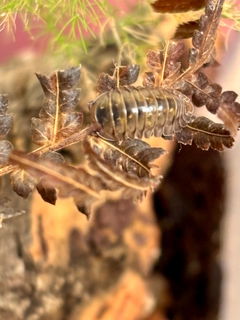
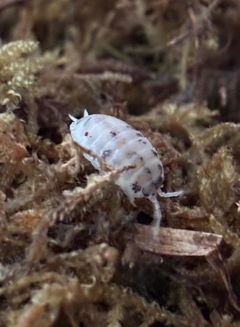
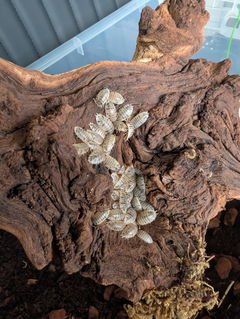
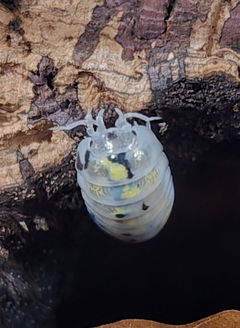
Tenerife White & Light Purple Isopods (Armadillidium sp)
Care Info:
 ORIGIN
 TEMP
TEMP
 HUMIDITY
 LENGTH
 DIFFICULTY
 RARITY
- Free shipping over £65
The place name on this listing points at a common animal, not a rare one, and we would rather lead with that than let it imply otherwise. There are no Armadillidium native to the Canary Islands. The Canarian isopod fauna runs to at least thirty-five native species, twenty-nine of them endemic, and Porcellio alone accounts for seventeen of those. The only Armadillidium on Tenerife is Armadillidium vulgare, the common pill woodlouse, and there it is an introduced invasive.
So what is in the tub
If the Tenerife provenance behind this line is accurate, the animal is almost certainly a colour line of A. vulgare. That is not a disappointment. A. vulgare is the species behind a good half of the interesting pale morphs in the hobby, including the Gem Mix and the St Lucia Jelly Bean that we also keep, and it is why this is an accessible animal rather than a scarce one.
What we sell it as is a mixed pale line: animals running from near-white through to a soft lilac cast, the purple more obvious on some individuals than others and most visible on a fresh moult in good light. It is a subtle animal. Set beside a high-contrast morph it will look understated, which is either the appeal or the problem depending on what you came for.
We cannot verify the Tenerife collection story. No other seller anywhere offers a line under this name, so there is nothing to check it against, and we treat it as a trade designation and not as a locality.
Worth knowing about the islands anyway
The Canarian woodlouse fauna really is still being described. A new endemic Porcellio, P. aguerensis, was published from Tenerife laurel forest in February 2025. That is a live and ongoing story, and it is exactly why the "undescribed island endemic" framing is tempting for a listing like this one. It simply does not apply to an Armadillidium.
Keeping them
Straightforward, which is the other half of the case for it. Treat it as A. vulgare: wet at one end of the tub, dry across the rest, five centimetres of substrate under a layer of hardwood leaf litter, cork bark and flat cover to hide beneath, and cuttlebone permanently available. Ordinary room temperature, 18 to 28°C, no heating required. Ventilation matters a great deal more than misting does.
Adults reach about 18mm. They conglobate completely, which is the party trick, and they climb smooth surfaces poorly, so containment is easy. They breed readily, they forgive mistakes, and they are hard to kill, which is why we put them on our list of best isopods for beginners.
One correction while we are here, because it comes up constantly: Armadillidium are not parthenogenetic. They breed sexually and the female carries the young in a marsupium. The genus does have an odd reproductive story, but it involves bacteria skewing the sex ratio, not females reproducing alone.
A good first pill woodlouse, and a reasonable second culture for somebody who already keeps a bold morph and wants something quieter beside it. Everything else in the genus is filed under Armadillidium isopods.
Captive-bred. Out Monday to Thursday, bedded on moss, in a pot drilled for air and boxed twice over, with Royal Mail for delivery the morning after before one. There will be a few more animals in there than the label promises. Live arrival guaranteed.
Use collapsible tabs for more detailed information that will help customers make a purchasing decision.
Ex: Shipping and return policies, size guides, and other common questions.