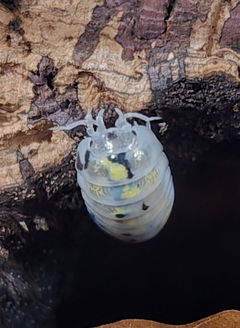
Armadillidium vulgare 'T- Albino' Isopods
Care Info:
 ORIGIN
 TEMP
TEMP
 HUMIDITY
 LENGTH
 DIFFICULTY
 RARITY
- Free shipping over £65
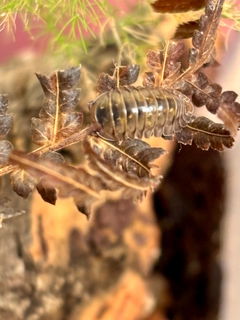
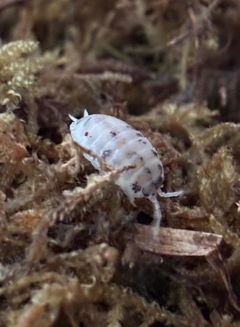
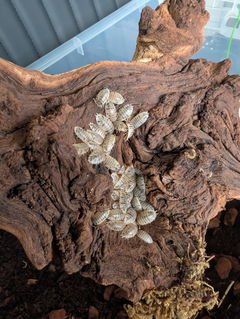
"Albino" gets thrown around loosely in this hobby, stuck on anything pale. The Armadillidium vulgare 'T- Albino' is one of the few animals that earns the word outright. The "T-" is borrowed from snake keeping, where it stands for tyrosinase-negative, though no isopod has ever been shown to work that way. What is published is that albino A. vulgare lack the ommochrome pigments behind the usual slate-grey, so they come out clean white to the faintest cream, with maybe a ghost of gold across the back. Even the eyes carry little dark pigment. Against dark substrate and leaf litter the effect is unmistakable, a pale animal that catches the eye from the other side of a room.
It helps to know how the two albino lines differ, because they look nothing alike. This one, the T-, is the fuller pigment loss of the two, so the body reads as near-pure white. Its sibling, the T+ (tyrosinase-positive) albino, keeps the machinery for warmer pigments and so glows orange and gold instead. If it is the crisp white you are after, the T- is your animal; if you would rather have warm citrus tones, the T+ is the one to add. Plenty of keepers end up with both.
Underneath the unusual colour this is still ordinary A. vulgare, the common pill woodlouse that anchors the beginner end of the hobby and the same species behind the speckled Magic Potion. Native across Mediterranean Europe and long since naturalised almost everywhere, it is about as hardy and forgiving as isopods get, and the albino carries all of that resilience with it. Like every Armadillidium it is a true pill bug, rolling into a tight, fully sealed ball when it feels threatened, the classic roly-poly trick, here on a striking white body.
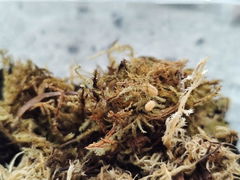
Housing is simple. A six to ten litre tub with a clip-lock lid suits a starter group, with cross-ventilation drilled into both sides. These lean drier rather than tropical, so I keep them at a moderate humidity with a clear gradient: one end lightly damp under a patch of sphagnum and leaf litter, the other left to run drier, and the colony moves between the two as it pleases. Good airflow heads off most mould before it starts. Normal heated room temperature suits them the year round, somewhere around 18 to 24°C.
For substrate I use a living, nutritious base of flake soil, well-rotted hardwood and organic topsoil, at least five centimetres deep for burrowing. I would steer you off a pure coco-coir base here: it holds water well but gives a substrate-grazer nothing worth eating. Cap it with a generous layer of leaf litter, magnolia and oak both ideal, and tuck in a few pieces of cork bark for cover. Leave a piece of cuttlebone or some crushed eggshell in for constant calcium, which keeps moulting clean and the white shells firm.
They are unfussy feeders. Leaf litter and rotting wood are the always-available staple; on top of that offer soft veg like courgette, squash and sweet potato, lifting out anything uneaten within a day, and give a little protein such as fish flake or dried insects once or twice a week to keep a breeding colony productive. Being a true Armadillidium, they will graze soft plants in a planted setup, so plant tough if you want the greenery to last.
Breeding is steady rather than explosive. Kept warm, fed well and given plenty of calcium, a settled group carries young in the female's brood pouch and releases live miniatures that come through pale from the start. Kept morph-to-morph the offspring breed true as albinos, since the trait is recessive; cross them back to a wild-type vulgare and the white vanishes for a generation, worth knowing if you want to hold a clean line.
Pair them with a springtail culture to keep mould in check, and browse the rest of the Armadillidium collection if you are building out the genus. Every order is captive-bred, boxed in a double-walled carton around a ventilated tub of damp sphagnum, and posted Monday to Thursday by tracked next-day Royal Mail with a live-arrival guarantee and a 20% overcount for good measure.
Use collapsible tabs for more detailed information that will help customers make a purchasing decision.
Ex: Shipping and return policies, size guides, and other common questions.