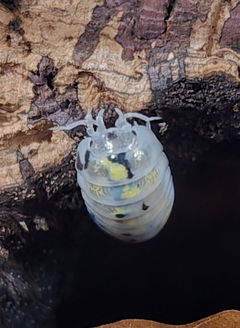
Armadillidium werneri 'Carrying Leucistic Gene' Isopods for Sale
Care Info:
 ORIGIN
 TEMP
TEMP
 HUMIDITY
 LENGTH
 DIFFICULTY
 RARITY
- Free shipping over £65
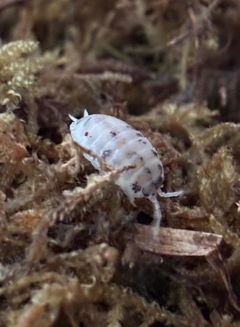
Pale animals turn up in this line. It is the honest version of what this page used to claim and the one we can stand behind, because we have bred them here and watched them appear out of normally coloured parents. What we cannot tell you is why, and after working through the literature we have had to take a fair amount off this page.
The old copy called them leucistic and printed a 25/50/25 inheritance ratio. Both have gone. Leucism is a vertebrate condition - a failure of pigment cells derived from the neural crest, which is a structure isopods do not possess and never have. Worse, it is not melanin that gives these animals their body colour. It is ommochrome, shown directly inside the genus by work on an albino strain of A. vulgare, where the block sits at the start of the pathway. Separately, breeding work on A. nasatum colour morphs shows the pale forms behaving as simple recessives and working by subtraction - the dark pigment absent, a lighter one that was always there becoming visible. That is inheritance, not pigment chemistry, and it is a different species, so we cannot move it onto this one. Either way the word was borrowed from snake keeping and applied to an animal it cannot describe.
The ratio was worse. There is no published cross, no identified locus and no documented pale morph in this species anywhere. A textbook monohybrid figure was being presented as though somebody had counted offspring. Nobody has. And there is no carrier test for any colour allele in any terrestrial isopod, so no seller on earth, us included, can tell you an individual animal carries anything.
What we will say
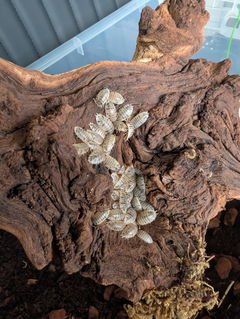
Pale offspring have appeared in our stock, from parents that looked ordinary. We cannot promise you will see them, we cannot tell you the odds, and we will not sell you a specific animal as a carrier. If that is the whole reason you want this line, buy a larger group and be patient, and understand you may get nothing.
The species itself
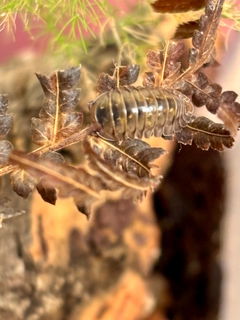
Armadillidium werneri Strouhal, 1927. Corfu, and by recent observation the Epirus mainland and southern Albania - Ionian and Adriatic, not Aegean, and nothing supports the Turkish islands this page used to name. It sits in the klugii group, and the way to tell it from A. klugii is not size but structure: frontal crests to the sides of the frontal shield, a distinct angle on the trailing edge of the first epimeron, and a narrowly rounded telson tip.
On size we have also had to retreat. The old page gave 20 to 22mm throughout and claimed the animal was bigger than klugii. The only measured werneri in the literature is a single illustrated male at 16mm, while klugii has a published maximum of 21mm - so if anything the comparison ran backwards. No maximum has ever been published for this species. Ours look about the size of a klugii to the eye.
Two footnotes. A subspecies exists, A. werneri obscurum, described by Strouhal in the same 1927 paper, and nobody in the trade resolves stock to that level including us. And the line other sellers actually carry for this species is an orange one, not a pale one, so there is nothing to compare ours against.
Keeping is standard Mediterranean Armadillidium: 18 to 26°C, a moisture gradient around 50 to 60% with most of the floor dry, 5cm of substrate, limestone and leaf litter, permanent calcium. They conglobate completely, as the genus does. More of them on the Armadillidium page.
One caveat on ordering, given everything above: we cannot select pale animals for you and we will not pretend to. What arrives is a mixed group from the colony. It travels in a vented tub on moist moss inside a twin-wall box, posted Monday through Thursday, with 20% more animals than you ordered, and a live arrival guarantee.
Use collapsible tabs for more detailed information that will help customers make a purchasing decision.
Ex: Shipping and return policies, size guides, and other common questions.