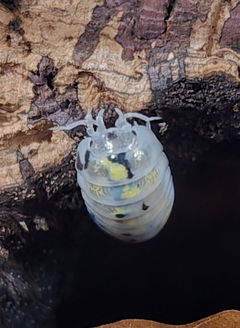
Armadillidium Esterelanum Isopods for Sale
Care Info:
 ORIGIN
 TEMP
TEMP
 HUMIDITY
 LENGTH
 DIFFICULTY
 RARITY
- Free shipping over £65
The Massif de l'Estérel is a block of red volcanic rock on the coast between Cannes and Saint-Raphaël, about 320 square kilometres of it. That is the core of this isopod's world range, and it is where Dollfus collected the specimens he described it from in 1887. The type material in London still carries its original label: Mt Vinaigre, the highest point of the massif.
A species with a very small map
Armadillidium esterelanum Dollfus, 1887, written without brackets because Dollfus placed it in Armadillidium himself and nobody has moved it since. It has no synonyms at all, which for a nineteenth-century Armadillidium is unusual, though a species with a range this small has had few chances to be confused with anything.
Of the occurrence records in the global databases, all but two are French, and the French ones cluster tightly in the Var: Fréjus, Saint-Raphaël, Le Muy, Draguignan. The Estérel and its immediate surroundings, and very little beyond. Karl Wilhelm Verhoeff collected there, and some of that material is still in Helsinki. It was reported as new to the Bouches-du-Rhône department as recently as 2021, pushing the known range a short way west toward Marseille, and a survey of the Port-Cros national park lists it among species of restricted national distribution. The map is small, but it is still being drawn.
What you are getting
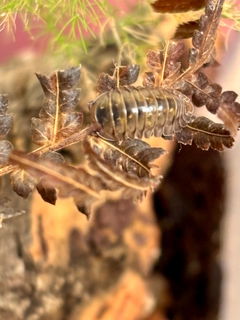
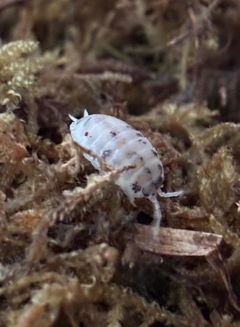
A smooth, glossy, dark brown-grey pill woodlouse of medium size, around 12 to 15mm in our stock. No banding, no spotting, no morph names. It is the opposite of the loud pattern animals that dominate the hobby, and the appeal is the finish more than the colour: clean tegument, a tight roll, and a shape that photographs better than a spotted animal does.
Two things we will not tell you. There is no published size figure for the species anywhere, so the millimetres above are what has circulated on this listing and we cannot point you at a source for them. And no vendor in the UK, Netherlands, Germany or Spain lists this animal at all, as far as we can find, which is the strongest evidence for the rarity claim we could possibly offer, but it also means there is no second opinion anywhere on how to keep it.
Keeping them
Southern French Mediterranean, so build for a dry animal that can retreat to moisture when it chooses. One damp corner, the rest of the floor on the dry side, and ventilation good enough that nothing stays wet on top. Five centimetres or so of substrate, hardwood leaf litter piled on top of it, and plenty of flat cover, bark and stone, the sort of thing it would sit under on a hot slope. If you want the reasoning behind the gradient, our guide to humidity for isopods covers it.
Ordinary room temperature works, roughly 18 to 25°C, with no heating of any kind. Cuttlebone or limestone permanently in the enclosure, because everything in this genus needs calcium and a conglobating species needs more of it. Feed the usual detritivore range with protein now and then.
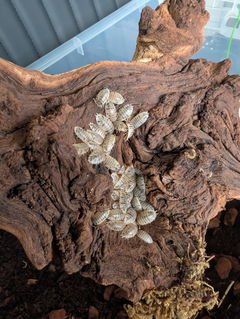
Breeding is steady rather than explosive, which is worth knowing before you commit: this is a collector's animal for somebody who wants something almost nobody else in the country has, not a fast colony. In that respect it sits close to ruffoi, the other single-locality endemic we keep, and both live under Armadillidium isopods.
Bred here from a small founding group. Packing is the same for everything alive that leaves us: airholes in the pot, damp moss for the journey, two thicknesses of board on the outside. We post between Monday and Thursday, Royal Mail get it there the following day by one o'clock, we always count in your favour, and live arrival is guaranteed.
Use collapsible tabs for more detailed information that will help customers make a purchasing decision.
Ex: Shipping and return policies, size guides, and other common questions.