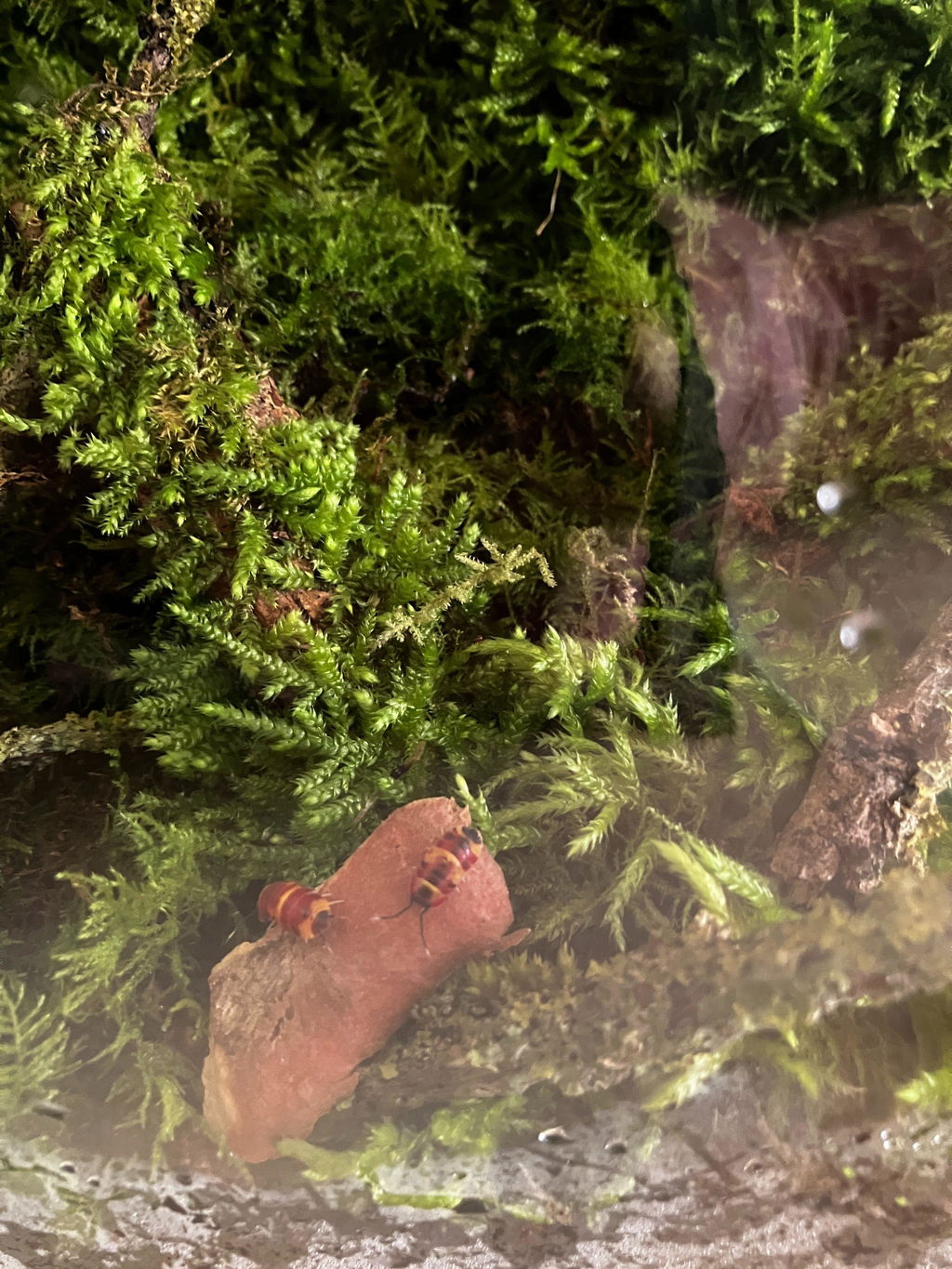
Red Diablo Isopods (Ardentiella sp.) for Sale UK
Care Info:
 ORIGIN
 TEMP
TEMP
 HUMIDITY
 LENGTH
 DIFFICULTY
 RARITY
- Free shipping over £65
The word in this page's web address now points at the wrong side of the planet. Since the 2025 reassessment, Merulanella covers only three species, all of them in New Caledonia. This animal is Vietnamese, and the hobby has moved its morphs across to Ardentiella. We have kept the old address because breaking a link nobody gains from is not worth it, but the name to use is Ardentiella sp. 'Red Diablo'.
What is actually described, and what is not
Ardentiella contains exactly two described species, A. bicolorata and A. caerulea, and both are from Myanmar. Red Diablo is neither. Like every Vietnamese morph in this group it has no formal description, no type specimen and no published collection locality, and although the 2025 paper that erected the genus examined hobbyist cultures and placed the undescribed Vietnamese trade animals in it, it named no morph. Attaching the name Red Diablo to the genus is the hobby's own inference, and a reasonable one, but it is inference.
The same paper makes a point worth repeating: undescribed species endemic to Vietnam are being targeted by collectors. Buying captive-bred stock of an animal in that position is not a marketing line, it is the difference between a colony and a pressure on a wild population nobody has even named yet.
The animal
Vivid red, blotched through with yellow and black, and finished with a bold red skirting along the segment edges. Around 20mm. Flat-bodied compared with a Cubaris, because it is built to climb rather than to dig, and active in daylight as well as after dark, which makes it one of the few isopods in this price bracket you will actually see.
It is capable of rolling into a ball, being an Armadillidae, but it rarely bothers.
The two things that kill them
Everything else about keeping this genus is in our Red Diablo care guide and in the Ember Bee guide, which covers the genus in more depth than any listing should. Two points are worth putting here anyway, because they are the ones people get wrong.
High humidity and heavy ventilation together. Not one or the other. Set fine mesh into opposing walls so a current crosses the enclosure, and hold 60 to 75 per cent as a gradient. Warm, wet, still air is the usual way this group is lost. Nobody has published physiology for Ardentiella, so that is our shelf experience and the hobby's rather than a measurement. The mechanism is not mysterious, though: seal a humid box and the moisture equalises within hours, so the colony loses the damp-to-dry choice it should be making, and the air stops turning over.
No heat mat. 20 to 23°C is the band they do best in, with 19 to 26°C tolerated. In a heated room, heat is the risk with these animals, not cold. A mat dries the substrate and builds a hot spot that a non-burrowing species cannot get away from. We used to recommend one and we were wrong.
Beyond that: they are semi-arboreal and do not dig, so build upwards with cork bark on edge and branching, and treat depth as leaf-litter volume, not burrowing room, five to eight centimetres of it. They walk up sheer glass and smooth plastic, mancae included, so the lid carries the whole burden. Limestone permanently available, and springtails going in on day one.
Not a beginner isopod. If you have kept a Cubaris successfully, use more ventilation than that taught you, not less. Other members of the genus are in Ardentiella isopods, and Phoenix is the nearest match we keep.
Bred here, and dispatched at the start of the week only. Animals travel on a moss bed in a punched cup, boxed inside a second carton, with Royal Mail delivering the next working day ahead of one. We send more than you order, and live arrival is guaranteed.