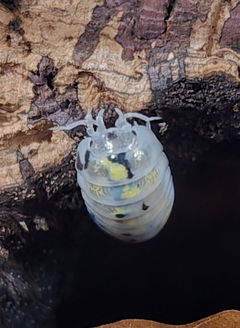
Cubaris sp. 'Cappu Cream' Isopods
Care Info:
 ORIGIN
 TEMP
TEMP
 HUMIDITY
 LENGTH
 DIFFICULTY
 RARITY
- Free shipping over £65
- Low stock - 2 items left
I would rather open with the awkward part than let a customer find it later. Cappu Cream sits very close to our Cappuccino, close enough that I cannot point anyone at a published source that tells the two apart. The name, which also appears as Cappuccino Cream, barely exists outside sales listings. No care sheet has been written for it, no measured description, no origin of its own. Anyone already keeping Cappuccino does not need this one as well, unless the cream-heavier look is specifically what they want. That is the honest position.
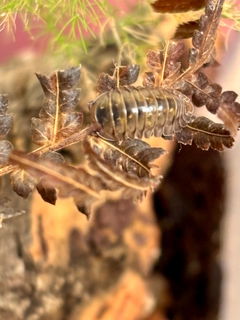
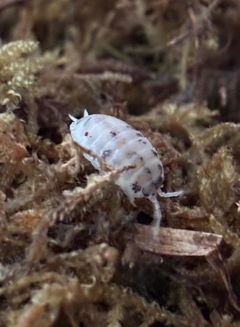
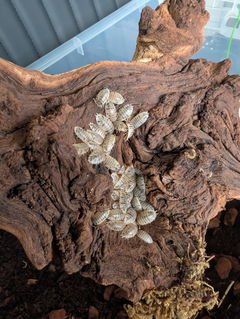
So here is what is actually in our tubs. Cream runs through the lower body and along the edges of the plates, with soft coffee brown broken across the back in a marbling that varies from one animal to the next. Against dark substrate the cream is the colour that carries, which is presumably where the name came from. Adults finish at around 15 to 20mm. Young ones come through paler, the tones firming up over successive moults, so a starter group takes a few months to look like its adults.
What it is, and what the name is not
Science has never described Cubaris sp. 'Cappu Cream'. It is a Thai animal in the family Armadillidae, living where limestone caves meet the forest floor above them, and the name on our tubs is a hobby label with no formal standing behind it. Worth saying once: that Cubaris tag sits provisionally across the premium Thai forms, and a number of them will be moved elsewhere when the group is finally revised. Coffee names are trade habit, nothing more, and not a recognised tier. Among our cream-and-coffee animals the clear outlier is Caramel Cream, which comes off its own parent stock, Cubaris sp. 'Caramel', and is the least demanding of the group. Paler again is Latte. Our guide to the Cubaris lays them out side by side.
Conditions
These are cave animals off limestone, and they work through calcium faster than most isopods do, which is why a lump of limestone or a piece of cuttlebone belongs in the enclosure permanently and not as an occasional offering. Under that, give them 5 to 8cm of substrate, deep enough to bury out of sight and moult undisturbed, then hardwood leaf litter spread generously with cork bark set over that. Litter is what they eat day to day, and letting it run out is the usual failure. Small amounts of courgette or carrot and an occasional pinch of dried protein cover the rest. Lift out what is left after a day or two.
Temperature wants 21 to 26°C, which a heated UK room holds for much of the year, with a low-wattage mat on a thermostat against one side for the colder months. Humidity belongs between 60 and 80 per cent, built as a gradient and never set as one flat number: damp end near the top of that band, far side noticeably drier, and let the colony pick its own ground. Damp, never soaked. Airflow decides more here than any figure on that list. Humid still air is what kills cave Cubaris, so run the ventilation across the box and never seal the moisture in beneath a lid.
They conglobate, closing into a ball when handled. Activity is mostly after dark, though a settled colony grows bolder and works the litter in the evening. Two to three years is the lifespan, growth runs normal to slow, and breeding is fair, never fast, so numbers build steadily instead of exploding. Everything I sell is captive-bred. This suits a keeper who has run humid tropical isopods before and would sooner be told plainly that an animal stands beside a sibling than sold a difference that does not exist. For colour that separates on sight instead of by degrees, Rose Quartz does that, and the rest sits in our Cubaris collection.
Dispatch runs Monday to Thursday, no later, which is how I keep a parcel out of the weekend backlog. What goes into the post is a vented deli tub bedded with moist sphagnum, sitting inside an outer box walled twice over. Royal Mail carries it tracked, for delivery ahead of 1pm the following day. I always add a few animals beyond the number you ordered, and arrival alive is guaranteed.
Use collapsible tabs for more detailed information that will help customers make a purchasing decision.
Ex: Shipping and return policies, size guides, and other common questions.