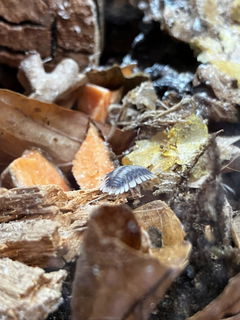
Cubaris sp. 'Daxin Tricolor' Isopods
Care Info:
 ORIGIN
 TEMP
TEMP
 HUMIDITY
 LENGTH
 DIFFICULTY
 RARITY
- Free shipping over £65
- Low stock - 3 items left
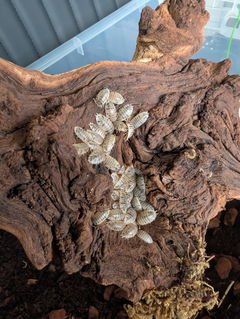
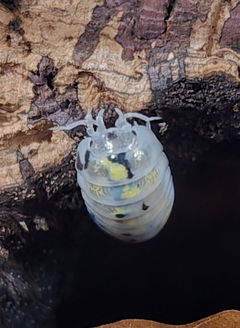
The first thing you notice about Cubaris sp. 'Daxin Tricolor' is the banding: warm orange, deep black and a lighter cream-to-white, laid in bands across the segmented body. That three-colour patterning is where the 'Tricolor' name comes from, and it is what sets this one apart from the many Cubaris that keep to subtle, uniform tones. No two are quite alike, so a colony reads as a spread of related patterns rather than one repeated look.
The exact spread and intensity of the banding shifts from one animal to the next, and the colour firms up as juveniles grow into it. These are a small-to-medium Cubaris, with adults reaching around 12 to 15mm and living two to three years in good conditions. They carry the classic rounded, compact shape of the genus and, like the rest of it, roll into a tight ball when they feel exposed. They are shy by nature too, happiest tucked under bark or down in the substrate through the day and coming up to graze in the evening and overnight. A larger group grows bolder over time and spends more of it in view.
This is a Chinese cave Cubaris, and that background shapes everything about how I keep it. Animals from those humid, limestone-rich cave systems expect steady warmth, moisture in the air and calcium within easy reach, so the setup leans towards holding conditions stable rather than chasing any one number.
Aim for warmth of around 21 to 26°C and build a moisture gradient across the enclosure rather than soaking the whole thing. Keep one end damp, somewhere near 75 to 85%, with the far end left drier so the isopods can pick the spot that suits them. Good cross-ventilation matters as much as the moisture: airflow moving through the tub keeps the damp end fresh and stops it turning stagnant. The rule I come back to is moist, not wet.
Give them a deep substrate they can burrow into, at least 5 to 8cm, worked through with crushed limestone or another calcium source and enriched with a little flake soil for structure and nutrition. Lay a generous top layer of leaf litter over it, and magnolia leaf litter holds up especially well for long-lasting cover, with cork bark and decaying wood filling in the hides. They feed as detritivores, grazing on that litter and rotting wood, with the odd piece of carrot or courgette and a little protein once or twice a week to help breeding along. A calcium source left available at all times matters, since they need it to moult cleanly.
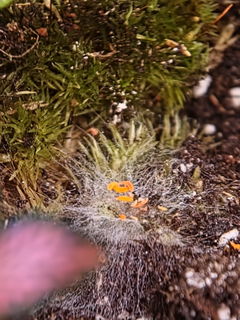
I run a springtail culture alongside every Cubaris tub, since they clear mould and microbial growth at a scale the isopods cannot manage in the humidity these animals need. For a Cubaris, the 'Daxin Tricolor' is a steady breeder: females brood their eggs internally and release fully formed live young, and given consistent conditions a colony builds at a dependable pace. That makes it a sensible step up from the hardy Mediterranean species, without the frustration some of the slower premium Cubaris bring. If you are working through the patterned end of the genus, it sits comfortably beside the Rubber Ducky, the Panda King and the Thai Blue Angel, adding a third colour to that lineup.
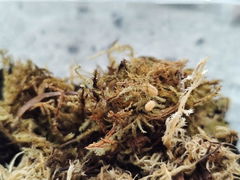
Every order is captive-bred here and sent as livestock, boxed double-walled around a ventilated tub of damp sphagnum and posted Monday to Thursday by tracked next-day Royal Mail, with a live-arrival guarantee and a small overcount included as standard.
Use collapsible tabs for more detailed information that will help customers make a purchasing decision.
Ex: Shipping and return policies, size guides, and other common questions.