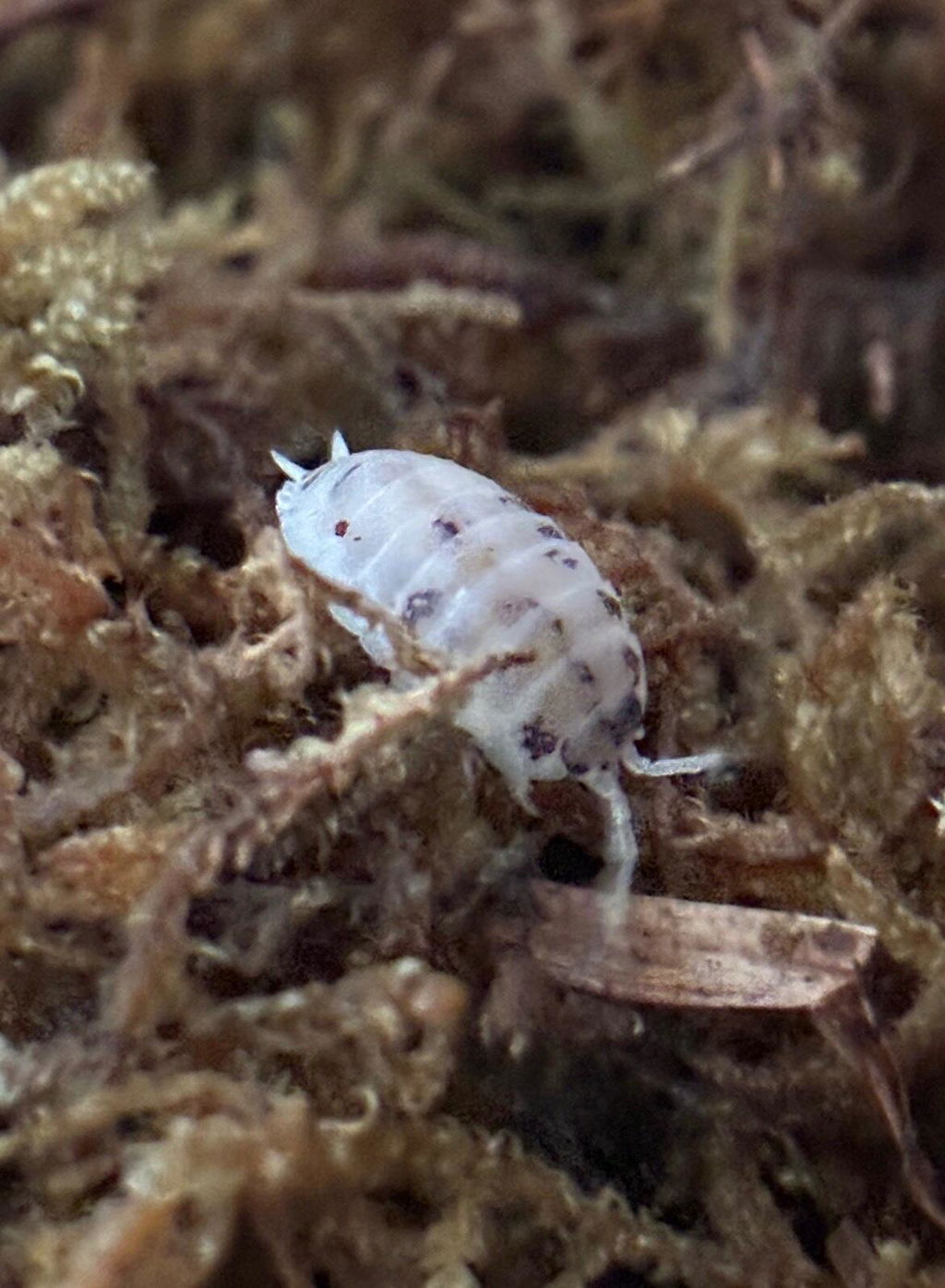
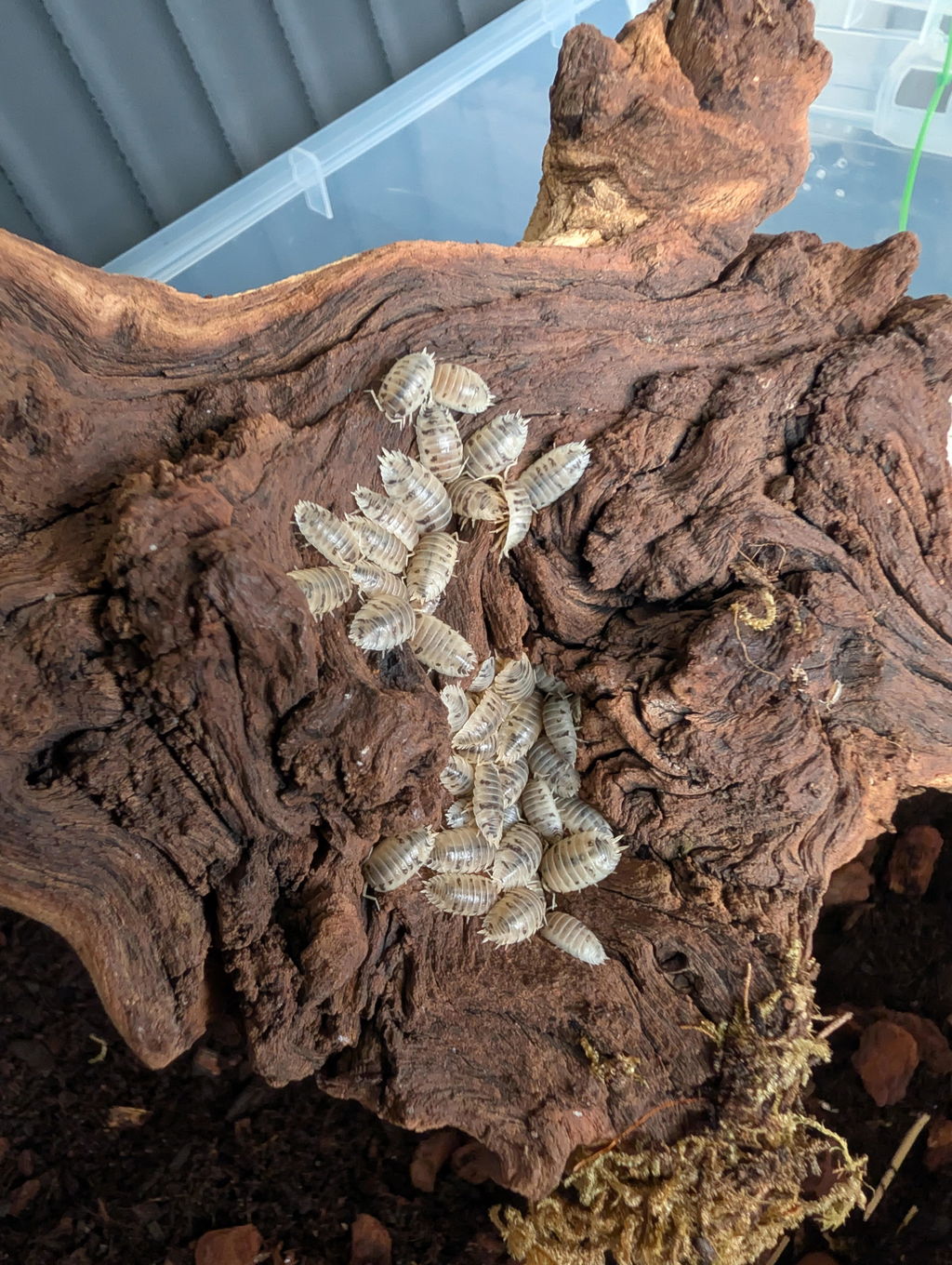
Close-up of a segmented creature on a natural background
Isopod on a soil surface with blurred background
dairy cow isopods
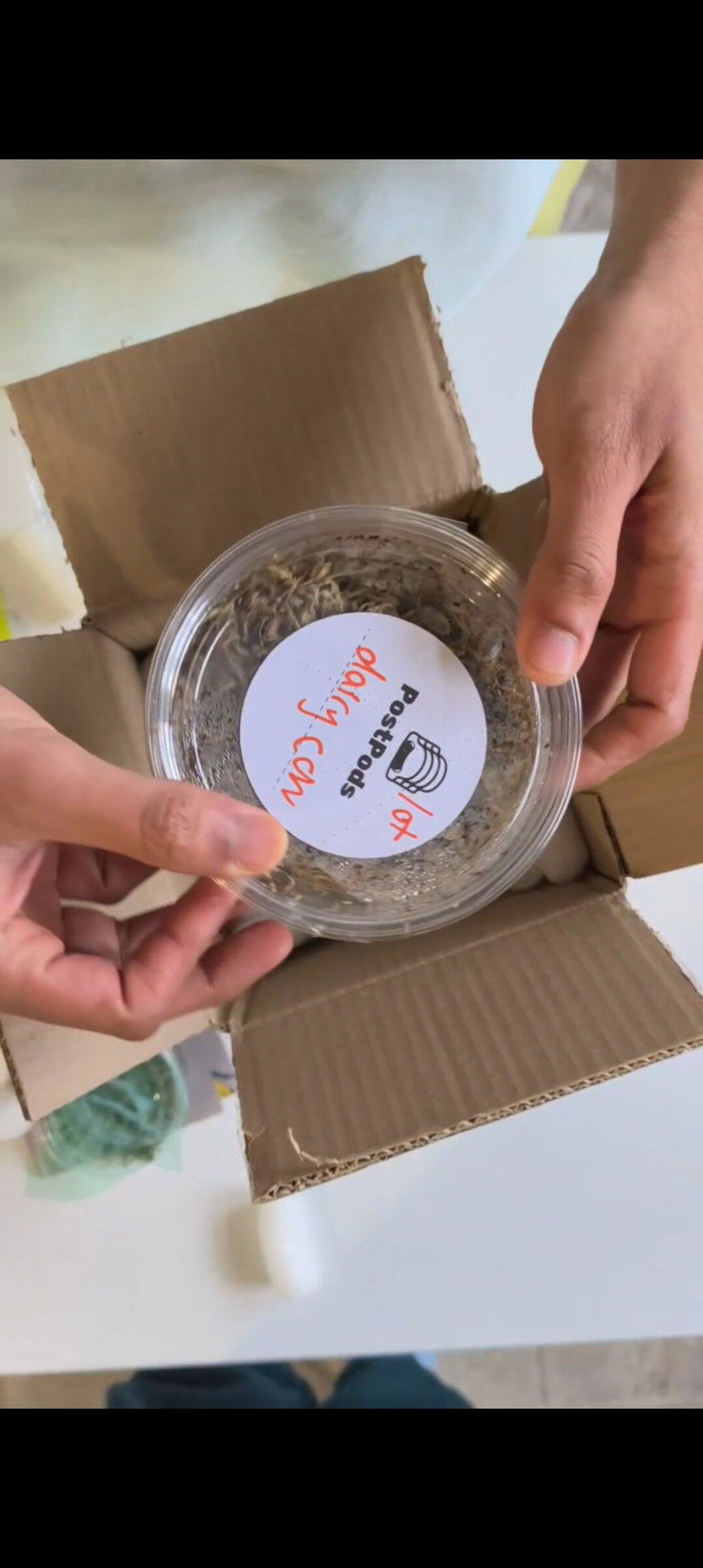
Close-up of a pill bug on a natural background with green  welsh moss and brown soil.
Dairy cow isopods
dairy cow isopod
Dairy cow isopod
Dairy cow isopods

Dairy Cow Isopods (Porcellio laevis) for Sale UK

Care Info:

Origin icon ORIGIN
NORTH AFRICA
Temperature icon TEMP
21-29 ℃
Humidity icon HUMIDITY
50-70 %
Length icon LENGTH
23 mm
Difficulty icon DIFFICULTY
VERY EASY
Rarity icon RARITY
VERY COMMON
Regular price £3.50 Sale price£2.50 Save £1.00
/
Tax included. Shipping calculated at checkout.

Quantity
  • Free shipping over £65
  • Low stock - 3 items left
  • Backordered, shipping soon

Dairy Cow Isopods are one of the most popular, hardy, and recognisable isopods in the hobby — and one of the best beginner species you can buy. Named for their black-and-white piebald pattern (the resemblance to dairy cows is uncanny), these are large, fast-breeding Porcellio laevis that combine real visual appeal with genuinely easy care. They're a workhorse cleanup crew, an excellent reptile feeder, and a perfectly good display species in their own right. If you only buy one isopod species, this is a strong candidate.

Available individually, in groups of 5, 10, or 20. Captive-bred stock from established UK colonies.

Quick Care Summary

  • Scientific Name: Porcellio laevis 'Dairy Cow'
  • Common Names: Dairy Cow Isopod, Swift Woodlouse, Smooth Slater
  • Family: Porcellionidae
  • Origin: Native to North Africa and Mediterranean Europe; now globally distributed
  • Adult Size: Up to 20 mm (around 0.8 inches) — one of the larger common species
  • Lifespan: 2–3 years typical
  • Difficulty: Easy — genuinely beginner-friendly
  • Temperature: 21–28°C (warm-friendly)
  • Humidity: Moderate humidity with a moisture gradient (one side damp, one side drier)
  • Breeding: Prolific — fast-establishing colonies
  • Conglobation: No — Porcellio species don't roll into a ball, they run

What Makes Dairy Cow Isopods Worth Buying

Several reasons make Dairy Cows one of the most universally recommended isopod species:

Striking visual pattern. The black-and-white piebald appearance is genuinely distinctive — they don't look like generic isopods. In a planted bioactive enclosure, the contrast against substrate and leaf litter makes them visible and engaging to watch. Some keepers describe them as looking like "tiny moving cows," which is exactly what they look like.

Big enough to actually see. At up to 20 mm, Dairy Cows are noticeably larger than typical Armadillidium species. You can observe them from across the room rather than needing to peer closely. Their size also means each individual processes more waste material than smaller species.

Voracious cleanup crew. Dairy Cows are widely regarded as the gold standard bioactive cleanup species. Their appetite is genuinely impressive — they'll process organic waste, decaying leaves, fallen fruit, dead insects, and even reptile shed skin at a rate that smaller species can't match. Multiple sources call them "the perfect cleanup crew."

Prolific breeding. A small starter colony establishes rapidly — within a few weeks you'll see new mancae (babies), and within a few months you'll have a thriving population. This makes them excellent for new keepers who want quick visible progress, and ideal for reptile/amphibian keepers using them as a sustainable feeder source.

Genuinely affordable. Dairy Cows are widely available and reasonably priced. You can start a serious colony without the investment that premium species require. This makes them a low-risk way to learn isopod husbandry before committing to expensive Cubaris or Ardentiella.

Highly tolerant of conditions. Dairy Cows handle temperature swings, humidity variations, and minor husbandry mistakes that would devastate sensitive species. This forgiveness factor makes them ideal for new keepers still learning, and for anyone who can't maintain perfect conditions year-round.

How Dairy Cow Isopods Compare to Other Beginner Species

If you're choosing between popular beginner-friendly isopods, here's how Dairy Cows fit in:

  • vs Giant Orange (P. laevis Orange): Same species, different colour morph. Identical care. Choose based on which colouration you prefer — bold orange or piebald black-and-white.
  • vs Porcellio scaber Mix: Both are hardy beginner Porcellio species. Scabers are smaller (around 12 mm) but breed even faster. Dairy Cows are larger and more visually striking. Scabers do well in slightly cooler conditions; Dairy Cows prefer warmth.
  • vs Armadillidium species: Armadillidium roll into balls (conglobate); Porcellio don't. Armadillidium are slower-moving and more decorative; Dairy Cows are more active and better cleanup performers. Both are easy. Different choices for different aesthetic preferences.

Setting Up the Enclosure

Dairy Cows aren't fussy about enclosure size, but bigger is better given their large size and prolific breeding. A 6–10 litre tub works for a starter colony of 10–20; scale up to 20+ litres for established breeding colonies.

A plastic tub with a clip-lock lid is the standard setup — easy to maintain, holds humidity well, and easy to drill ventilation holes into. Glass terrariums also work but cost more. For ventilation, drill multiple small holes on alternating sides of the container to create cross-ventilation. This prevents stagnant air without dropping humidity too much. Our accessories collection has air vents and enclosures suitable for Porcellio setups.

The Moisture Gradient

Like all Porcellio species, Dairy Cows do best with a moisture gradient rather than uniform humidity. This lets them choose their preferred conditions at any moment:

  • One-third to half damp: Moist substrate with sphagnum moss and damp leaf litter. Mist this area to maintain moisture.
  • Remaining area drier: Drier substrate with leaf litter cover. Allow this side to be noticeably drier.

The gradient approach prevents the enclosure-wide stagnant humidity that causes mould issues, while still giving the isopods access to moisture for moulting and breeding. Place protein foods on the dry side — they spoil quickly in damp conditions.

Substrate

Use organic topsoil (pesticide-free) as a base, with at least 5 cm depth — Dairy Cows will burrow occasionally and benefit from substrate they can dig into. Mix in flake soil for added nutrition and texture.

Top with leaf litter — magnolia leaves for long-lasting cover and bamboo leaf litter for structure. Add pieces of rotting wood (white rotten hardwood is ideal) and cork bark hides. Dairy Cows aren't shy and will use multiple hides spread throughout the enclosure.

Temperature

21–28°C is the ideal range. Dairy Cows are notably warmth-loving — they thrive at temperatures that other species find too warm. Room temperature in most UK homes during summer is comfortable; during winter, a low-wattage heat mat can extend the comfort zone and maintain breeding activity year-round.

If your aim is maximum reproduction (for example, sustaining a feeder colony for reptiles), keeping them on the warmer end of the range — around 24–28°C — produces noticeably faster breeding rates than cooler conditions.

Diet

Dairy Cows are big eaters with broad appetites. Their willingness to consume almost anything organic is a major reason they make such effective cleanup crew.

  • Primary diet: Dried leaf litter and rotting wood — always available.
  • Vegetables: Cucumber, courgette, sweet potato, carrot, butternut squash, pumpkin, courgette, broccoli stems. Replace daily.
  • Fruit (occasionally): Apple, banana, melon, mango.
  • Protein (essential): Dairy Cows need significant protein and will resort to cannibalism (eating their own newly-moulted soft individuals) if protein is insufficient. Offer 2–3 times per week. Good options include dried daphnia, silkworm pupae, fish flakes, and freeze-dried peas.
  • Calcium: Essential for healthy moulting at this size. Cuttlebone always available, plus limestone pieces for passive calcium.

One word of caution: Dairy Cows are protein-hungry, and in mixed-species or planted bioactive setups they can occasionally damage soft-bodied animals or plant material if underfed. Make sure protein supplementation is regular and adequate.

Breeding

Dairy Cows are some of the most prolific isopod breeders available. Porcellio laevis females are ovoviviparous — they carry fertilised eggs in a brood pouch (marsupium) on the underside of their body until the offspring are fully developed, then release live mancae directly into the substrate.

Under good conditions (warm temperatures, ample food, moisture gradient), a starter colony of 10 will typically begin producing visible mancae within 4–8 weeks. Within 6 months, the colony will be substantial. Within a year, it'll be a thriving population that can sustain regular harvesting for feeding to reptiles or splitting into new enclosures.

For sustained breeding production, keep the enclosure warm (24–28°C), provide consistent protein, ensure ample calcium, and don't disturb breeding females (visible by their visibly swollen marsupium underside).

Pair With Springtails

Add a thriving springtail culture to any Dairy Cow enclosure. Springtails handle mould and microbial growth at a scale too small for isopods to manage, particularly important in protein-fed setups where uneaten food can quickly develop mould. Springtails and Dairy Cows coexist without conflict and form the classic bioactive cleanup pairing.

Dairy Cows as Reptile Feeders

One of the most common uses for Dairy Cow Isopods is as a feeder species for reptiles and amphibians. Their large size, soft body, calcium content, and active movement make them attractive prey for a wide range of herp species. Dart frogs, mourning geckos, crested geckos, and small lizards all readily eat Dairy Cows.

If you're planning to use Dairy Cows as feeders, the breeding rate is the major appeal — a well-maintained colony can sustain regular harvesting indefinitely without depleting the population. Gut-load with high-quality food (such as Repashy Bug Burger) before feeding to maximise nutritional value to your animals.

One Important Note for Mixed Setups

Dairy Cows are not always suitable for cohabiting with small, soft-bodied pets. They've been known to nibble at sleeping or moulting animals if hungry. They're not ideal companions for delicate species like baby Unicorn Snails or sensitive isopod morphs. They work best either standalone, with hardy reptile/amphibian species, or alongside other equally robust invertebrates.

Why Dairy Cow Isopods Make Such a Good First Isopod

If you're new to isopod keeping, Dairy Cows give you the best foundation for several reasons:

You'll see results quickly. Fast breeding and easy husbandry mean you'll see your colony establish within weeks, which is motivating for new keepers and lets you learn faster.

You'll learn the standard husbandry without high stakes. Mistakes that would devastate a £150 Cubaris colony will barely register with Dairy Cows. You can practise the moisture gradient approach, ventilation balance, and feeding rotation on forgiving animals before committing to harder species.

They demonstrate full bioactive function. A Dairy Cow setup paired with springtails shows you exactly how a self-maintaining bioactive enclosure works. The lessons transfer directly to setting up enclosures for other species later.

They're useful long-term. Even after you graduate to more demanding species, Dairy Cows continue to serve as cleanup crew for plant terrariums, reptile enclosures, and as a backup feeder colony. They never become redundant.

Pairs Well With

For a complete Dairy Cow setup:

For more on Porcellio species and morphs, read our blog post on different types of Porcellio isopods. For new keepers, our setting up guide covers full enclosure walkthroughs. Browse the complete Porcellio collection or all isopods for more options.

Use collapsible tabs for more detailed information that will help customers make a purchasing decision.

Ex: Shipping and return policies, size guides, and other common questions.


Recently viewed

  • 5 stars: 21 (100%)
  • 4 stars: 0 (0%)
  • 3 stars: 0 (0%)
  • 2 stars: 0 (0%)
  • 1 star: 0 (0%)
M
Matthew Watkins
Third time for ordering from you

Third time for ordering from you I've bought powder orange isopods and dairy cow isopods and they are booming and all orders arrived all alive I wouldn't go anywhere else thank you for an easy and fast process

T
Thirdcultureframe
Healthy isopods, very nice packing

Very happy with the service

k
kain harding
Brilliant communication and service

The guys at PostPods are awesome, absolute heroes

E
Esta Bostock
Perfect

Ordering and delivery went smoothly. My pods arrived happy and healthy. Will definately buy from here again.

M
Max

Very active after arrival and look healthy

G
Gabrielle Paterson

Very pleased with these beautiful wee creatures. All arrived in perfect condition.

Hi Gabrielle, we're so happy to hear you're pleased with your dairy cow isopods! Thank you for your kind words and support.

B
Bronte Rouse
50 isopods

All pods were healthy and in great condition. They arrived safe and were packaged very well. They were in moss so it was easy to decant them into their enclosure :)

Hi Mrs. Rouse, thank you for your lovely review! We're so glad the isopods arrived healthy and well-packaged. Enjoy watching them in their new home!

O
Owen

Good some extra ones in there and healthy specimens

M
Marco Narajos
Happy with purchase

Received way more than I bought including pregnant females!

C
Christopher Stinson

Dairy Cow Isopods (Porcellio Laevis)

D
Duncan Bellamy
Great isopods

Arrived well packaged

L
Lea

Very happy, i am a repear customer

R
Richard Snook
Great Isopod!

Excellent and healthy isopods. All doing great, will use again! Thanks postpods!

D
Daniel Giles
Great

Great delivery time and all alive on arrival.

S
Sarah
Great

great fast customer service, all the isopods came really well packaged. Isopods all very healthy so thank you ☺️.

K
Kiara
Will always shop here in future!

On ordering quite a few various ones, nothing too expensive as wanted to try being a first time buyer from here, but now I have the confidence to go for things like the rubber duckies.
The length of time and actions packing the isopods I seriously cannot fault . 110/100% Thanks Dan

L
Lennox Ellison
Superb

Lovely critters and arrived promptly! Cheers mate

J
Jonathan Bexfield
Bioactive set up

Arrived next day, safely packaged- all fighting fit and now happily supporting bioactive set up.

S
Sam Woolley
Dairy cow isopods

All isopods arrived in great condition all healthy and settled in well. Best place to buy isopods 🙂

H
Helena

Absolutely fantastic, highly recommend! Can’t believe how fast delivery was, the isopods arrived in fresh condition. I always expect a couple to die naturally during transit, but every single one arrived alive and healthy!

J
Jacob

Excellently packaged no damage to the box and there was a heat pack that kept them warm to make sure they would not have froze in the winter temperatures

  • 5 stars: 21 (100%)
  • 4 stars: 0 (0%)
  • 3 stars: 0 (0%)
  • 2 stars: 0 (0%)
  • 1 star: 0 (0%)
M
Matthew Watkins
Third time for ordering from you

Third time for ordering from you I've bought powder orange isopods and dairy cow isopods and they are booming and all orders arrived all alive I wouldn't go anywhere else thank you for an easy and fast process

T
Thirdcultureframe
Healthy isopods, very nice packing

Very happy with the service

k
kain harding
Brilliant communication and service

The guys at PostPods are awesome, absolute heroes

E
Esta Bostock
Perfect

Ordering and delivery went smoothly. My pods arrived happy and healthy. Will definately buy from here again.

M
Max

Very active after arrival and look healthy

G
Gabrielle Paterson

Very pleased with these beautiful wee creatures. All arrived in perfect condition.

Hi Gabrielle, we're so happy to hear you're pleased with your dairy cow isopods! Thank you for your kind words and support.

B
Bronte Rouse
50 isopods

All pods were healthy and in great condition. They arrived safe and were packaged very well. They were in moss so it was easy to decant them into their enclosure :)

Hi Mrs. Rouse, thank you for your lovely review! We're so glad the isopods arrived healthy and well-packaged. Enjoy watching them in their new home!

O
Owen

Good some extra ones in there and healthy specimens

M
Marco Narajos
Happy with purchase

Received way more than I bought including pregnant females!

C
Christopher Stinson

Dairy Cow Isopods (Porcellio Laevis)

D
Duncan Bellamy
Great isopods

Arrived well packaged

L
Lea

Very happy, i am a repear customer

R
Richard Snook
Great Isopod!

Excellent and healthy isopods. All doing great, will use again! Thanks postpods!

D
Daniel Giles
Great

Great delivery time and all alive on arrival.

S
Sarah
Great

great fast customer service, all the isopods came really well packaged. Isopods all very healthy so thank you ☺️.

K
Kiara
Will always shop here in future!

On ordering quite a few various ones, nothing too expensive as wanted to try being a first time buyer from here, but now I have the confidence to go for things like the rubber duckies.
The length of time and actions packing the isopods I seriously cannot fault . 110/100% Thanks Dan

L
Lennox Ellison
Superb

Lovely critters and arrived promptly! Cheers mate

J
Jonathan Bexfield
Bioactive set up

Arrived next day, safely packaged- all fighting fit and now happily supporting bioactive set up.

S
Sam Woolley
Dairy cow isopods

All isopods arrived in great condition all healthy and settled in well. Best place to buy isopods 🙂

H
Helena

Absolutely fantastic, highly recommend! Can’t believe how fast delivery was, the isopods arrived in fresh condition. I always expect a couple to die naturally during transit, but every single one arrived alive and healthy!

J
Jacob

Excellently packaged no damage to the box and there was a heat pack that kept them warm to make sure they would not have froze in the winter temperatures