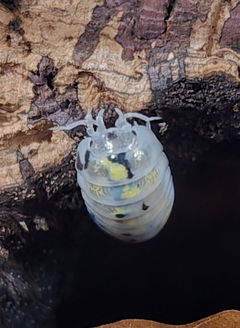
Porcellio Duboscqui Troglophila Isopods
Care Info:
 ORIGIN
 TEMP
TEMP
 HUMIDITY
 LENGTH
 DIFFICULTY
 RARITY
- Free shipping over £65
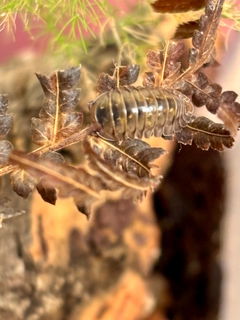
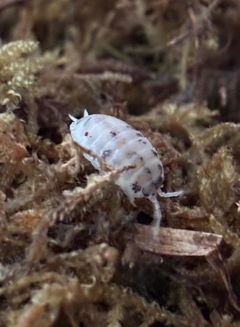
The cave part of this animal's name is earned, which is not something we can say about every isopod sold with a cave story attached. Every mapped locality for the troglophila form is an actual cave: Belvis, Lapradelle and the Mythones caves in the Aude, the Cova Bastera at Villefranche-de-Conflent and the Grotte des Voleurs in the Pyrenees-Orientales, and on the Spanish side the Cueva San Francisco in Huesca, the Cova dels Ermitons in Girona and two systems in the Montserrat massif. The ordinary form of the species, by contrast, turns up in perfectly unremarkable places - Argeles-sur-Mer, Collioure, Pamplona. The cave association attaches to this form specifically, and it is documented rather than assumed.
What it is not is an obligate cave animal. In biospeleology a troglophile is a species that can complete its life cycle underground while also living outside it, and nothing published describes this one as eyeless, depigmented or restricted to caves. It is a woodlouse comfortable in the dark, not a cave specialist.
The name, honestly
Porcellio duboscqui Paulian de Felice, 1941, described from Banyuls-sur-Mer on the French side of the eastern Pyrenees. It first appeared as a subspecies of P. lugubris and was later raised, and because the genus never changed, the authority takes no brackets. The word troglophila comes from a name Vandel published in 1951 for the cave form. Vandel himself downgraded it to a forme by 1962, and the current world checklist recognises no subspecies here at all. We keep the trade name because it is what the animal is sold as across Europe, though it is a form name with no standing and not a subspecies.
The range is restricted: the eastern Pyrenees on both slopes and Andorra, with outliers running west into Navarre and Aragon and east into the Catalan massifs at Montserrat. It is more French than Spanish by a wide margin, whatever the German listings say.
It is not, however, a scarce animal in the trade. A 2025 study of woodlice moving through the Spanish market picked it up as a regularly listed native species, and not as one of the labels used to move undescribed animals under a commoner name.
Conditions on our shelf
Warm and dry, with real airflow. 22 to 26°C, humidity around 45 to 55%, one fifth of the floor kept permanently damp while the rest stays untouched. Dry does not mean bone dry - there must always be moisture they can reach. That may look counterintuitive for a cave-associated animal. These are our shelf settings.
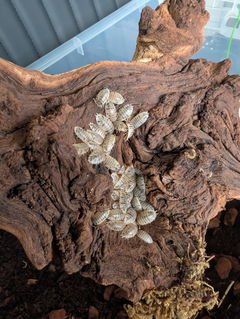
Substrate 5cm or so, topped with limestone chippings and flat stone stacked in layers. They want hard surfaces to sit against and vertical faces to climb, and that habit is the one thing which does read across from the caves. Leaf litter, white-rotted hardwood and permanent calcium. Protein about weekly. Like the other Spanish and French Porcellio they take it keenly.
No conglobation. Porcellio do not roll, and a large one under threat will run for the nearest gap instead.
Sizes quoted around the trade run from 22mm up to 28mm. We have not measured a series, and no published source we could locate has either, so treat the upper figure as an ambition and not a promise.
Every pot goes out with 20% more animals in it than your order states. They travel on damp moss in a vented tub, wrapped inside a two-ply box, sent out between Monday and Thursday on the pre-1pm service, and covered by our guarantee that they arrive alive.
Use collapsible tabs for more detailed information that will help customers make a purchasing decision.
Ex: Shipping and return policies, size guides, and other common questions.