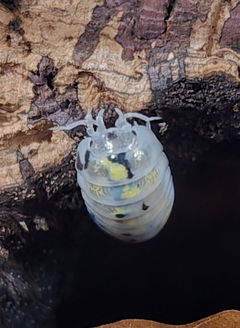
Oniscus Lusitanus Portugal Isopods
Care Info:
 ORIGIN
 TEMP
TEMP
 HUMIDITY
 LENGTH
 DIFFICULTY
 RARITY
- Free shipping over £65
When Britain's myriapod and isopod recording group worked north-west Iberia, published by Gregory and colleagues in 2012, this was the woodlouse they kept finding. A hundred and thirty-five specimens from fifteen sites, and it appeared in each of the main habitat types they recorded - synanthropic sites, the coast, pine and oak woodland, upland moorland - and was typically numerous where it appeared at all. For an animal most keepers have never heard of, that is a useful thing to know: it is a broad-tolerance generalist, not a specialist you need to get exactly right.
Twelve of those fifteen sites were in Spain, in Pontevedra and Ourense. Which is worth saying because the trade name is "Portugal".
Where it actually lives
Oniscus lusitanus Verhoeff, 1908. No brackets. Its range runs from central Portugal north into Galicia and on to Asturias, and it is most abundant in the warmer parts of northern Portugal and southern Galicia. This listing already said Portugal and north-west Spain, which was right - it is the common name that undersells it, and we are keeping that name because it is what people search for while being clear it covers half the story.
The genus is small and mostly Iberian: five species, three of them confined to north-west Iberia, one to the Pyrenees, and the familiar Oniscus asellus spread across Europe and introduced to the Americas. Two of those five species are David Bilton's, published in 1992 and 1997, and he also named the asellus subspecies we sell alongside this one.
What we cannot tell you
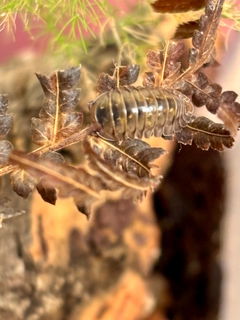
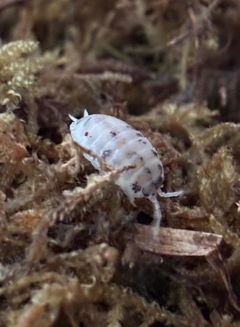
No adult size has ever been published for this species. The figure here was around 16mm, and it has gone, because that number belongs to O. asellus and we had transplanted it. No published description of its colour or markings exists either - that same paper gives a diagnosis for its sister species and none for this one.
And there is no external character that separates it from a common shiny woodlouse. None has been published. As with our other Oniscus line, what you are buying is a lineage, not something you could confirm from a photograph, and we prefer saying so to inventing a field mark.
Keeping them
15 to 25°C, no heating needed in a British room, and if anything lean towards the warmer half - Gregory and colleagues describe it as most abundant in the warmer parts of its range, which is not a measurement but is a direction. Humidity 60 to 75% across a gradient. Both come from keeping the animals here. No measurement exists for this species.
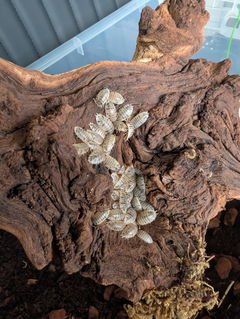
Lay 5cm of substrate beneath a heavy bed of leaf litter, rotten hardwood mixed through, stone slabs and bark to shelter beneath, calcium always in. They are unfussy, slow and steady, and they eat leaf litter faster than you expect.
No conglobation. Nothing in this family closes into a ball.
If you already keep the common shiny woodlouse and want something with the same easy temperament and a genuinely obscure provenance, this is the one. Our stock has run here through UK and French lineages and is captive-bred throughout.
Our stock has come through UK and French lineages and is captive-bred throughout. Sending runs Monday through Thursday for next-working-day delivery, bedded on damp sphagnum in a perforated tub inside a two-ply box, adding a fifth again to your count, and guaranteed to reach you alive.
Use collapsible tabs for more detailed information that will help customers make a purchasing decision.
Ex: Shipping and return policies, size guides, and other common questions.