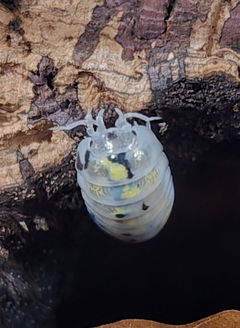
Porcellio Flavocinctus Isopods
Care Info:
 ORIGIN
 TEMP
TEMP
 HUMIDITY
 LENGTH
 DIFFICULTY
 RARITY
- Free shipping over £65
- Low stock - 1 item left
We had the map wrong on this page and it is worth correcting in public. The old copy sold this as an eastern Mediterranean island species and listed Crete, the Cyclades, Cyprus, the Dodecanese, Malta, the North Aegean and Sicily. It is none of those. The published treatment of the species gives southern Spain, southern Portugal and northern Morocco, with the Moroccan records from the Rif around Melilla, Tetouan and Ceuta. The Andalusian records - Cadiz, Cordoba, Huelva, Malaga, Seville - come from a 2021 revision of the Spanish Porcellio. Of around 250 occurrence records worldwide, not one is from Greece, Cyprus, Malta or Italy.
The island story traces back to a single European database entry that Wikipedia copied and everybody else copied from Wikipedia. One source repeated four times is still one source, and in this case a contradicted one. This is a western Mediterranean and North African animal, a Strait of Gibraltar species, and that is a better story than the one we were telling.
The name
Porcellio flavocinctus Budde-Lund, 1885. You will see 1879 attached to it in several places, inherited from the same database that got the range wrong; the accepted date is 1885. No brackets, because it has always sat in Porcellio.
We will not be telling you what the epithet means. The obvious reading is available to anyone with a Latin dictionary, but no source we could find states an etymology, and the formal treatment of this species - which illustrates the animal in detail - contains no colour description at all. So we will not describe banding we cannot source. Nor, for that matter, could the old page: it never described the animal's colour either, and simply called it attractive and undemanding.
A separate 2025 survey of the Spanish woodlouse trade is why we are careful with names on this page. It found a number of species in this genus, several of them probably still unnamed, being sold under the names of commoner animals. Ours is not one of those cover labels; it appears under its own name. Still a reminder that what is written on a tub is not an identification.
Rarity, honestly reassessed
The old page called it uncommon and not widely available in the UK. The UK half of that may well still be fair. The implication that the animal itself is scarce is not: the same Spanish trade survey found it widely listed and at the cheap end of the market. It is a perfectly obtainable southern Iberian Porcellio that happens not to be famous, and we would rather you bought it for what it is.
The occurrence record backs the revision rather than the database: something over two hundred Spanish records, a couple of dozen Portuguese, around twenty Moroccan and a single one from Gibraltar. That is a tight, coherent distribution round the western end of the Mediterranean.
Keeping
20 to 27°C, which is a warm room and no heat mat. Humidity 60 to 75% across a gradient with a clear dry end. Substrate 5cm, leaf litter, white-rotted hardwood, flat bark and stone for cover. Nobody has measured what this animal will actually tolerate, so read those two figures as the settings on our shelf and not as biology.
No conglobation, as with every Porcellio. Under threat this one runs. Protein weekly and permanent calcium; the genus takes both keenly. Sizes around 20mm get quoted, ours included, and we should say the formal treatment carries no measurements, so that figure has no scientific backing behind it.
The outer box is doubled card, and inside it a perforated pot with moss kept damp. Posting runs Mondays to Thursdays on the pre-1pm service. Twenty per cent over your count is included, as is our promise that every one lands alive. Other species in the genus are under Porcellio.
Use collapsible tabs for more detailed information that will help customers make a purchasing decision.
Ex: Shipping and return policies, size guides, and other common questions.