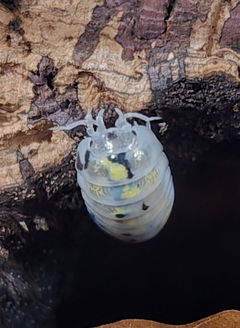
Cubaris sp. 'Red Edge Albino / Anderman's Pearl' Isopods for Sale
Care Info:
 ORIGIN
 TEMP
TEMP
 HUMIDITY
 LENGTH
 DIFFICULTY
 RARITY
- Free shipping over £65
- Low stock - 1 item left
We have described Anderman's Pearl on this page as a common UK trade name. Looking again, we cannot find it in use anywhere outside our own listing, and the nearest match elsewhere is one European seller writing Andaman Pearl with no explanation attached. A name with no paper trail tells you nothing about what is in the tub, so here is what we can actually stand behind instead.
What we can actually tell you
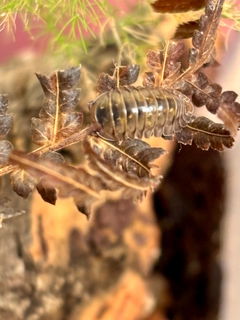
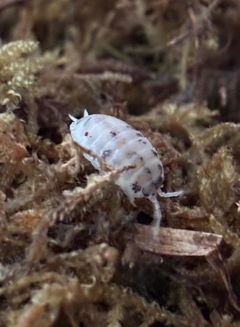
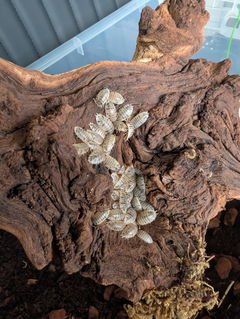
It is the pale Red Edge Cubaris, sold here as it is sold across the trade, under the name Red Edge Albino as well as Anderman's Pearl. Ours are captive-bred. The body is cream through to a soft off-white with a faint sheen to it. The orange-red margin that gives the parent morph its name is still there, running the length of the skirt, and against the pale body it reads much stronger than it does on a standard Red Edge. That contrast is the whole appeal.
Settled adults measure somewhere around 15 to 18mm, matching our other pale Red Edge listing. Startle one and it closes into a sphere. The outline stays rounded and the head blunt, as the genus goes.
Three things we will not claim
Three assertions travel with this animal, ours among them, and none of them survives a look.
- That the albino in the name is a genetic diagnosis. It is a trade name, and we sell under it because that is what the animal is called. We can find no published breeding test behind the label on any Cubaris colour line. Pale is what we can see; the genetics behind it are not something we can evidence.
- That red eyes confirm the trait. A vertebrate albino's eye reads red because you are seeing retinal blood vessels through an unpigmented iris. An isopod has no such structure, and its eye pigment is ommochrome rather than melanin, so the reasoning does not carry across. Sellers disagree about eye colour on these pale lines, some reporting dark and some red, which is itself a reason to be careful with the word.
- Where the name came from. We previously suggested it points at the Andaman Sea. We can find nothing behind that, and no record of a Cubaris from the Andamans to support it. It was a guess printed as an explanation, which it should not have been.
Keeping them
Fifteen litres is ample for a starter group. Build 8 to 10cm of substrate on topsoil that has never seen pesticide, hardwood broken down soft with shell grit folded in, then a generous litter layer. Flat cork sheets give the close-fitting hides these animals use.
Warmth between 22 and 27C, which in most British houses means a small heat mat under thermostatic control if you want them breeding, not ambient. Keep the box away from radiators and windows where the temperature swings. Damp one end, drier the other, and let them choose. These are more forgiving than the premium Cubaris that need the moisture held constant, but they will still stall if the whole box goes wet and airless. No water dish. A misted damp corner covers their needs; standing water breeds mould and takes the smallest animals down. Ventilation on one side, misted at the damp end, is the arrangement that works on our shelves.
Rotting leaf and softened timber do the feeding. Keep cuttlebone in the box permanently and add protein roughly weekly, clearing leftovers inside a day, since they spoil fast at this temperature.
Where it sits in the range
The standard Red Edge is the darker parent form and the cheaper way into the line. Red Edge Blonde is our other pale Red Edge listing. Whether those two names cover one animal or two is unsettled in the trade, and we are not about to declare it settled. Lemon Blue gives you a completely different colour in a similar care bracket, and Rubber Ducky is the step up in both price and fussiness.
Breeding
Slow to start, steady afterwards. Expect several months of apparently nothing before broods appear, which this genus does routinely. Resist opening the box to check.
Animals travel on damp sphagnum inside a punched cup, that cup sleeved in twin-wall board. Dispatch falls Monday to Thursday, never later, so no parcel of ours idles through a weekend. A fifth again goes in above the count you ordered, and every one is guaranteed alive when it lands. Anything wrong, let us know the same day it lands and we will sort it.
Use collapsible tabs for more detailed information that will help customers make a purchasing decision.
Ex: Shipping and return policies, size guides, and other common questions.