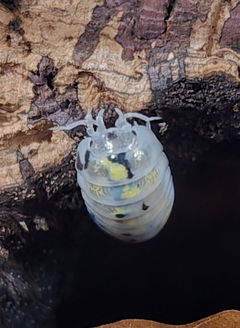
Cameroon Olive Millipede (Telodeinopus aoutii)
Care Info:
 ORIGIN
 TEMP
TEMP
 HUMIDITY
 LENGTH
 DIFFICULTY
 RARITY
- Free shipping over £65
- Low stock - 6 items left
A long-legged African millipede with an olive to bronze body and pale banded legs. Of the big African species in the UK trade, this is one of the readiest to leave the floor: it will climb cork bark and branches and sit up where you can see it, instead of lying flat under the substrate the way the heaviest giants do. Ours run slimmer and lighter in colour than the Ghana stock we also keep.
Identifying it
The legs. Long, and banded white against brown, set off by an olive to coppery body. The banding is on the legs, not on the body rings, and that is the split from the Olive Banded Millipede, Spirostreptus sp. 1, where the rings carry the annulation and the legs are plain. It is a quicker check than counting segments.
On size, the 16 to 18cm quoted everywhere for this species traces to a single keeping article, not a measured series, so treat it as a ballpark. Females run larger than males.
When you will see it
In the evening. Large spirostreptids are night animals, and this one matches: it comes up as the light drops and spends the day down in the substrate or under bark. Set the enclosure up with height and it will use it after dark. It is not a daytime display animal, and any listing telling you otherwise is overselling.
The species
It is Telodeinopus aoutii, the same species as our Ghana Speckled Leg Millipedes. Demange described it in 1971 as Onychostreptus aoutii and it was later moved across, which is why the authority is written in brackets: Telodeinopus aoutii (Demange, 1971). Family Spirostreptidae, order Spirostreptida.
The "Cameroon" is trade provenance, not a published range record. Demange's material came from Togo, Benin and Côte d'Ivoire and the occurrence records run across that belt into Ghana, but exporters ship under the country the crate left from, and West African stock reaches the UK by a good many routes. It is the animal we describe here either way.
One caution on our slimmer-and-lighter note: our Ghana page records keepers seeing males come out greener and females browner, so some of a difference between two lots may be a sex ratio.
It is a different animal from the African Olive Millipede, Analocostreptus gregorius, despite the shared "olive". That one was described from Angola at up to about 12 cm, and its legs are reddish brown to orange instead of banded. Both are Spirostreptidae, in different tribes.
Setting up
Substrate is the meal, not the flooring. Rotten wood is not simply soft wood either: a millipede has almost no cellulase of its own, and the work is done by bacteria in its hindgut on wood that fungi have already broken down. That is why white-rotted hardwood matters more than any other ingredient, and why sound dry wood is not food.
Give it 10 to 15cm of invertebrate substrate as the base, work shredded rotten wood generously through it, and top the surface with crushed leaf litter. Magnolia lasts longer than most under an animal this size. Never softwood or pine.
Because it climbs, floor area is only half the picture. Cork bark and sturdy branches will all get used, and the lid needs to be secure; they are stronger than they look. Never put heat under the tank. This animal answers both warmth and alarm by digging, which takes it straight onto the element.
Warmth and moisture
22 to 28°C, humidity around 70 to 90 per cent, the same window we hold the Ghana stock at. An unheated UK room in winter will not do it, so plan for gentle background heat through the colder months.
Keep the substrate evenly damp all the way down, not misted on top. The decay that turns wood into food only runs in damp material, so the water is feeding the animal as much as watering it. Never sodden, and no standing water at the base.
Food and calcium
Rotting hardwood and leaf litter are the diet. Soft fruit, vegetables and an occasional pinch of fish flake are extras on top, not the meal. Calcium is not optional at this size: every moult spends it, and a shortage surfaces as a failed moult long before anything else gives it away. Keep cuttlebone in there permanently and let them help themselves. Our millipede substrate guide covers the mix in detail.
Handling and defence
They are placid and slow, and they neither bite nor sting. Startled, this one winds down into a flat spiral; the ball-shaped defence belongs to an entirely different group of millipedes.
Under stress it can release a defensive fluid. The chemistry is benzoquinone-based. It stains skin brown for days, and on a large tropical millipede it can do more than stain, with burning, blistering and swelling all on record. Wash it off promptly with soap and water instead of leaving it on the skin. In an eye it is an emergency: irrigate immediately and get seen, because corneal damage has been reported. Lift from underneath, let the animal walk across your hands, and keep sessions short.
Who this suits
Anyone who wants a large, long-legged, climbing millipede and is happy to meet it in the evening. European captive-bred lines of this species have a name for being tough and free-breeding, but Orin McMonigle's Millipeds in Captivity says the opposite of freshly imported ones: touchy, and awkward to bring through. Ours are imports, so treat the first couple of months as the real test. If that sounds like more than you want, the African Giant Chocolate is the gentler starting point, and the full range is in millipedes for sale.
Arriving with you
These are wild-collected imports, so no captive-bred claim from us on this listing. What we will promise is the packing and the timing: an air-holed pot, damp sphagnum moss, two walls of card outside that. Dispatch is Monday to Thursday, Royal Mail next day by 1pm, so nothing sits in the network over a weekend. Every order carries a 20% overcount and our live arrival guarantee. Give new arrivals a warm, dark, deep enclosure and a fortnight before you expect to see much of them.
Use collapsible tabs for more detailed information that will help customers make a purchasing decision.
Ex: Shipping and return policies, size guides, and other common questions.