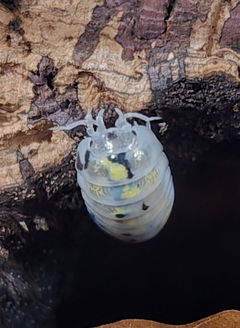
Armadillidium pallasii 'Orange' (Corfu) Isopods
Care Info:
 ORIGIN
 TEMP
TEMP
 HUMIDITY
 LENGTH
 DIFFICULTY
 RARITY
- Free shipping over £65
- Low stock - 5 items left
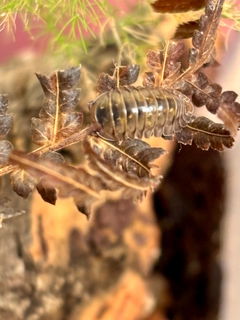
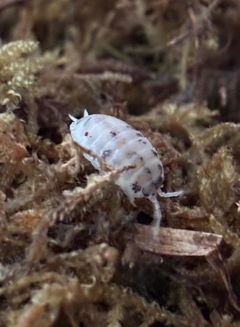
Light seems to pass straight through Armadillidium pallasii 'Orange'. The warm orange body has a semi-translucent quality, so under a terrarium light the animal looks almost lit from within, glowing rather than simply coloured. It is a selectively-bred morph of the large Greek pill woodlouse from Corfu, and that luminous orange is what draws most people to it. The colour comes from hypomelanism, a reduction in dark pigment, and it is one of the brightest orange Armadillidium in the hobby.
This is a big isopod. Adults reach up to 24 mm, which makes A. pallasii one of the largest Armadillidium you can keep, comfortably bigger than most of the popular species. The name is worth a mention too. The epithet pallasii honours Peter Simon Pallas, the 18th-century German zoologist and botanist, and the animal is sometimes traded as Pallas's Pill Woodlouse. A colony of them at full size, all glowing orange, is a lovely thing to look at.
Like every true pill woodlouse, it conglobates, rolling into a tight sealed ball when startled, and on an animal this large the roll is wide and full. Day to day they are calm and tolerate group housing well, and you will see the most of them at night and in the early morning rather than in bright light. They are hardy and, once settled, dependable.
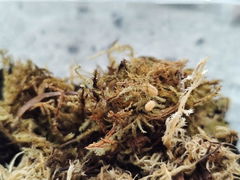
Being a Mediterranean animal from Corfu, this is a drier-gradient species rather than a wet-box one. Aim for moderate humidity, somewhere around 50 to 70 per cent, and build a gradient rather than a uniform damp: one damp corner kept moist with sphagnum and leaf litter, and the rest of the enclosure left drier under bark and litter. Medium ventilation matters, and both extremes cause moulting trouble, so it is the balance you are after rather than precision. Room temperature suits them through the year in most heated homes.
I build mine over a Mediterranean-style, pesticide-free topsoil base, with a little sphagnum worked through for moisture and some flake soil mixed in for nutrition, around five to eight centimetres deep for burrowing. Top it with generous hardwood leaf litter; magnolia leaf litter and oak both last well and double as food. Keep calcium available at all times through cuttlebone, crushed limestone or eggshell, since the large adults need it for clean moults. They are detritivores that lean a little more on protein than most Armadillidium, so a small, regular protein source alongside the leaf litter keeps them in good condition.
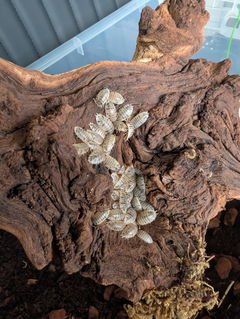
Once established they breed prolifically all year round and build a substantial colony quickly. One honest note from me: the Orange morph tends to have a slightly higher mortality than the wild-type while it is settling in, so start with a larger group rather than the bare minimum and give them time to find their feet. After that, they are as productive as any pallasii.
They sit naturally alongside the standard Armadillidium pallasii, the same species in its wild grey-brown form, and the metallic Armadillidium corcyraeum 'Silver', another Corfu native, if you want to build a small Greek-island cluster. Set next to a smaller vulgare morph like Magic Potion, the difference in scale is striking, and you can compare the rest of the range in our Armadillidium collection. Every order is captive-bred, packed double-walled around a ventilated tub of damp sphagnum and posted Monday to Thursday by tracked next-day Royal Mail, with a live-arrival guarantee and a 20% overcount included as standard.
Use collapsible tabs for more detailed information that will help customers make a purchasing decision.
Ex: Shipping and return policies, size guides, and other common questions.