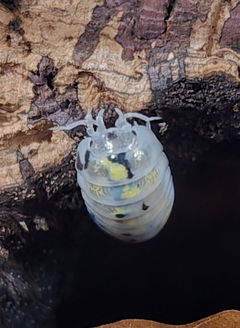
Thai Rainbow Millipede (Atopochetus Spinimargo)
Care Info:
 ORIGIN
 TEMP
TEMP
 HUMIDITY
 LENGTH
 DIFFICULTY
 RARITY
- Free shipping over £65
Most millipedes are animals you buy, settle into a deep tub of substrate, and then barely see again for weeks at a time. The Thai Rainbow is one of the exceptions. Its legs are noticeably longer than you would expect from a burrower, and it uses them: give it cork bark and a few branches and it will climb, and mature animals often wander about in daylight rather than waiting for the lights to go off. For a species that spends its life processing leaf litter, it earns its enclosure space in a way a lot of millipedes simply do not.
About the Thai Rainbow Millipede
Sold here as Atopochetus spinimargo, and occasionally listed as the Thailand Rainbow Millipede, this is a Thai member of a genus that also contains the better-known Vietnamese Rainbow Millipede, Atopochetus dollfusii. It is a relatively recent addition to science as well as to the hobby, which is part of why it remains uncommon in UK collections.
One thing worth knowing before you compare care notes online: "Thai Rainbow" is a common name that gets applied to more than one closely related millipede, so advice written for a different animal can end up attached to this one. If you are cross-referencing what you read elsewhere, work from the scientific name rather than the trade name and you will avoid most of the confusion.
Appearance
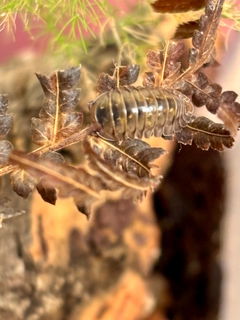
Adults reach roughly 8 to 10cm, which puts them at the mid-size end of the hobby rather than among the giants. The body carries alternating bands of warm orange and grey-green that shift depending on the light, and the effect is at its best under a bright lamp where the segments catch the beam individually. It is a subtler animal than some of the fluorescent-looking species, and I would describe the appeal as refined rather than loud. Juveniles are duller and darker, and the banding sharpens as they grow through successive moults.
Housing and Substrate
Substrate depth is the one thing I would not compromise on with any millipede, and it is where most losses come from. They moult underground, sealing themselves into a chamber for days at a time while the new exoskeleton hardens, and an animal that cannot get deep enough to do that safely is at real risk. As a rule of thumb, give them substrate at least as deep as an adult is long, so a minimum of 10cm and more if the container allows. Our guide to millipede moulting covers what is happening down there and why it matters.
Floor space matters less than depth. Around 30 x 30cm suits a small group comfortably. For the mix itself I build on flake soil, crumbled white-rotted hardwood and untreated organic topsoil, then cover the surface generously with leaf litter and lay in some pieces of rotten wood. I would leave coco coir out of the base. It is cheap and holds water beautifully, but an animal that eats its way through the substrate for a living gets almost nothing back from it, and you end up feeding around a floor that should be feeding them.
Keep the substrate damp through the lower layers without letting it turn to mud, and add cork bark and branches above ground so they have something to climb. Normal heated UK room temperature suits them for much of the year, though a gentle heat source is worth having through the colder months to keep them at the warmer end of their range and feeding steadily.
Diet
The staple is decaying leaf litter and white-rotted wood, and it should never run out; they graze on it continuously rather than waiting to be fed. Beyond that they are refreshingly unfussy for a millipede. Carrot, courgette, cucumber and squash all go down well, along with occasional fruit, and a pinch of fish flake now and then covers protein. Lichen sticks and fresh moss are both taken readily and add variety worth offering.
Calcium needs to be permanently available rather than offered occasionally, because a millipede this long is building a great deal of exoskeleton every time it moults. A piece of cuttlebone left in the enclosure, topped up as it is grazed away, handles this without any effort on your part.
Temperament and Handling
These are placid animals, more inclined to curl up than to fight, and they take gentle handling calmly. Like most millipedes they can release a defensive fluid if they are alarmed, which stains skin and irritates it if it is left on, and which burns an eye badly enough to need treating, so wash your hands with soap afterwards and before you touch your face, and watch that children do the same, because they account for almost every eye injury on record. They live happily in groups, and settled adults become noticeably bolder over time.
Breeding
This is among the more willing millipedes to reproduce in captivity, which is a fair part of the appeal. Females lay into the substrate and the young hatch out independent, gaining segments and legs with each moult as they grow. Maturity takes patience, generally into their second year, so this is a project measured in seasons rather than weeks. Deep substrate and a constant supply of leaf litter and rotten wood do most of the work; colonies build slowly and then quite suddenly become obvious.
Who Is This Millipede For?
I would put this a step beyond a first millipede rather than at the very start, not because the animal is delicate but because the setup has to be right from day one, and a deep, well-built tub is less forgiving of shortcuts than an isopod tub is. If you have kept inverts before and want something visible, active and unusual in UK collections, it is an excellent choice. Anyone still deciding where to begin may prefer to read our rundown of the best beginner millipedes first, or look at the larger and very forgiving Ivory Millipede as an easier starting point. The rest of the range sits in our millipedes collection.
All our millipedes are captive-bred, and they travel in ventilated tubs bedded with damp sphagnum moss inside a double-walled box. We only dispatch Monday to Thursday, by Royal Mail Tracked, so nothing is left sitting in a depot over a weekend, and every parcel is covered by our live arrival guarantee.
Use collapsible tabs for more detailed information that will help customers make a purchasing decision.
Ex: Shipping and return policies, size guides, and other common questions.