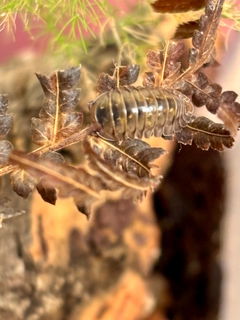
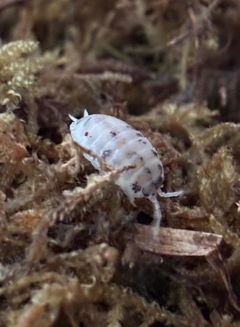
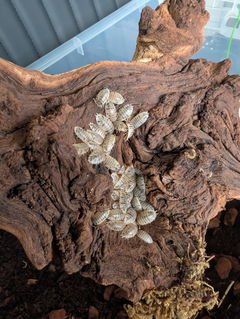
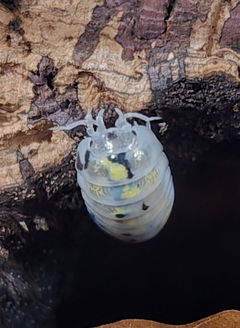
White Panda King Isopods (Cubaris sp.)
Care Info:
 ORIGIN
 TEMP
TEMP
 HUMIDITY
 LENGTH
 DIFFICULTY
 RARITY
- Free shipping over £65
- Low stock - 1 item left
Two shops sell two different animals under this name. A Dutch seller describes a full albino: white legs, white underside, white eyes. Our animals are not that. Ours are almost entirely white, broken by a darker line along the spine, which makes it a high-white patterned animal, not a pigmentless one, and a third seller markets that same thing as a High White Panda. So before anything else: what you get from us is the animal in our photographs, and across the trade the name is not doing reliable work.
This page has been rewritten from a bullet list, and three things on it have gone.
What we have removed
What was here before said that if Cubaris share genetics with other isopods then the white colouring is "likely a recessive gene", and then predicted what pairing colours would produce. That is a conditional built on an untested assumption, and the prediction does not follow from it. There is no genetic study of colour in this animal and no carrier test for any colour allele in any terrestrial isopod, so nobody can look at one and tell you what it carries.
The size read 10 to 18mm. We have narrowed that to 10 to 12mm, which is the only figure any seller publishes for the white line specifically. To be fair to the old page, 18mm was not invented - the same seller puts the standard Panda King at up to 22mm, so the number sat inside the parent form's range. It just was not a figure for this animal.
And the rarity line read "Very Rare". At the price these change hands for from established colonies, that is a tier label and not a fact, so it has gone too.
What this actually is
A pale line within the Panda King. Not a separate species, and not a separate morph in any sense that means anything. Every source that explains it says the same. The parent, Panda King, is reported from cave systems in Vietnam by four independent sources, which we are reasonably confident about - though for the white line specifically the sellers say Vietnam, Thailand and "Southeast Asia" between them, so no locality is documented for it.
It conglobates, as the family does, shutting itself into a sphere when handled. It is also, like everything traded as Cubaris, undescribed. No type specimen, no scientific name beyond the genus, no published measurement. The genus is an acknowledged dumping ground with a standing recommendation for revision, and a few animals filed there have turned out not to belong.
Keeping them
Warm and humid with low airflow, which is the Panda King regime and the thing that separates cave Cubaris from most other isopods. We hold 22 to 28°C with humidity from 60 up to 75% across a gradient, and a lid that retains moisture instead of mesh on every side. Low airflow is the point with cave Cubaris, but low is not none - overwetting a sealed tub kills more of these than dryness ever does, so keep one end drier and do not let the substrate go sodden.
Bed them on 6 to 8cm of substrate with rotted hardwood worked in and a thick layer of litter over the top. Calcium is not optional for this group - keep limestone in permanently and let them work at it. Protein occasionally.
They are considered the gateway into the premium Cubaris: more forgiving than a Rubber Ducky, slower than a Porcellio. Sellers agree the white line breeds well once established but takes a while to get going, so buy a group, not a pair, and give it a season before you judge it.
Everything travels in a vented pot on damp moss inside twin-wall card. We send Monday to Thursday for next-day delivery, put 20% more animals in than your order states, and guarantee they arrive alive.
Use collapsible tabs for more detailed information that will help customers make a purchasing decision.
Ex: Shipping and return policies, size guides, and other common questions.